|
|
Математическая индукция, лошади и не только
|
|
15/04/20 |
|
|
|
|
 |
 18.06.2020, 13:33

|
kotenok gav |
Re: Математическая индукция, лошади и не только
|
|
21/05/16 |
|
|
|
|
|
|
mihaild |
Re: Математическая индукция, лошади и не только
|
||
16/07/14 |
Где-то я эти слова (про «базу при разных , где вы прочитали, что Ошибка в док-ве состоит в том, что шаг индукции не согласуется с базой ? Строго говоря, рассуждение по индукции должно иметь вид «если
|
||
|
|
|||
|

 » в задаче о лошадях) уже видел. Видимо, есть какой-то источник, где это неудачно изложено.
  [база] выполнено и для любого
  [шаг], то
  выполнено для всех
  а не с
  , в зависимости от того, считается ли
  .
.|
VoprosT |
Re: Математическая индукция, лошади и не только
|
|
15/04/20 |
Где-то я эти слова (про «базу при разных «Конкретная математика» за авторством Кнута, Паташника и Грэма (на русском языке), 34 страница, упражнение 1 и ответ к этому упражнению в конце книги Строго говоря, рассуждение по индукции должно иметь вид «если А когда мы осуществляем переход
|
|
|
|
|

 , то ограничение на
  ) вылезет где-то в переходе в общем виде, и мы не сможем осуществить переход без того факта, что
 |
eugensk |
Re: Математическая индукция, лошади и не только
|
|
14/12/17 |
Задача — доказать, что Что с чем согласуется? надо сводить к первоисточнику. Есть принцип индукции P(1) истинно, P(n) => P(n+1) истинно, тогда P(n) истинно для всех натуральных n. Надо доказать какое-то утверждение не для всех натуральных. Тогда есть два пути: — включить условие на n в это же утверждение, В нашем случае доказываем утверждение или доказываем утверждение Всё, ничего согласовыать не надо.
|
|
|
|
|

 при
при 
 для
для 
 для
для 
|
mihaild |
Re: Математическая индукция, лошади и не только
|
||
16/07/14 |
«Конкретная математика» Там я вижу формулировку упражнения, а в ответах — «доказательство безупречно за исключением случая А когда мы осуществляем переход Да.
|
||
|
|
|||
|
 «. Про «согласование шага с базой» там ничего нет.
 ) вылезет где-то в переходе в общем виде, и мы не сможем осуществить переход без того факта, что
  и для
и для  . Например можно непосредственно проверить утверждение при
  (и этого достаточно для перехода при
  для таких случаев, этого достаточно для импликации), а дальше записать переход. Но и такое рассуждение можно записать в общую схему эти две части вместе доказывают, что
 |
VoprosT |
Re: Математическая индукция, лошади и не только
|
|
15/04/20 |
|
|
|
|
|
|
mihaild |
Re: Математическая индукция, лошади и не только
|
||
16/07/14 |
про «согласование с базой» вычитал на Вики Ага, спасибо. Убрал оттуда эти странные слова.
|
||
|
|
|||
|
|
VoprosT |
Re: Математическая индукция, лошади и не только
|
|
15/04/20 |
Тогда вот такое уточнение про то, что в обосновании должна вылезти необходимость в Антидемидович, Том 1, 46 пример (как раз таки пример, который вместе с лошадьми в первом сообщении): Неравенство И Где здесь понадобилось
|
|
|
|
|
 .
. умножается на
  , получается


|
Sender |
Re: Математическая индукция, лошади и не только
|
|
14/01/11 |
Где здесь понадобилось А какое значение
|
|
|
|
|
|
VoprosT |
Re: Математическая индукция, лошади и не только
|
|
15/04/20 |
|
|
|
|
|
|
mihaild |
Re: Математическая индукция, лошади и не только
|
||
16/07/14 |
А какое в точности утверждение вы доказываете по индукции? Оно должно иметь вид «для любого
|
||
|
|
|||
|

|
VoprosT |
Re: Математическая индукция, лошади и не только
|
|
15/04/20 |
А какое в точности утверждение вы доказываете по индукции? Оно должно иметь вид «для любого
|
|
|
|
|
|
mihaild |
Re: Математическая индукция, лошади и не только
|
||
16/07/14 |
Это утверждение у вас доказать не получится, потому что оно неверно (подставьте
|
||
|
|
|||
|
|
VoprosT |
Re: Математическая индукция, лошади и не только
|
|
15/04/20 |
|
|
|
|
|
Модераторы: Модераторы Математики, Супермодераторы
From Wikipedia, the free encyclopedia
«Invalid proof» redirects here. For any type of invalid proof besides mathematics, see Fallacy.
«0 = 1» redirects here. For the algebraic structure where this equality holds, see Null ring.
In mathematics, certain kinds of mistaken proof are often exhibited, and sometimes collected, as illustrations of a concept called mathematical fallacy. There is a distinction between a simple mistake and a mathematical fallacy in a proof, in that a mistake in a proof leads to an invalid proof while in the best-known examples of mathematical fallacies there is some element of concealment or deception in the presentation of the proof.
For example, the reason why validity fails may be attributed to a division by zero that is hidden by algebraic notation. There is a certain quality of the mathematical fallacy: as typically presented, it leads not only to an absurd result, but does so in a crafty or clever way.[1] Therefore, these fallacies, for pedagogic reasons, usually take the form of spurious proofs of obvious contradictions. Although the proofs are flawed, the errors, usually by design, are comparatively subtle, or designed to show that certain steps are conditional, and are not applicable in the cases that are the exceptions to the rules.
The traditional way of presenting a mathematical fallacy is to give an invalid step of deduction mixed in with valid steps, so that the meaning of fallacy is here slightly different from the logical fallacy. The latter usually applies to a form of argument that does not comply with the valid inference rules of logic, whereas the problematic mathematical step is typically a correct rule applied with a tacit wrong assumption. Beyond pedagogy, the resolution of a fallacy can lead to deeper insights into a subject (e.g., the introduction of Pasch’s axiom of Euclidean geometry,[2] the five colour theorem of graph theory). Pseudaria, an ancient lost book of false proofs, is attributed to Euclid.[3]
Mathematical fallacies exist in many branches of mathematics. In elementary algebra, typical examples may involve a step where division by zero is performed, where a root is incorrectly extracted or, more generally, where different values of a multiple valued function are equated. Well-known fallacies also exist in elementary Euclidean geometry and calculus.[4][5]
Howlers[edit]
Anomalous cancellation in calculus
Examples exist of mathematically correct results derived by incorrect lines of reasoning. Such an argument, however true the conclusion appears to be, is mathematically invalid and is commonly known as a howler. The following is an example of a howler involving anomalous cancellation:

Here, although the conclusion 16/64 = 1/4 is correct, there is a fallacious, invalid cancellation in the middle step.[note 1] Another classical example of a howler is proving the Cayley–Hamilton theorem by simply substituting the scalar variables of the characteristic polynomial by the matrix.
Bogus proofs, calculations, or derivations constructed to produce a correct result in spite of incorrect logic or operations were termed «howlers» by Maxwell.[2] Outside the field of mathematics the term howler has various meanings, generally less specific.
Division by zero[edit]
The division-by-zero fallacy has many variants. The following example uses a disguised division by zero to «prove» that 2 = 1, but can be modified to prove that any number equals any other number.
- Let a and b be equal, nonzero quantities
- Multiply by a
- Subtract b2
- Factor both sides: the left factors as a difference of squares, the right is factored by extracting b from both terms
- Divide out (a − b)
- Use the fact that a = b
- Combine like terms on the left
- Divide by the non-zero b






- Q.E.D.[6]
The fallacy is in line 5: the progression from line 4 to line 5 involves division by a − b, which is zero since a = b. Since division by zero is undefined, the argument is invalid.
Analysis[edit]
Mathematical analysis as the mathematical study of change and limits can lead to mathematical fallacies — if the properties of integrals and differentials are ignored. For instance, a naive use of integration by parts can be used to give a false proof that 0 = 1.[7] Letting u = 1/log x and dv = dx/x, we may write:

after which the antiderivatives may be cancelled yielding 0 = 1. The problem is that antiderivatives are only defined up to a constant and shifting them by 1 or indeed any number is allowed. The error really comes to light when we introduce arbitrary integration limits a and b.

Since the difference between two values of a constant function vanishes, the same definite integral appears on both sides of the equation.
Multivalued functions[edit]
Many functions do not have a unique inverse. For instance, while squaring a number gives a unique value, there are two possible square roots of a positive number. The square root is multivalued. One value can be chosen by convention as the principal value; in the case of the square root the non-negative value is the principal value, but there is no guarantee that the square root given as the principal value of the square of a number will be equal to the original number (e.g. the principal square root of the square of −2 is 2). This remains true for nth roots.
Positive and negative roots[edit]
Care must be taken when taking the square root of both sides of an equality. Failing to do so results in a «proof» of[8] 5 = 4.
Proof:
- Start from
- Write this as
- Rewrite as
- Add 81/4 on both sides:
- These are perfect squares:
- Take the square root of both sides:
- Add 9/2 on both sides:
- Q.E.D.




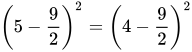


The fallacy is in the second to last line, where the square root of both sides is taken: a2 = b2 only implies a = b if a and b have the same sign, which is not the case here. In this case, it implies that a = –b, so the equation should read
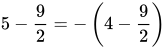
which, by adding 9/2 on both sides, correctly reduces to 5 = 5.
Another example illustrating the danger of taking the square root of both sides of an equation involves the following fundamental identity[9]

which holds as a consequence of the Pythagorean theorem. Then, by taking a square root,

Evaluating this when x = π , we get that
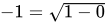
or

which is incorrect.
The error in each of these examples fundamentally lies in the fact that any equation of the form

where 

and it is essential to check which of these solutions is relevant to the problem at hand.[10] In the above fallacy, the square root that allowed the second equation to be deduced from the first is valid only when cos x is positive. In particular, when x is set to π, the second equation is rendered invalid.
Square roots of negative numbers[edit]
Invalid proofs utilizing powers and roots are often of the following kind:

The fallacy is that the rule 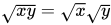


Alternatively, imaginary roots are obfuscated in the following:

The error here lies in the third equality, as the rule 
Complex exponents[edit]
When a number is raised to a complex power, the result is not uniquely defined (see Exponentiation § Failure of power and logarithm identities). If this property is not recognized, then errors such as the following can result:

The error here is that the rule of multiplying exponents as when going to the third line does not apply unmodified with complex exponents, even if when putting both sides to the power i only the principal value is chosen. When treated as multivalued functions, both sides produce the same set of values, being {e2πn | n ∈ ℤ}.
Geometry[edit]
Many mathematical fallacies in geometry arise from using an additive equality involving oriented quantities (such as adding vectors along a given line or adding oriented angles in the plane) to a valid identity, but which fixes only the absolute value of (one of) these quantities. This quantity is then incorporated into the equation with the wrong orientation, so as to produce an absurd conclusion. This wrong orientation is usually suggested implicitly by supplying an imprecise diagram of the situation, where relative positions of points or lines are chosen in a way that is actually impossible under the hypotheses of the argument, but non-obviously so.
In general, such a fallacy is easy to expose by drawing a precise picture of the situation, in which some relative positions will be different from those in the provided diagram. In order to avoid such fallacies, a correct geometric argument using addition or subtraction of distances or angles should always prove that quantities are being incorporated with their correct orientation.
Fallacy of the isosceles triangle[edit]

The fallacy of the isosceles triangle, from (Maxwell 1959, Chapter II, § 1), purports to show that every triangle is isosceles, meaning that two sides of the triangle are congruent. This fallacy was known to Lewis Carroll and may have been discovered by him. It was published in 1899.[12][13]
Given a triangle △ABC, prove that AB = AC:
- Draw a line bisecting ∠A.
- Draw the perpendicular bisector of segment BC, which bisects BC at a point D.
- Let these two lines meet at a point O.
- Draw line OR perpendicular to AB, line OQ perpendicular to AC.
- Draw lines OB and OC.
- By AAS, △RAO ≅ △QAO (∠ORA = ∠OQA = 90°; ∠RAO = ∠QAO; AO = AO (common side)).
- By RHS,[note 2] △ROB ≅ △QOC (∠BRO = ∠CQO = 90°; BO = OC (hypotenuse); RO = OQ (leg)).
- Thus, AR = AQ, RB = QC, and AB = AR + RB = AQ + QC = AC.
Q.E.D.
As a corollary, one can show that all triangles are equilateral, by showing that AB = BC and AC = BC in the same way.
The error in the proof is the assumption in the diagram that the point O is inside the triangle. In fact, O always lies on the circumcircle of the △ABC (except for isosceles and equilateral triangles where AO and OD coincide). Furthermore, it can be shown that, if AB is longer than AC, then R will lie within AB, while Q will lie outside of AC, and vice versa (in fact, any diagram drawn with sufficiently accurate instruments will verify the above two facts). Because of this, AB is still AR + RB, but AC is actually AQ − QC; and thus the lengths are not necessarily the same.
Proof by induction[edit]
There exist several fallacious proofs by induction in which one of the components, basis case or inductive step, is incorrect. Intuitively, proofs by induction work by arguing that if a statement is true in one case, it is true in the next case, and hence by repeatedly applying this, it can be shown to be true for all cases. The following «proof» shows that all horses are the same colour.[14][note 3]
- Let us say that any group of N horses is all of the same colour.
- If we remove a horse from the group, we have a group of N − 1 horses of the same colour. If we add another horse, we have another group of N horses. By our previous assumption, all the horses are of the same colour in this new group, since it is a group of N horses.
- Thus we have constructed two groups of N horses all of the same colour, with N − 1 horses in common. Since these two groups have some horses in common, the two groups must be of the same colour as each other.
- Therefore, combining all the horses used, we have a group of N + 1 horses of the same colour.
- Thus if any N horses are all the same colour, any N + 1 horses are the same colour.
- This is clearly true for N = 1 (i.e. one horse is a group where all the horses are the same colour). Thus, by induction, N horses are the same colour for any positive integer N. i.e. all horses are the same colour.
The fallacy in this proof arises in line 3. For N = 1, the two groups of horses have N − 1 = 0 horses in common, and thus are not necessarily the same colour as each other, so the group of N + 1 = 2 horses is not necessarily all of the same colour. The implication «every N horses are of the same colour, then N + 1 horses are of the same colour» works for any N > 1, but fails to be true when N = 1. The basis case is correct, but the induction step has a fundamental flaw.
See also[edit]
- Anomalous cancellation – Kind of arithmetic error
- Division by zero – Class of mathematical expression
- List of incomplete proofs
- Mathematical coincidence – Coincidence in mathematics
- Paradox – Statement that apparently contradicts itself
- Proof by intimidation – Marking an argument as obvious or trivial
Notes[edit]
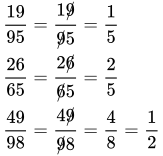
- ^ The same fallacy also applies to the following:
- ^ Hypotenuse–leg congruence
- ^ George Pólya’s original «proof» was that any n girls have the same colour eyes.
References[edit]
- ^ Maxwell 1959, p. 9
- ^ a b Maxwell 1959
- ^ Heath & Heiberg 1908, Chapter II, §I
- ^ Barbeau, Ed (1991). «Fallacies, Flaws, and Flimflam» (PDF). The College Mathematics Journal. 22 (5). ISSN 0746-8342.
- ^ «soft question – Best Fake Proofs? (A M.SE April Fools Day collection)». Mathematics Stack Exchange. Retrieved 2019-10-24.
- ^ Heuser, Harro (1989), Lehrbuch der Analysis – Teil 1 (6th ed.), Teubner, p. 51, ISBN 978-3-8351-0131-9
- ^ Barbeau, Ed (1990), «Fallacies, Flaws and Flimflam #19: Dolt’s Theorem», The College Mathematics Journal, 21 (3): 216–218, doi:10.1080/07468342.1990.11973308
- ^ Frohlichstein, Jack (1967). Mathematical Fun, Games and Puzzles (illustrated ed.). Courier Corporation. p. 207. ISBN 0-486-20789-7. Extract of page 207
- ^ Maxwell 1959, Chapter VI, §I.1
- ^ Maxwell 1959, Chapter VI, §II
- ^ Nahin, Paul J. (2010). An Imaginary Tale: The Story of «i«. Princeton University Press. p. 12. ISBN 978-1-4008-3029-9. Extract of page 12
- ^ S.D.Collingwood, ed. (1899), The Lewis Carroll Picture Book, Collins, pp. 190–191
- ^ Robin Wilson (2008), Lewis Carroll in Numberland, Penguin Books, pp. 169–170, ISBN 978-0-14-101610-8
- ^ Pólya, George (1954). Induction and Analogy in Mathematics. Mathematics and plausible reasoning. Vol. 1. Princeton. p. 120.
- Barbeau, Edward J. (2000), Mathematical fallacies, flaws, and flimflam, MAA Spectrum, Mathematical Association of America, ISBN 978-0-88385-529-4, MR 1725831.
- Bunch, Bryan (1997), Mathematical fallacies and paradoxes, New York: Dover Publications, ISBN 978-0-486-29664-7, MR 1461270.
- Heath, Sir Thomas Little; Heiberg, Johan Ludvig (1908), The thirteen books of Euclid’s Elements, Volume 1, The University Press.
- Maxwell, E. A. (1959), Fallacies in mathematics, Cambridge University Press, ISBN 0-521-05700-0, MR 0099907.
External links[edit]
- Invalid proofs at Cut-the-knot (including literature references)
- Classic fallacies with some discussion
- More invalid proofs from AhaJokes.com
- Math jokes including an invalid proof
From Wikipedia, the free encyclopedia
«Invalid proof» redirects here. For any type of invalid proof besides mathematics, see Fallacy.
«0 = 1» redirects here. For the algebraic structure where this equality holds, see Null ring.
In mathematics, certain kinds of mistaken proof are often exhibited, and sometimes collected, as illustrations of a concept called mathematical fallacy. There is a distinction between a simple mistake and a mathematical fallacy in a proof, in that a mistake in a proof leads to an invalid proof while in the best-known examples of mathematical fallacies there is some element of concealment or deception in the presentation of the proof.
For example, the reason why validity fails may be attributed to a division by zero that is hidden by algebraic notation. There is a certain quality of the mathematical fallacy: as typically presented, it leads not only to an absurd result, but does so in a crafty or clever way.[1] Therefore, these fallacies, for pedagogic reasons, usually take the form of spurious proofs of obvious contradictions. Although the proofs are flawed, the errors, usually by design, are comparatively subtle, or designed to show that certain steps are conditional, and are not applicable in the cases that are the exceptions to the rules.
The traditional way of presenting a mathematical fallacy is to give an invalid step of deduction mixed in with valid steps, so that the meaning of fallacy is here slightly different from the logical fallacy. The latter usually applies to a form of argument that does not comply with the valid inference rules of logic, whereas the problematic mathematical step is typically a correct rule applied with a tacit wrong assumption. Beyond pedagogy, the resolution of a fallacy can lead to deeper insights into a subject (e.g., the introduction of Pasch’s axiom of Euclidean geometry,[2] the five colour theorem of graph theory). Pseudaria, an ancient lost book of false proofs, is attributed to Euclid.[3]
Mathematical fallacies exist in many branches of mathematics. In elementary algebra, typical examples may involve a step where division by zero is performed, where a root is incorrectly extracted or, more generally, where different values of a multiple valued function are equated. Well-known fallacies also exist in elementary Euclidean geometry and calculus.[4][5]
Howlers[edit]
Anomalous cancellation in calculus
Examples exist of mathematically correct results derived by incorrect lines of reasoning. Such an argument, however true the conclusion appears to be, is mathematically invalid and is commonly known as a howler. The following is an example of a howler involving anomalous cancellation:
Here, although the conclusion 16/64 = 1/4 is correct, there is a fallacious, invalid cancellation in the middle step.[note 1] Another classical example of a howler is proving the Cayley–Hamilton theorem by simply substituting the scalar variables of the characteristic polynomial by the matrix.
Bogus proofs, calculations, or derivations constructed to produce a correct result in spite of incorrect logic or operations were termed «howlers» by Maxwell.[2] Outside the field of mathematics the term howler has various meanings, generally less specific.
Division by zero[edit]
The division-by-zero fallacy has many variants. The following example uses a disguised division by zero to «prove» that 2 = 1, but can be modified to prove that any number equals any other number.
- Let a and b be equal, nonzero quantities
- Multiply by a
- Subtract b2
- Factor both sides: the left factors as a difference of squares, the right is factored by extracting b from both terms
- Divide out (a − b)
- Use the fact that a = b
- Combine like terms on the left
- Divide by the non-zero b
- Q.E.D.[6]
The fallacy is in line 5: the progression from line 4 to line 5 involves division by a − b, which is zero since a = b. Since division by zero is undefined, the argument is invalid.
Analysis[edit]
Mathematical analysis as the mathematical study of change and limits can lead to mathematical fallacies — if the properties of integrals and differentials are ignored. For instance, a naive use of integration by parts can be used to give a false proof that 0 = 1.[7] Letting u = 1/log x and dv = dx/x, we may write:
after which the antiderivatives may be cancelled yielding 0 = 1. The problem is that antiderivatives are only defined up to a constant and shifting them by 1 or indeed any number is allowed. The error really comes to light when we introduce arbitrary integration limits a and b.
Since the difference between two values of a constant function vanishes, the same definite integral appears on both sides of the equation.
Multivalued functions[edit]
Many functions do not have a unique inverse. For instance, while squaring a number gives a unique value, there are two possible square roots of a positive number. The square root is multivalued. One value can be chosen by convention as the principal value; in the case of the square root the non-negative value is the principal value, but there is no guarantee that the square root given as the principal value of the square of a number will be equal to the original number (e.g. the principal square root of the square of −2 is 2). This remains true for nth roots.
Positive and negative roots[edit]
Care must be taken when taking the square root of both sides of an equality. Failing to do so results in a «proof» of[8] 5 = 4.
Proof:
- Start from
- Write this as
- Rewrite as
- Add 81/4 on both sides:
- These are perfect squares:
- Take the square root of both sides:
- Add 9/2 on both sides:
- Q.E.D.
The fallacy is in the second to last line, where the square root of both sides is taken: a2 = b2 only implies a = b if a and b have the same sign, which is not the case here. In this case, it implies that a = –b, so the equation should read
which, by adding 9/2 on both sides, correctly reduces to 5 = 5.
Another example illustrating the danger of taking the square root of both sides of an equation involves the following fundamental identity[9]
which holds as a consequence of the Pythagorean theorem. Then, by taking a square root,
Evaluating this when x = π , we get that
or
which is incorrect.
The error in each of these examples fundamentally lies in the fact that any equation of the form
where
and it is essential to check which of these solutions is relevant to the problem at hand.[10] In the above fallacy, the square root that allowed the second equation to be deduced from the first is valid only when cos x is positive. In particular, when x is set to π, the second equation is rendered invalid.
Square roots of negative numbers[edit]
Invalid proofs utilizing powers and roots are often of the following kind:
The fallacy is that the rule
Alternatively, imaginary roots are obfuscated in the following:
The error here lies in the third equality, as the rule
Complex exponents[edit]
When a number is raised to a complex power, the result is not uniquely defined (see Exponentiation § Failure of power and logarithm identities). If this property is not recognized, then errors such as the following can result:
The error here is that the rule of multiplying exponents as when going to the third line does not apply unmodified with complex exponents, even if when putting both sides to the power i only the principal value is chosen. When treated as multivalued functions, both sides produce the same set of values, being {e2πn | n ∈ ℤ}.
Geometry[edit]
Many mathematical fallacies in geometry arise from using an additive equality involving oriented quantities (such as adding vectors along a given line or adding oriented angles in the plane) to a valid identity, but which fixes only the absolute value of (one of) these quantities. This quantity is then incorporated into the equation with the wrong orientation, so as to produce an absurd conclusion. This wrong orientation is usually suggested implicitly by supplying an imprecise diagram of the situation, where relative positions of points or lines are chosen in a way that is actually impossible under the hypotheses of the argument, but non-obviously so.
In general, such a fallacy is easy to expose by drawing a precise picture of the situation, in which some relative positions will be different from those in the provided diagram. In order to avoid such fallacies, a correct geometric argument using addition or subtraction of distances or angles should always prove that quantities are being incorporated with their correct orientation.
Fallacy of the isosceles triangle[edit]
The fallacy of the isosceles triangle, from (Maxwell 1959, Chapter II, § 1), purports to show that every triangle is isosceles, meaning that two sides of the triangle are congruent. This fallacy was known to Lewis Carroll and may have been discovered by him. It was published in 1899.[12][13]
Given a triangle △ABC, prove that AB = AC:
- Draw a line bisecting ∠A.
- Draw the perpendicular bisector of segment BC, which bisects BC at a point D.
- Let these two lines meet at a point O.
- Draw line OR perpendicular to AB, line OQ perpendicular to AC.
- Draw lines OB and OC.
- By AAS, △RAO ≅ △QAO (∠ORA = ∠OQA = 90°; ∠RAO = ∠QAO; AO = AO (common side)).
- By RHS,[note 2] △ROB ≅ △QOC (∠BRO = ∠CQO = 90°; BO = OC (hypotenuse); RO = OQ (leg)).
- Thus, AR = AQ, RB = QC, and AB = AR + RB = AQ + QC = AC.
Q.E.D.
As a corollary, one can show that all triangles are equilateral, by showing that AB = BC and AC = BC in the same way.
The error in the proof is the assumption in the diagram that the point O is inside the triangle. In fact, O always lies on the circumcircle of the △ABC (except for isosceles and equilateral triangles where AO and OD coincide). Furthermore, it can be shown that, if AB is longer than AC, then R will lie within AB, while Q will lie outside of AC, and vice versa (in fact, any diagram drawn with sufficiently accurate instruments will verify the above two facts). Because of this, AB is still AR + RB, but AC is actually AQ − QC; and thus the lengths are not necessarily the same.
Proof by induction[edit]
There exist several fallacious proofs by induction in which one of the components, basis case or inductive step, is incorrect. Intuitively, proofs by induction work by arguing that if a statement is true in one case, it is true in the next case, and hence by repeatedly applying this, it can be shown to be true for all cases. The following «proof» shows that all horses are the same colour.[14][note 3]
- Let us say that any group of N horses is all of the same colour.
- If we remove a horse from the group, we have a group of N − 1 horses of the same colour. If we add another horse, we have another group of N horses. By our previous assumption, all the horses are of the same colour in this new group, since it is a group of N horses.
- Thus we have constructed two groups of N horses all of the same colour, with N − 1 horses in common. Since these two groups have some horses in common, the two groups must be of the same colour as each other.
- Therefore, combining all the horses used, we have a group of N + 1 horses of the same colour.
- Thus if any N horses are all the same colour, any N + 1 horses are the same colour.
- This is clearly true for N = 1 (i.e. one horse is a group where all the horses are the same colour). Thus, by induction, N horses are the same colour for any positive integer N. i.e. all horses are the same colour.
The fallacy in this proof arises in line 3. For N = 1, the two groups of horses have N − 1 = 0 horses in common, and thus are not necessarily the same colour as each other, so the group of N + 1 = 2 horses is not necessarily all of the same colour. The implication «every N horses are of the same colour, then N + 1 horses are of the same colour» works for any N > 1, but fails to be true when N = 1. The basis case is correct, but the induction step has a fundamental flaw.
See also[edit]
- Anomalous cancellation – Kind of arithmetic error
- Division by zero – Class of mathematical expression
- List of incomplete proofs
- Mathematical coincidence – Coincidence in mathematics
- Paradox – Statement that apparently contradicts itself
- Proof by intimidation – Marking an argument as obvious or trivial
Notes[edit]
- ^ The same fallacy also applies to the following:
- ^ Hypotenuse–leg congruence
- ^ George Pólya’s original «proof» was that any n girls have the same colour eyes.
References[edit]
- ^ Maxwell 1959, p. 9
- ^ a b Maxwell 1959
- ^ Heath & Heiberg 1908, Chapter II, §I
- ^ Barbeau, Ed (1991). «Fallacies, Flaws, and Flimflam» (PDF). The College Mathematics Journal. 22 (5). ISSN 0746-8342.
- ^ «soft question – Best Fake Proofs? (A M.SE April Fools Day collection)». Mathematics Stack Exchange. Retrieved 2019-10-24.
- ^ Heuser, Harro (1989), Lehrbuch der Analysis – Teil 1 (6th ed.), Teubner, p. 51, ISBN 978-3-8351-0131-9
- ^ Barbeau, Ed (1990), «Fallacies, Flaws and Flimflam #19: Dolt’s Theorem», The College Mathematics Journal, 21 (3): 216–218, doi:10.1080/07468342.1990.11973308
- ^ Frohlichstein, Jack (1967). Mathematical Fun, Games and Puzzles (illustrated ed.). Courier Corporation. p. 207. ISBN 0-486-20789-7. Extract of page 207
- ^ Maxwell 1959, Chapter VI, §I.1
- ^ Maxwell 1959, Chapter VI, §II
- ^ Nahin, Paul J. (2010). An Imaginary Tale: The Story of «i«. Princeton University Press. p. 12. ISBN 978-1-4008-3029-9. Extract of page 12
- ^ S.D.Collingwood, ed. (1899), The Lewis Carroll Picture Book, Collins, pp. 190–191
- ^ Robin Wilson (2008), Lewis Carroll in Numberland, Penguin Books, pp. 169–170, ISBN 978-0-14-101610-8
- ^ Pólya, George (1954). Induction and Analogy in Mathematics. Mathematics and plausible reasoning. Vol. 1. Princeton. p. 120.
- Barbeau, Edward J. (2000), Mathematical fallacies, flaws, and flimflam, MAA Spectrum, Mathematical Association of America, ISBN 978-0-88385-529-4, MR 1725831.
- Bunch, Bryan (1997), Mathematical fallacies and paradoxes, New York: Dover Publications, ISBN 978-0-486-29664-7, MR 1461270.
- Heath, Sir Thomas Little; Heiberg, Johan Ludvig (1908), The thirteen books of Euclid’s Elements, Volume 1, The University Press.
- Maxwell, E. A. (1959), Fallacies in mathematics, Cambridge University Press, ISBN 0-521-05700-0, MR 0099907.
External links[edit]
- Invalid proofs at Cut-the-knot (including literature references)
- Classic fallacies with some discussion
- More invalid proofs from AhaJokes.com
- Math jokes including an invalid proof
Пятничная математика |
Я |
11.09.09 — 10:20
Нужно найти ошибку в рассуждении:
Доказываемое утверждение: Все лошади одного цвета. Проведём доказательство по индукции.
База индукции: Одна лошадь, очевидно, одного (одинакового) цвета.
Шаг индукции: Пусть доказано, что любые K лошадей всегда одного цвета. Рассмотрим K + 1 каких-то лошадей. Уберём одну лошадь. Оставшиеся K лошадей одного цвета по предположению индукции. Возвратим убранную лошадь и уберём какую-то другую. Оставшиеся K лошадей снова будут одного цвета. Значит, все K + 1 лошадей одного цвета.
Отсюда следует, что все лошади одного цвета. Утверждение доказано.
1 — 11.09.09 — 10:21
(0) База индукции неверна
2 — 11.09.09 — 10:22
(1) база верная: множество лошадей из одной лошади одноцветно
3 — 11.09.09 — 10:23
Пусть доказано, что любые K лошадей всегда одного цвета… это как?
4 — 11.09.09 — 10:24
(3) это мат. индукция
5 — 11.09.09 — 10:24
ошибка в шаге индукции, так как при к=1 получаем, что при убирании разных лошадей из множества К+1 лошадей получаются непересекающиеся подмножества К лошадей, а раз они не пересекаются, значит эти множества не обязательно одного цвета.
6 — 11.09.09 — 10:24
Докажи, что любые К лошадей одного цвета.
7 — 11.09.09 — 10:26
если доказано, что любые К лошадей одного цвета — то ошибки нет… только как это доказать?
8 — 11.09.09 — 10:26
Если доказано, что любые две лошади одного цвета, значит они все одного цвета…
9 — 11.09.09 — 10:27
(6), (7) читайте описание ММИ?
10 — 11.09.09 — 10:28
(5) ответ верный, шаг индукции не срабатывает при переходе от K=1 к K=2
11 — 11.09.09 — 10:29
приз?)
12 — 11.09.09 — 10:29
Рассмотрим K + 1 каких-то лошадей. Уберём одну лошадь. Оставшиеся K лошадей одного цвета по предположению индукции
Вот это далеко не факт….
К примеру, лошадь с номером (К+1) отличается цветом. Говоря, уберем одну лошадь, ты не фиксируешь, какая именно лошадь убирается…
13 — 11.09.09 — 10:30
(0)Ошибка в индукции («Написал… смог… да…») , т.к. по этой хери расмотрина 1 лошадь как одного цвета, то ошибочно рассматривать «К» лошадей как единый цвет, ибо лошадь 1 из К не является равному цвету лошади 2 из К и т.д.
Т.к. не было приведено массовой утверждений того что лошади одного цвета…
14 — 11.09.09 — 10:32
15 — 11.09.09 — 10:33
Пока к > 0 Цикл
Если Лощадь[к-1] <> НужныйЦвет тогда
Сообщить(«Аларм , неправильная лошадь»);
прервать;
иначе
к = к — 1;
КонецЕсли;
КонецЦикла;
Если к = 0 тогда
Сообщить(«Все лошади кошерны!»);
КонецЕсли;
=) А вот с математикой непомню нефига
16 — 11.09.09 — 10:34
(9) сам читай. _любые_ и _пусть доказано_.
17 — 11.09.09 — 10:35
Загоним лошадей в пронумерованные стойла. К1, К2, Кn-1, Kn. Добавим лошадь К+1, то есть в стойло Kn+1. >>Уберём одну лошадь. — КАКУЮ? Из какого стойла, если еще конкретней? Если стойло Kn+1 — дальнейшие утверждения верны, иначе — чушь, так как мы не знаем, какого цвета кобыла в стойле Kn+1.
18 — 11.09.09 — 10:36
Есть колония Бактерий (очень большая, N, или нет, N мало — целых M штук). В ней поселяется Вирус. Каждую секунду Вирус пожирает одну бактерию, и, наевшись, тут же делится на два себе подобных. Бактерии питаются всем подряд (не бактериями и не вирусами, конечно) и тоже каждую секунду делятся пополам.
Съест ли Вирус все Бактерии?
Уж лучше об это копья поломайте.
19 — 11.09.09 — 10:37
(18) об это ломали — съест
20 — 11.09.09 — 10:37
(18) сожрет, было..
21 — 11.09.09 — 10:40
Почему к только в промежутке от 1 до 2?
22 — 11.09.09 — 10:40
Если
«Шаг индукции: Пусть доказано, что любые K лошадей всегда одного цвета.»
это верно, то никакой ошибки в рассуждениях нет. Тогда все лошади одного цвета.
23 — 11.09.09 — 10:45
(14)Ну а я что написал 🙂 в (13) ?
24 — 11.09.09 — 10:46
(23) мне понравилось в (14) кроме слова «хери»-)
25 — 11.09.09 — 10:47
ой в 13-)
NikVars
26 — 11.09.09 — 12:29
(9) Вот и читай сам!
«любые К лошадей одного цвета»- ложная посылка.
А из лжи следует все что угодно.
Определенный тип ошибочного доказательства
В математике некоторые виды ошибочного доказательства часто выставляется, а иногда и собирается, как иллюстрации концепции, называемой математической ошибкой . Существует различие между простой ошибкой и математической ошибкой в доказательстве, поскольку ошибка в доказательстве приводит к недействительному доказательству, в то время как в наиболее известных примерах математических ошибок присутствует некоторый элемент сокрытия или обмана в представлении доказательство.
Например, причина, по которой не действует достоверность, может быть отнесена к делению на ноль, которое скрыто алгебраической записью. Есть определенное качество математической ошибки: в том виде, в котором она обычно представлена, она приводит не только к абсурдному результату, но и делает это хитрым или хитрым способом. Следовательно, эти заблуждения по педагогическим причинам обычно принимают форму ложных доказательств очевидных противоречий. Хотя доказательства ошибочны, ошибки, как правило, преднамеренные, являются сравнительно малозаметными или предназначены для демонстрации того, что определенные шаги являются условными и неприменимы в случаях, которые являются исключениями из правил.
Традиционный способ представления математической ошибки состоит в том, чтобы дать неверный шаг вывода, смешанный с действительными шагами, так что значение ошибки здесь немного отличается от логического . заблуждение. Последнее обычно применяется к форме аргумента, которая не соответствует действующим правилам логического вывода, тогда как проблемный математический шаг обычно является правильным правилом, применяемым с неявным неверным предположением. Помимо педагогики, разрешение ошибки может привести к более глубокому пониманию предмета (например, введение аксиомы Паша евклидовой геометрии, теоремы пяти цветов теории графов ). Псевдария, древняя утерянная книга ложных доказательств, приписывается Евклиду.
. Математические заблуждения существуют во многих областях математики. В элементарной алгебре типичные примеры могут включать в себя этап, на котором выполняется деление на ноль, где корень извлекается неправильно или, в более общем смысле, когда разные значения многозначная функция приравнивается. Известные заблуждения также существуют в элементарной евклидовой геометрии и исчислении.
Содержание
- 1 Howlers
- 2 Деление на ноль
- 3 Анализ
- 4 Многозначные функции
- 4.1 Положительные и отрицательные корни
- 4.2 Квадратные корни из отрицательных чисел
- 4.3 Комплексные показатели
- 5 Геометрия
- 5.1 Ошибка равнобедренного треугольника
- 6 Доказательство индукцией
- 7 См. Также
- 8 Примечания
- 9 Ссылки
- 10 Внешние ссылки
Howlers
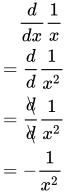
ddx 1 x = dd 1 x 2 = d ∖ d ∖ 1 x 2 = — 1 x 2 { displaystyle { begin {array} {l} ; ; ; { dfrac {d} {dx}} { dfrac {1} {x}} \ = { dfrac {d} {d}} { dfrac {1} {x ^ {2}} } \ = { dfrac {d ! ! ! backslash} {d ! ! ! backslash}} { dfrac {1} {x ^ {2}}} \ = — { dfrac {1} {x ^ {2}}} end {array}}}
Существуют примеры математически правильных результатов, полученных в результате неправильных рассуждений. Такой аргумент, каким бы верным он ни казался, математически неверен и широко известен как вопль. Ниже приведен пример сигнализатора, включающего аномальную отмену :
- 16 64 = 16/6/4 = 1 4. { displaystyle { frac {16} {64}} = { frac {16 ! ! ! /} {6 ! ! ! / 4}} = { frac {1} {4}}.}
Здесь, хотя вывод 16/64 = 1/4 верен, на среднем этапе происходит ошибочная, недопустимая отмена. Другой классический пример ревуна — доказательство теоремы Кэли – Гамильтона простой заменой скалярных переменных характеристического полинома на матрицу.
Поддельные доказательства, вычисления или выводы, построенные для получения правильного результата, несмотря на неправильную логику или операции, Максвелл назвал «завываниями». Вне математики термин ревун имеет различные значения, как правило, менее конкретные.
Деление на ноль
Ошибка деления на ноль имеет множество вариантов. В следующем примере используется замаскированное деление на ноль, чтобы «доказать», что 2 = 1, но его можно изменить, чтобы доказать, что любое число равно любому другому числу.
- Пусть a и b равны, ненулевые величины
- a = b { displaystyle a = b}
- a = b { displaystyle a = b}
- Умножить на a
- a 2 = ab { displaystyle a ^ {2} = ab}
- a 2 = ab { displaystyle a ^ {2} = ab}
- Вычтем b
- a 2 — b 2 = ab — b 2 { displaystyle a ^ {2} -b ^ {2} = ab-b ^ {2}}
- a 2 — b 2 = ab — b 2 { displaystyle a ^ {2} -b ^ {2} = ab-b ^ {2}}
- Разложим на множители обе стороны: левый множитель как разность квадратов, правый множится путем извлечения b из обоих членов
- (a — b) (a + b) = b (a — b) { displaystyle (ab) (a + b) = b (ab)}
- (a — b) (a + b) = b (a — b) { displaystyle (ab) (a + b) = b (ab)}
- Разделить (a — b)
- a + b = b { displaystyle a + b = b}
- a + b = b { displaystyle a + b = b}
- Учитывая, что a = b
- b + b = b { displaystyle b + b = b}
- b + b = b { displaystyle b + b = b}
- Объедините одинаковые термины слева
- 2 b = b { displaystyle 2b = b}
- 2 b = b { displaystyle 2b = b}
- Разделите на ненулевое b
- 2 = 1 { displaystyle 2 = 1}
- 2 = 1 { displaystyle 2 = 1}
- QED
Ошибка в строке 5: переход от строки 4 к строке 5 включает деление на a — b, которое равно нулю, поскольку a = b. Поскольку деление на ноль не определено, аргумент недопустим.
Анализ
Математический анализ как математическое исследование изменений и пределов может привести к математическим ошибкам — если свойства интегралов и дифференциалы игнорируются. Например, наивное использование интегрирования по частям может быть использовано для ложного доказательства того, что 0 = 1. Полагая u = 1 / log x и dv = dx / x, мы может писать:
- ∫ 1 x журнал xdx = 1 + ∫ 1 x журнал xdx { displaystyle int { frac {1} {x , log x}} , dx = 1 + int { frac {1} {x , log x}} , dx}
, после чего первообразные могут быть отменены с получением 0 = 1. Проблема в том, что первообразные определены только до a константа и их смещение на 1 или любое другое число разрешено. Ошибка действительно обнаруживается, когда мы вводим произвольные пределы интегрирования a и b.
- ∫ a b 1 x журнал x d x = 1 | ab + ∫ ab 1 x журнал xdx = 0 + ∫ ab 1 x log xdx = ∫ ab 1 x log xdx { displaystyle int _ {a} ^ {b} { frac {1} {x , log x}} , dx = 1 | _ {a} ^ {b} + int _ {a} ^ {b} { frac {1} {x , log x}} , dx = 0 + int _ {a} ^ {b} { frac {1} {x log x}} , dx = int _ {a} ^ {b} { frac {1} {x log x} } , dx}
Поскольку разница между двумя значениями постоянной функции равна нулю, один и тот же определенный интеграл появляется с обеих сторон уравнения.
Многозначные функции
Многие функции не имеют уникального обратного. Например, возведение числа в квадрат дает уникальное значение, но есть два возможных квадратных корня из положительного числа. Квадратный корень — это многозначный. Одно значение может быть выбрано по соглашению в качестве основного значения ; в случае квадратного корня неотрицательное значение является главным значением, но нет гарантии, что квадратный корень, заданный как главное значение квадрата числа, будет равен исходному числу (например, главный квадратный корень квадрата −2 равно 2). Это остается верным для корней n-й степени.
Положительных и отрицательных корней
Необходимо соблюдать осторожность при извлечении квадратного корня из обеих частей равенства. В противном случае «доказательство» составляет 5 = 4.
Доказательство:
- Начать с
- — 20 = — 20 { displaystyle -20 = -20}
- — 20 = — 20 { displaystyle -20 = -20}
- Запишите это как
- 25-45 = 16-36 { displaystyle 25-45 = 16-36}
- 25-45 = 16-36 { displaystyle 25-45 = 16-36}
- Перепишите как
- 5 2–5 × 9 = 4 2–4 × 9 { displaystyle 5 ^ {2 } -5 times 9 = 4 ^ {2} -4 times 9}
- 5 2–5 × 9 = 4 2–4 × 9 { displaystyle 5 ^ {2 } -5 times 9 = 4 ^ {2} -4 times 9}
- Добавьте 81/4 с обеих сторон:
- 5 2 — 5 × 9 + 81 4 = 4 2 — 4 × 9 + 81 4 { displaystyle 5 ^ {2} -5 times 9 + { frac {81} {4}} = 4 ^ {2} -4 times 9 + { frac {81} {4}}}
- 5 2 — 5 × 9 + 81 4 = 4 2 — 4 × 9 + 81 4 { displaystyle 5 ^ {2} -5 times 9 + { frac {81} {4}} = 4 ^ {2} -4 times 9 + { frac {81} {4}}}
- Это полные квадраты:
- (5 — 9 2) 2 = (4 — 9 2) 2 { displaystyle left (5 — { frac {9} {2}} right) ^ {2} = left (4 — { frac {9} {2}} right) ^ {2}}
- (5 — 9 2) 2 = (4 — 9 2) 2 { displaystyle left (5 — { frac {9} {2}} right) ^ {2} = left (4 — { frac {9} {2}} right) ^ {2}}
- Извлеките квадратный корень из обеих сторон:
- 5 — 9 2 = 4 — 9 2 { displaystyle 5 — { frac {9} {2}} = 4 — { frac {9} {2}}}
- 5 — 9 2 = 4 — 9 2 { displaystyle 5 — { frac {9} {2}} = 4 — { frac {9} {2}}}
- Добавьте 9/2 с обеих сторон:
- 5 = 4 { displaystyle 5 = 4}
- 5 = 4 { displaystyle 5 = 4}
- QED
Ошибка заключается в предпоследней строке, где берется квадратный корень из обеих частей: a = b означает, что a = b, только если a и b имеют одинаковый знак, что здесь не так. В данном случае это означает, что a = –b, поэтому уравнение должно выглядеть так:
- 5 — 9 2 = — (4 — 9 2) { displaystyle 5 — { frac {9} {2}} = — left (4 — { frac {9} {2}} right)}
которое, добавив 9/2 с обеих сторон, правильно сокращается до 5 = 5.
Еще один пример, иллюстрирующий опасность извлечение квадратного корня из обеих частей уравнения включает следующее фундаментальное тождество:
- cos 2 x = 1 — sin 2 x { displaystyle cos ^ {2} x = 1- sin ^ {2} x }
, которое выполняется как следствие теоремы Пифагора. Затем, извлекая квадратный корень,
- cos x = 1 — sin 2 x { displaystyle cos x = { sqrt {1- sin ^ {2} x}}}
так, чтобы
- 1 + соз х знак равно 1 + 1 — грех 2 х. { displaystyle 1+ cos x = 1 + { sqrt {1- sin ^ {2} x}}.}

Но оценивая это при x = π, мы получаем, что
- 1 — 1 = 1 + 1–0 { displaystyle 1-1 = 1 + { sqrt {1-0}}}

или
- 0 = 2 { displaystyle 0 = 2}

, что неверно.
Ошибка в каждом из этих примеров в основном заключается в том, что любое уравнение вида
- x 2 = a 2 { displaystyle x ^ {2} = a ^ {2}}
где a ≠ 0 { displaystyle a neq 0}
- x = ± a { displaystyle x = pm a}
и важно, чтобы проверьте, какое из этих решений имеет отношение к рассматриваемой проблеме. В приведенной выше ошибке квадратный корень, который позволил вывести второе уравнение из первого, действителен только тогда, когда cos x положителен. В частности, когда x установлен в π, второе уравнение становится недействительным.
Квадратные корни из отрицательных чисел
Недействительные доказательства с использованием степеней и корней часто бывают следующего вида:
- 1 = 1 = (- 1) (- 1) = — 1 — 1 знак равно я ⋅ я знак равно — 1. { displaystyle 1 = { sqrt {1}} = { sqrt {(-1) (- 1)}} = { sqrt {-1}} { sqrt {-1 }} = i cdot i = -1.}
Ошибка заключается в том, что правило xy = xy { displaystyle { sqrt {xy}} = { sqrt {x}} { sqrt {y }}}
В качестве альтернативы, мнимые корни затемняются следующим образом:
- i = — 1 = (- 1) 2 4 = ((- 1) 2) 1 4 = 1 1 4 = 1 { displaystyle i = { sqrt {-1}} = left (-1 right) ^ { frac {2} {4}} = left ( left (-1 right) ^ {2} right) ^ { frac {1} {4}} = 1 ^ { frac {1} {4}} = 1}
Ошибка здесь в последнем равенство, где мы игнорируем другие корни четвертой степени из 1, которые равны -1, i и -i (где i — мнимая единица ). Поскольку мы возводили нашу фигуру в квадрат, а затем пустили корни, мы не всегда можем предположить, что все корни будут правильными. Таким образом, правильные корни четвертой степени — это i и −i, которые представляют собой мнимые числа, возведенные в квадрат до −1.
Комплексные показатели
Когда число возводится в комплексную степень, результат не определяется однозначно (см. Отказ мощности и тождества логарифма ). Если это свойство не распознается, могут возникнуть следующие ошибки:
- e 2 π i = 1 (e 2 π i) i = 1 ie — 2 π = 1 { displaystyle { begin {align} e ^ {2 pi i} = 1 \ влево (e ^ {2 pi i} right) ^ {i} = 1 ^ {i} \ e ^ {- 2 pi} = 1 \ end {align}}}
Ошибка здесь в том, что правило умножения показателей степени, как при переходе к третьей строке, не применяется без изменений с комплексными показателями, даже если при установке обеих сторон в степень i только главный значение выбрано. Когда они рассматриваются как многозначные функции, обе стороны производят одинаковый набор значений, являющихся {e | n ∈ ℤ}.
Геометрия
Многие математические ошибки в геометрии возникают из-за использования аддитивного равенства, включающего ориентированные величины (например, добавление векторов вдоль заданной линии или добавление ориентированных углов в плоскости) к действительной идентичности, но которая фиксирует только абсолютное значение (одной из) этих величин. Затем эта величина включается в уравнение с неправильной ориентацией, чтобы сделать абсурдный вывод. Эта неправильная ориентация обычно подразумевается путем предоставления неточной схемы ситуации, в которой относительное положение точек или линий выбирается таким образом, который фактически невозможен в соответствии с гипотезами аргумента, но неочевидно.
В общем, такое заблуждение легко выявить, нарисовав точную картину ситуации, в которой некоторые относительные положения будут отличаться от тех, что указаны на представленной диаграмме. Чтобы избежать таких заблуждений, правильный геометрический аргумент с использованием сложения или вычитания расстояний или углов должен всегда доказывать, что величины включаются с их правильной ориентацией.
Ошибка равнобедренного треугольника
Ошибка равнобедренного треугольника из (Максвелл 1959, Глава II, § 1) имеет целью показать, что каждый треугольник равно равнобедренный, что означает, что две стороны треугольника конгруэнтны. Это заблуждение было приписано Льюису Кэрроллу.
. Дан треугольник △ ABC, докажите, что AB = AC:
- Проведите линию пополам ∠A.
- Проведите серединный перпендикуляр отрезка BC, который делит BC пополам в точке D.
- Пусть эти две прямые пересекаются в точке O.
- Нарисуйте линию OR перпендикулярно AB, прямую OQ перпендикулярно AC.
- Нарисуйте линии OB и OC.
- По AAS, RAO ≅ △ QAO (∠ORA = ∠OQA = 90 °; ∠RAO = ∠QAO; AO = AO (общая сторона)).
- По RHS, △ ROB ≅ △ QOC (∠BRO = ∠CQO = 90 °; BO = OC (гипотенуза); RO = OQ (нога)).
- Таким образом, AR = AQ, RB = QC и AB = AR + RB = AQ + QC = AC.
QED
В качестве следствия можно показать, что все треугольники равносторонние, показав, что AB = BC и AC = BC таким же образом.
Ошибка доказательства заключается в предположении на диаграмме, что точка O находится внутри треугольника. Фактически, O всегда лежит в описанной окружности треугольника ABC (за исключением равнобедренных и равносторонних треугольников, в которых AO и OD совпадают). Более того, можно показать, что если AB длиннее, чем AC, то R будет лежать внутри AB, а Q будет лежать вне AC, и наоборот (фактически, любая диаграмма, нарисованная с помощью достаточно точных инструментов, подтвердит два вышеупомянутых факта.). Из-за этого AB по-прежнему AR + RB, но AC на самом деле AQ — QC; и, следовательно, длины не обязательно одинаковы.
Доказательство по индукции
Существует несколько ошибочных доказательств по индукции, в которых один из компонентов, базисный случай или индуктивный шаг, неверен. Интуитивно, доказательства с помощью индукции работают, утверждая, что если утверждение истинно в одном случае, оно истинно в следующем, и, следовательно, многократно применяя это утверждение, можно показать, что оно истинно для всех случаев. Следующее «доказательство» показывает, что все лошади одного цвета..
- Допустим, что любая группа из N лошадей одного цвета.
- Если мы удалим лошадь из группы, у нас есть группа из N — 1 лошадей одного цвета. Если мы добавим еще одну лошадь, у нас будет еще одна группа из N лошадей. Согласно нашему предыдущему предположению, все лошади одного цвета в этой новой группе, так как это группа из N лошадей.
- Таким образом, мы построили две группы из N лошадей одного цвета, с N — 1 общая лошадь. Поскольку у этих двух групп есть несколько общих лошадей, эти две группы должны быть одного цвета друг с другом.
- Следовательно, объединяя всех используемых лошадей, мы получаем группу из N + 1 лошадей одного цвета..
- Таким образом, если все N лошадей одного цвета, все N + 1 лошади одного цвета.
- Это явно верно для N = 1 (т.е. одна лошадь — это группа, в которой все лошади одного цвета). Таким образом, по индукции N лошадей одного цвета для любого натурального числа N. т. Е. Все лошади одного цвета.
Ошибка в этом доказательстве возникает в строке 3. При N = 1 две группы лошадей имеют N — 1 = 0 общих лошадей и, следовательно, не обязательно одного цвета, поэтому группа из N + 1 = 2 лошадей не обязательно будет всех одного цвета. Импликация «все N лошадей одного цвета, тогда N + 1 лошадей одного цвета» работает для любого N>1, но не выполняется, когда N = 1. Базовый случай верен, но шаг индукции имеет фундаментальный недостаток. Если бы нам дополнительно дали тот факт, что любые две лошади одного цвета, то мы могли бы правильно произвести индукцию из базового случая N = 2.
См. Также
- Аномальное исключение — арифметическая ошибка
- Деление на ноль — Результат, полученный при делении действительного числа на ноль
- Список неполных доказательств — Статья в Википедии со списком
- Математическое совпадение — совпадение в математике
- Парадокс — Утверждение, которое явно противоречит самому себе
- Доказательство запугиванием — Метод убедить кого-то, используя жаргон или заявляя его ясным
Примечания
Ссылки
Внешние ссылки
- Недействительными доказательствами в Разрезать узел (включая литературные ссылки)
- Классические заблуждения с некоторым обсуждением
- Больше недействительных доказательств с AhaJokes.com
- Математические шутки, включая недействительное доказательство