Неисправности дизель-генератора и их устранение
Даже при регулярном техническом обслуживании не удается предотвратить неисправности дизель-генератора. Чтобы обеспечить максимально быстрый ввод оборудования в эксплуатацию, рекомендуем ознакомиться с наиболее распространенными поломками, характерными для агрегатов этого класса. Обратите внимание — перечень неисправностей характерен и для промышленных, и для бытовых агрегатов.
ДГУ не запускается — основные причины
Подобные ошибки дизель-генератора характерны для следующих неисправностей:
Разряд аккумуляторных батарей или снижение давления в баллонах сжатого воздуха, обеспечивающих запуск двигателя. Если не завелся ДГУ после простоя (на протяжении нескольких месяцев), то причину искать необходимо именно в этом.
Выход из строя топливного насоса, что приводит к неравномерной или недостаточной подаче горючего в дизельный двигатель.
Применение некачественного или загрязненного горючего, что становится причиной засорения топливного фильтра.
Зачастую в зимних условиях не запускается дизель-генератор по причине применения не соответствующего сезону топлива. Летняя солярка парафинизируется, превращаясь практически в вязкое желе.
В большинстве случаев, если не заводится дизель-генератор, причины следует искать в топливной системе или в пусковых устройствах. Помимо этого, при появлении проблем с запуском агрегата в работу в холодных условиях стоит обратить внимание на работоспособность предпускового подогрева оборудования.
Проблемы с напряжением — причины падения напряжения на дизель-генераторе при нагрузке
Большая часть проблем обычно связана не с тем, что не заводится дизельный генератор, а с тем, что при работе двигателя в штатном режиме оборудование не выдает заявленную мощность или уровень напряжения занижен. Для электрической части оборудования характерны неисправности следующих типов:
Нарушение контакта в местах подсоединения проводов, износ щеток генератора.
Причина просадки с 380 до 330 В у трехфазного агрегата может быть связана с недостаточной подачей напряжения в цепь возбуждения, кроме того, свою роль может сыграть и перекос фаз при неравномерной нагрузке.
Если дизельный генератор выдает повышенное напряжение, проблему стоит искать в работе устройства AVR (регулятор напряжения).
В случаях, когда дизельный генератор не выдает напряжения совсем, следует обратить внимание на автомат защиты или предохранители, которые могут выйти из строя из-за токовой перегрузки или короткого замыкания в цепи.
При ситуациях, когда ДГУ работает с недовозбуждением, ток отстает от напряжения по фазе на 90 градусов, то есть становится индуктивным по отношению в сети. Длительная эксплуатация установки в таком режиме недопустима.
Особую опасность представляет встречное напряжение при работе ДГУ. Причина такой неисправности связана с повреждением переключателя или АВР, при котором питание подается из основной сети и самого генератора.
Для подключаемой нагрузки особо опасным считается повышенное напряжение на выходе ДГУ. Причины перенапряжения в дизель-генераторе могут отличаться, но в любом случае это способно вызвать выход обслуживаемого оборудования и устройств из строя.
При эксплуатации установок этого класса следует придерживаться простого правила — запуск дизельного двигателя при неисправном генераторе запрещен. Это может стать причиной выхода из строя обмоток статора и ротора, ремонт в таком случае обойдется дорого, в отдельных случаях дешевле будет купить новый ДГУ.
Самопроизвольное отключение — почему глохнет дизель-генератор
Нестабильно работающая установка или регулярное самопроизвольное отключение может быть вызвана рядом факторов. Но если разбираться, почему сам отключается дизельный генератор, оказывается, что причины связаны с топливной системой:
Недостаточный уровень горючего в топливном баке.
Используется топливо, не соответствующее сезону.
Повышенное сопротивление в выпускной и впускной системе.
Вышла из строя система подогрева топливного фильтра.
Кроме того, двигатель ДГУ глохнет и при неправильной регулировке количества оборотов на холостом ходу.
Стук двигателя
Если при работе дизельного двигателя появились посторонние шумы или стуки, установку следует немедленно остановить. Причина таких звуковых эффектов может быть связана со следующими повреждениями:
Повреждение или износ кривошипно-шатунного механизма, его подшипников.
Наличие посторонних предметов в камере сгорания.
Неправильно отрегулирован момент подачи топлива.
Повреждения клапанов или распределительного вала.
Вышли из строя поршневые кольца.
Если глобальные проблемы не обнаружены, следует проверить регулировку клапанов, механизма газораспределения. Кроме того, причина появления стуков при работе ДВС часто связана с применением несоответствующего топлива, в том числе и с высокооктановыми добавками. Посторонние шумы могут появиться и при постоянной эксплуатации перегретого двигателя, в этом случае стоит обратить внимание на состояние системы охлаждения.
Причины увеличенного расхода масла
При эксплуатации ДГУ обращайте внимание и на увеличившийся расход масла, это может свидетельствовать о серьезных проблемах, среди которых выделим:
Вышли из строя поршневые кольца или повреждено зеркало самих цилиндров.
Закоксованы прорези на маслосъемных кольцах или соответствующие канавки на поршнях, что произошло вследствие использования несоответствующего масла.
Выход из строя или чрезмерный износ маслоотражательных колпачков, установленных на клапанах.
Повреждения клапанов и других деталей газораспределительного механизма.
При эксплуатации обращают внимание и на цвет выхлопных газов, если двигатель стал дымить, это связано со следующими проблемами:
Закоксованы форсунки, которые обеспечивают впрыск горючего
Загрязнен воздушный фильтр.
Отметим, что повышенный расход масла практически всегда вызывает обильное дымообразование и изменение цвета выхлопных газов. Именно по этим признакам можно определить чрезмерное потребление смазочных материалов даже без проверки уровня в картере.

Похожие материалы

Как выбирать дизельную электростанцию: главные критерии и нюансы выбора

Правила эксплуатации дизель-генераторов

Объективные преимущества и недостатки дизельных генераторов

Принцип работы дизель-генератора

Срок службы дизель-генератора: чем определяется и как сэкономить моторесурс?
Остались вопросы?
Заполните форму или позвоните
по телефону 8 (812) 643-42-11
Источник
Как проверить датчик масла генератора
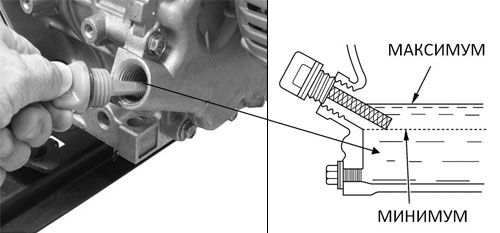
Всем известно, что обойтись сегодня без резервного источника энергии достаточно сложно, ведь он способен обеспечить электричеством любую местность или дом. Каждое такое устройство работает на бензине или дизеле, но кроме этого для полноценной работы прибору требуется качественное масло. Современные станции укомплектованы специальным датчиком, который защищает установку от низкого уровня масла в баке. Он попросту перестанет заводиться, поэтому, если вы не можете завести конструкцию, то следует в первую очередь измерить уровень масла или посмотреть на дисплей.
Как проверить датчик масла генератора? Из чего он состоит? На самом деле это обычный поплавковый выключатель, который регулирует уровень жидкости и если она падает ниже допустимой нормы, то моментально передает сигнал на панель. Последний останавливает мотор установки, замыкает высоковольтное напряжение элементов зажигания на каркасе устройства.
Что следует сделать в первую очередь
- Сначала необходимо отключить прибор от выключателя поплавкового, чтобы не нарушить его дальнейшую работу.
- Далее возьмите клемму и аккуратно замкните ее на металлическом корпусе двигателя.
- Только после этого можно вытащить ручку стартера и посмотреть дает свеча зажигания искру или нет. Заметим, что отсутствие искры является нормальным состоянием, а вот ее наличие свидетельствует о поломке.
- После этих действий необходимо прозвонить все действующие контакты оборудования и сам корпус. В идеале сопротивление, которое там присутствует, должно быть нулевым. В случае, когда вы заметили изменения, тогда обязательно обновите масло в конструкции и регулярно следите за его уровнем.
Если после всех манипуляций генератор все равно не заводится, обратитесь в сервисный центр, где мастера смогут узнать причину поломки и исправить ее.
Помните, что серьезные поломки может исправить только специалист, поэтому лучше обращаться в специальные организации, которые занимаются ремонтов электростанций.
Источник
Руководство по эксплуатации и обслуживанию электростанции «тсс стандарт»
Часть 8. Система управления электростанцией
Система управления выполнена на базе одного из 2 цифровых контроллеров Smartgen HGM6120K/KC или HGM6120U/UC, в зависимости от производственной целесообразности.
Smartgen HGM 6120K/KC


Общие сведения
Данная электростанция оснащена системой управления на базе AMF (Automatic Mains Failure Module) контроллера Smartgen HGM6120K/КС или HGM6120U/UC, который обеспечивает автоматический контроль параметров внешней сети и автоматический запуск электростанции при ее отказе. Контроллер объединяет в себе цифровые, интеллектуальные и сетевые технологии, используется как автоматическая система управления дизельными генераторами. Он может выполнять такие функции, как автоматический запуск/останов, измерение параметров, сигнализация, а также функции удаленного управления, мониторинга и коммуникации с применением протокола MODBUS (для контроллера HGM6120U). Контроллер оснащен ЖК-дисплеем и простыми и удобными в работе китайским, английским, испанским, португальским и русским интерфейсами.
Контроллеры HGM6120 KC и HGM6120UC оснащены портом RS485, контроллеры HGM6120K и HGM6120U – не оснащены им.
В контроллере используется микропроцессорная технология, способная обеспечивать точные измерения, постоянную корректировку значений, задавать временные и пороговые значения и многие другие параметры. Все параметры могут конфигурироваться с передней панели или с ПК, используя стандартный запрограммированный интерфейс (ПО для установки на ПК – прилагается) или интерфейс RS485 (если контроллер оснащен этим портом). Устройство может использоваться во всех системах автоматического управления генераторами, обеспечивая компактность, современный подход, простоту подключений и высокую надежность.
Контроллер обеспечивает :
- измерение и отображение следующих параметров:
фазное напряжение сети (Ua, Ub и Uc), В
линейное напряжение сети (Uab, Ubc, Uca), В
Примечание : контроллер предназначен для подключения к 3-фазной 4-х и 3-х проводной сети, к 1-фазной 2-х проводной и 2-фазной 3-х проводной сети
фазное напряжение генератора (Ua, Ub и Uc), В
линейное напряжение генератора (Uab, Ubc и Uca), В
ток генератора по фазам (Ia, Ib и Iс), А
активная мощность генератора, кВт
реактивная мощность генератора, кВАр,
полная мощность генератора, кВА
коэффициент мощности генератора, cos φ
количество выработанной электроэнергии генератора, кВт*ч
температура охлаждающей жидкости, °С / °F
давление масла, кПА / psi / Bar
напряжение аккумулятора, В
напряжение зарядки аккумулятора, В
количество запусков генератора, шт
- управление электростанцией: автоматический запуск/останов, в том числе автоматическое управление процессом запуска/останова, автоматическое управление ATS (переключение нагрузки), управление переключением нагрузки вручную, управление предпусковыми обогревателями и сигнализация на дисплее;
- обработку и индикацию 3 аналоговых входов от датчиков пользователя. Параметры входов могут также задаваться пользователем.
- Настройки параметров сохраняются в энергонезависимой памяти и защищены паролем. Все параметры могут быт установлены кнопками передней панели контроллера, а также с ПК (с использованием адаптора SG72 – USB-LINK-RS485 – для HGM6120K и HGM5120U) или порта RS485 (для HGM6120KC и HGM6120UС).
- Работа с датчиками температуры охлаждающей жидкости, давления масла и уровня топлива, в том числе с заданием кривых их зависимостей,
- Питание контроллера осуществляется от аккумулятора электростанции, минимальное напряжение питания 8 В, максимальное – 35 В.
- Пластиковая брызгозащитная панель (HGM6120K/KC) или водонепроницаемая панель (HGM5120U/UC).
| Модель контроллера | Название кнопки | Функции кнопки | |
| HGM6120K/KC | HGM6120U/UC | ||
 |
 |
Кнопка остановки/перезапуска | Когда двигатель работает, нажатие этой кнопки в ручном и автоматическом режимах задает автоматическое выполнение установленного процесса его остановки (снятия нагрузки, охлаждения и самой остановки). Когда при автоматическом отключении срабатывает сигнализация, нажатие этой кнопки приводит к сбросу этой сигнализации. При остановленном двигателе, нажатие и удерживание этой кнопки в течение 3 секунд используется для тестирования индикаторов.
Если процесс остановки уже задан, то повторное нажатие на это кнопку приведет к немедленной остановке двигателя. |
 |
 |
Кнопка запуска | В ручном режиме или режиме Test нажатие этой кнопки задает автоматическое управление запуском двигателя. |
 |
 |
Кнопка ручного режима | Нажатие этой кнопки переводит контроллер в ручной режим. |
 |
 |
Кнопка автоматического режима | Нажатие этой кнопки переводит контроллер в автоматический режим. |
 |
 |
Режим Test под нагрузкой | Нажатие этой кнопки приводит к переходу контроллера в режим тестирования (Test) под нагрузкой. Нагрузка автоматически подключится к электростанции, когда параметры тока электростанции будут в норме. |
 |
Настройка/ ввод | Вход в меню настроек или ввод положения курсора | |
 |
Вкл/выкл нагрузки | Нажатие на эту кнопку в ручном режиме подключает/отключает нагрузку | |
 |
Ввод курсора | Ввод положения курсора в меню настроек | |
 |
 |
Прокрутка вверх / увеличение | Прокрутка показания монитора вверх или увеличение значения параметра. |
 |
 |
Прокрутка вниз / уменьшение | Прокрутка показания монитора вниз или уменьшение значения параметра. |
 |
Меню | Вход в меню настроек. Повторное нажатие на эту кнопку – выход из меню настроек. |
Логика работы в автоматическом режиме
Автоматический режим включается нажатием кнопки . Действие подтверждается светодиодным индикатором, расположенным рядом с кнопкой.
Запуск электростанции
Когда на вход контроллера удаленного запуска поступает удаленный сигнал запуска или когда имеет место отказ сети (повышенное/пониженное напряжение или потеря фазы в сети), контроллер выполняет следующее:
Для подтверждения сигнала об отказе сети запускается таймер аномалии в сети. Затем запускается таймер задержки запуска. Остаток времени таймера задержки запуска индицируется на дисплее. После этой задержки, если задано включение предпускового подогревателя, запускается таймер предварительного прогрева и запитывается соответствующий выход контроллера (если он задан). Остаток времени работы предпускового обогревателя индицируется на дисплее.
По окончании времени указанных задержек. включается подача топлива и через 1 сек включается электростартер. Мотор запускается в течение заранее заданного времени. Если за время попытки запуска двигатель так и не запускается, электростартер не может быть включен в течение некоторого времени. Если количество попыток запуска превышает заданное, попытки запуска прекращаются и на ЖК-дисплее появляется сигнал Запуск невозможен (Fail to start).
Если же двигатель запустился, электростартер по достижении запрограммированной частоты на выходе генератора отключается. В качестве альтернативы, для определения момента отключения электростартера может использоваться импульсный датчик оборотов, установленный на картере маховика (задается в параметрах контроллера). Для отключения стартера может также использоваться параметр возрастающего давления масла.
После отключения стартера, включается задержка безопасности, позволяющий параметрам отказов : низкое давление масла, высокая температура двигателя, падение оборотов, падение напряжения , отказ зарядки аккумулятора и любым другим дополнительным входным сигналам о неисправностях стабилизироваться без появления во этот период сигнала о неисправности электростанции.
Когда двигатель запустился, включается таймер его прогрева (на холостом ходу, если холостой ход выбран в настройках параметров или на номинальном режиме), при этом аварийная сигнализация падения оборотов, падения частоты и падения напряжения – не работают.
После того, как время таймера прогрева закончилось, и параметры электростанции (напряжение и частота) находятся в норме – контроллер подключает нагрузку к генератору, после ее подключения загорается индикатор. Если параметры электростанции – не в норме, контроллер включает аварийную сигнализацию и индикацию на дисплее, и останавливает электростанцию.
Остановка электростанции
Если удаленная команда запуска снята или при снятии сигнала отказа сети, включается таймер задержки останова. После истечения его времени, подается сигнал на отключение нагрузки от электростанции и переключение нагрузки на сеть. Нагрузка с электростанции снимается.
После этого включается таймер охлаждения (на номинальном режиме или на холостом ходу, если холостой ход выбран в настройках параметров), и двигателю дается время на остывание без нагрузки до его выключения. После того, как заканчивается работа таймера охлаждения, закрывается подача топлива и электростанция останавливается.
Если при этом электростанция не остановилась, контроллер подает аварийный сигнал «Отказ останова» («Fail to stop»)
Логика работы в ручном режиме и режиме «Test»
Ручной режим включается нажатием кнопки . Режим «Test» под нагузкой включается нажатием кнопки . Рядом с кнопкой загорается светодиодный индикатор, подтверждающие действие. В любом из этих двух режимов нажатие кнопки приводит к включению следующей последовательности запуска.
Если выбрано включение предпусковых подогревателей, то включается таймер прогрева, и подается напряжение на соответствующий выход контроллера.
После вышеупомянутой задержки срабатывает соленоид подачи топлива, а затем запускается электростартер.
Мотор запускается в течение заранее заданного времени. Если за время попытки запуска двигатель так и не запускается, электростартер не может быть включен в течение определенного времени. Если количество попыток запуска превышает заданное, попытки запуска прекращаются и на ЖК-дисплее появляется сигнал Запуск невозможен (Fail to start).
Если же двигатель запускается, электростартер при заданной частоте генератора отключается В качестве альтернативы, для определения этой частоты оборотов может использоваться импульсный датчик оборотов, установленный на картере маховика (задается в параметрах контроллера). Для отключения электростартера может также использоваться параметр давления масла.
После отключения стартера, активируется таймер безопасности, позволяющий параметрам отказов : низкое давление масла, высокая температура двигателя, падение оборотов, падение напряжения , отказ зарядки аккумулятора и любым другим дополнительным входным сигналам о неисправностях стабилизироваться без запуска сигнала о неисправности электростанции.
Когда двигатель запустился, включается таймер его прогрева (если выбран в настройках параметров), позволяющий двигателю стабилизироваться до приема нагрузки.
В ручном режиме, подключение нагрузки к электростанции произойдет в зависимости от наличия подключения нагрузки к сети. Если питание от сети в норме, нагрузка к электростанции не подключится, если нагрузка к сети не подключена (или присутствует отказ сети) – нагрузка подключится к электростанции.
В режиме «Test» под нагрузкой, переключение нагрузки на электростанцию произойдет вне зависимости от того, в норме ли питание от сети.
Для HGM6120U/UC : В ручном режиме нажатие на кнопку подключит нагрузку к электростанции или сети вне зависимости от состояния сети.
В ручном режиме и режиме «Test» нажатие кнопки приводит к остановке генератора (последовательность остановки см. в описании автоматического режима).
Защитные функции контроллера
Предупредительные сообщения
Предупреждения – это сигналы о некритических проблемах, которые не влияют на работу генераторной системы. Эти предупреждения нужны только для привлечения к проблеме внимания оператора.
На ЖК-дисплее отображаются следующие предупреждения :
Потеря сигнала частоты вращения (Loss of speed signal) — предупреждение выдается, если потерян сигнал измерения оборотов от импульсного датчика, при работающем двигателе контроллер определяет что обороты равны 0, а задержка при потере этого сигнала установлена на ноль.
Превышение тока генератора (Gens over current) — предупреждение выдается, если контроллер обнаруживает, что выходной ток генератора превышает заданное значение, а задержка для этой ситуации установлена на ноль.
Отказ останова (Failed to stop) — если модуль обнаруживает, что двигатель все еще работает, хотя время работы таймера задержки при отказе останова истекло.
Пониженный уровень топлива (Low oil level) — предупреждение выдается, если контроллер определяет, что уровень топлива упал ниже заданного минимального значения или входной сигнал «Мал уровень топлива» активен.
Отказ зарядки аккумулятора (Charge alt fail) — предупреждение выдается, если контроллер обнаруживает, что зарядное напряжение упало ниже заданного минимального значения.
Низкое напряжение аккумулятора (Battery low voltage) — предупреждение выдается, если контроллер обнаруживает, что напряжение аккумулятора упало ниже заданного минимального уровня .
Повышенное напряжение аккумулятора (Battery high voltage) — предупреждение выдается, если контроллер обнаруживает, что напряжение аккумулятора превысило заданный максимальный уровень.
Низкий уровень охлаждающей жидкости (Low water level) – предупреждение выдается, когда входной сигнал «Низкий уровень охлаждающей жидкости» активен.
Обрыв цепи датчика температуры охлаждающей жидкости (Temp. sensor open circuit) (только HGM6120U/UC) – предупреждение (если задано) выдается, когда контроллер не видит сигнала от датчика.
Обрыв цепи датчика давления масла (Oil pressure sensor open circuit) (только для HGM6120U/UC) – предупреждение (если задано) выдается, когда контроллер не видит сигнала от датчика.
Подошло время обслуживания (Maintenance time out warn) (только для HGM6120U/UC) – предупреждение (если задано) выдается, когда установленный в контроллере интервал до очередного обслуживания истек. Если установлено «Not used» — предупреждающий сигнал не выдается.
Сообщения об аварийном отключении
При аварийном отключении контроллер посылает команду на отключение нагрузки от электростанции и на ее остановку, выдается аварийный сигнал и сообщение на ЖК-дисплее.
После этого следует устранить неисправность и возвратить контроллер в исходное состояние.
ВНИМАНИЕ: Перед возвратом контроллера в исходное состояние необходимо устранить проблему, в противном случае контроллер вернуть в исходное состояния не удастся. (Исключением является сигнал о падении давления масла, поскольку давление масла при неработающем двигателе отсутствует).
Аварийный останов (Emergency stop) – снятие питания «+» с ввода от кнопки аварийного останова запускает следующую последовательность: сначала осуществляется снятие нагрузки от электростанции и предотвращаются любые попытки ее перезапуска (пока не будет сброшена кнопка аварийного останова). Затем снимается «+» питания как с соленоида подачи топлива двигателя, так и с соленоида стартера.
Остановка из-за высокой температуры двигателя (High temp. shutown) – электростанция отключается (после окончания времени работы таймера безопасности), если контроллер обнаруживает, что температура охлаждающей жидкости двигателя превысила установленный уровень максимальной температуры
Остановка из-за падения давления масла (Low oil pressure shutdown) — электростанция отключается (после окончания времени работы таймера безопасности), если контроллер обнаруживает, что давление масла двигателя упало ниже заданного минимального давления масла.
Остановка из-за превышения оборотов (Over speed shutdown) — электростанция отключается, если число оборотов двигателя превышает заданное значение.
Остановка из-за падения оборотов (Under speed shutdown) — электростанция отключается, если число оборотов двигателя падает ниже заданного значения.
Остановка из-за потери сигнала частоты вращения (Loss of speed signal shutdown) — электростанция отключается, контроллер обнаруживает, что обороты равны 0, а задержка при потере этого сигнала не установлена на ноль.
Остановка из-за повышенного напряжения генератора (Genset over voltage shutdown) — электростанция отключается, если контроллер обнаруживает, что выходное напряжение генератора превышает заданное значение.
Остановка из-за падения напряжения генератора (Genset under voltage shutdown) — электростанция отключается, если контроллер обнаруживает, что выходное напряжение генератора падает ниже заданного значения.
Остановка из-за превышения тока генератора (Genset over current shutdown) — электростанция отключается, если контроллер обнаруживает, что выходной ток генератора превышает заданное значение, а задержка при этом событии не установлена на 0..
Отказ запуска (Fail to start) — если после заданного количества попыток двигатель так и не запустился, осуществляется блокировка дальнейших попыток запуска.
Остановка из-за повышения частоты генератора (Over frequency shutdown) — электростанция отключается, если контроллер обнаруживает, что частота генератора превышает заданное значение.
Остановка из-за понижения частоты генератора (Under frequency shutdown) — электростанция отключается, если контроллер обнаруживает, что частота генератора ниже заданного значения.
Отказ электростанции (Genset failed) – электростанция отключается, если контроллер обнаруживает, что частота генератора равна 0.
Остановка из-за низкого уровня топлива (Low fuel level) – если на вход контроллера подается сигнал «Низкий уровень топлива», электростанция отключается.
Остановка из-за низкого уровня охлаждающей жидкости (Low water level) – если на вход контроллера подается сигнал «Низкий уровень охлаждающей жидкости», электростанция отключается.
Остановка из-за обрыва цепи датчика температуры охлаждающей жидкости (Temp. sensor open circuit) (только HGM6120U/UC) – электростанция останавливается (если задано), когда контроллер не видит сигнала от датчика.
Остановка из-за обрыва цепи датчика давления масла (Oil pressure sensor open circuit) (только для HGM6120U/UC) – электростанция останавливается (если задано), когда контроллер не видит сигнала от датчика.
Остановка, т.к. подошло время обслуживания (Maintenance time out warn) (только для HGM6120U/UC) – электростанция останавливается (если задано), когда установленный в контроллере интервал до очередного обслуживания истек. Если установлено «Not used» — отключения электростанции не промсходит.
С хема подключения контроллеров Smartgen HGM6120КС и HGM6120UC
Подключение контроллеров Smartgen HGM6120К/КС и HGM6120U/UC

Ч асть 9. Автоматический выключатель (автомат защиты)
Для электростанции применяется автоматический выключатель (автомат защиты) CHINT NM1
Часть 10. Коммутационное устройство
А
втоматическое коммутационное устройство (ATS), применяемое при исполнении ДГУ по 2 степени автоматизации – Aisikai SKT1.
Электрозамок предназначен для подачи управляющего питания на ATS. Когда электрозамок открыт, подается управляющий сигнал автоматики, а когда электрозамок закрыт – доступно лишь ручное управление.
Ручка переключения используется при закрытом электрозамке.
Механический фиксатор – для выполнения обслуживания вначале установите ручкой переключения ATS в положение «0», затем вытяните механический фиксатор и сохраняйте его положение при обслуживании. Вытягивание фиксатора отключает внутреннее автоматическое управление ATS, и ATS не может управляться ни автоматически, ни вручную.
Индикатор положения – показывает рабоче состояние ATS : I – 0 – II .
Напряжение, управляемое ATS – показывает назначение ATS.
Внимание ! В случае, если ATS не работает, откройте боковую крышку и проверьте (если надо, замените) предохранитель.
Источник
|
|
Вверх #1 |
|
ЛагуноВед Освоился
Регистрация: 31.08.2008 Адрес: Kiev Сообщений: 319 Имя: Ростислав Автомобиль: Laguna II Ph I |
Срочно нужна консультация и мнения В течении недели начала появляться периодически надпись Battery charge fail, горит красным экран и написано STOP но ошибка имела периодический характер и проявлялась крайне редко Вчера вечером, после очередной остановки, перестал крутить стартер, при нажатии кнопки свет и все приборы тухли, завел машину с небольшой горочки и поехал домой. По дороге домой напряжение в эл. сети начало падать, это было видно по затухающей приборной панели, и включению всех контрольных лампочек которые только были, быстро замерив тестером прикуриватель, обнаружил в 8,5В В связи с выше изложенным, у меня вопрос, это коротит какая-то банка в аккумуляторе или все же таки генератор? Аккум у меня хоть и молодой, но у него все время подтекал электролит
__________________ |

|
|


|
|
Вверх #2 |
|
ЛагуноВед Помогу советом
Регистрация: 10.03.2011 Адрес: Киров Сообщений: 3,553 Имя: Евгений Автомобиль: Laguna III |
Цитата:
Сообщение от Ross Срочно нужна консультация и мнения В первую очередь свози акум на диагностику. У нас в магазинах, где их продают есть спецприборы, делают проверку бесплатно. Также ток заряда и ток утечки померяют в разных состояниях… А потом уже выводы делай
__________________ |
|
|
|



|
|
Вверх #3 |
|
ЛагуноВед Освоился
Регистрация: 31.08.2008 Адрес: Kiev Сообщений: 319 Имя: Ростислав Автомобиль: Laguna II Ph I |
Цитата:
Сообщение от Colombo В первую очередь свози акум на диагностику. У нас в магазинах, где их продают есть спецприборы, делают проверку бесплатно. Также ток заряда и ток утечки померяют в разных состояниях… А потом уже выводы делай Ну аккум я исключу немного другим способом, нашел на балконе свой бывший аккум, который в принципе ещё работал не плохо, только при сильных морозах вяло крутил, вот сейчас стоит на зарядке, вечером поставлю. тут вопрос по генератору меня больше мучает
__________________ |
|
|
|
|
|
Вверх #4 |
|
ЛагуноВед Помогу советом
Регистрация: 10.03.2011 Адрес: Киров Сообщений: 3,553 Имя: Евгений Автомобиль: Laguna III |
Цитата:
Сообщение от Ross Ну аккум я исключу немного другим способом, нашел на балконе свой бывший аккум, который в принципе ещё работал не плохо, только при сильных морозах вяло крутил, вот сейчас стоит на зарядке, вечером поставлю. тут вопрос по генератору меня больше мучает Так на диагностике все бы и проверили разом…
__________________ |
|
|
|
|
|
Вверх #5 |
|
ЛагуноВед Освоился Регистрация: 03.01.2010 Адрес: Литва Сообщений: 1,206 Имя: Aльфонсас Автомобиль: Laguna II Ph II |
Если генератор фирмы ВАЛЕО то тогда проверь цепь якоря, они имеет одну слабость, обрывается провод рядом с соединением с кольцами, там всё залита пластмасой. Сначала появляется при сильной тряске , о потом всё чашче и наконец постояно.
__________________ |
|
|
|
|
|
Вверх #6 |
|
ЛагуноВед Освоился
Регистрация: 31.08.2008 Адрес: Kiev Сообщений: 319 Имя: Ростислав Автомобиль: Laguna II Ph I |
Цитата:
Сообщение от Alfam Если генератор фирмы ВАЛЕО то тогда проверь цепь якоря, они имеет одну слабость, обрывается провод рядом с соединением с кольцами, там всё залита пластмасой. Сначала появляется при сильной тряске , о потом всё чашче и наконец постояно. да Valeo
__________________ |
|
|
|
|
|
Вверх #7 |
|
ЛагуноВед Освоился Регистрация: 14.01.2012 Адрес: Московская область г.Дмитров Сообщений: 600 Имя: Дмитрий Автомобиль: Laguna II Ph I |
может просто провод на возбуждение который идет проверить перед тем как гену снимать.
__________________ |
|
|
|

|
|
Вверх #8 |
|
ЛагуноВед Освоился
Регистрация: 31.08.2008 Адрес: Kiev Сообщений: 319 Имя: Ростислав Автомобиль: Laguna II Ph I |
Не, провода уже все я проверил и все зачистил у меня так стартер типа сдох, почистил неждаком место крепления и уже как два года работает
__________________ |
|
|
|
|
|
Вверх #9 |
|
ЛагуноВед Освоился
Регистрация: 19.06.2008 Адрес: Россия, Брянск Сообщений: 921 Имя: Николай Автомобиль: Koleos |
а электролит по какой причине подтекал?
__________________ |
|
|
|

 —> Лагуна 2ф1 F9Q 750 120 кобыл PK6 сарай PRIVILEGE — продал —> Лагуна 3 К4М — не едет —> Колеос 2TR
 |
|
Вверх #10 |
|
ЛагуноВед Освоился
Регистрация: 31.08.2008 Адрес: Kiev Сообщений: 319 Имя: Ростислав Автомобиль: Laguna II Ph I |
Цитата:
Сообщение от salut511_nik а электролит по какой причине подтекал? более чем уверен, что качество аккума такое Добавлено через 4 минуты 53 секунды поменял щетки, результат тот же, выход с гены всего 2в
__________________
Последний раз редактировалось Ross; 21.08.2012 в 15:13. Причина: Добавлено сообщение
|
|
|
|
|
|
Вверх #11 |
|
ЛагуноВед Освоился
Регистрация: 19.06.2008 Адрес: Россия, Брянск Сообщений: 921 Имя: Николай Автомобиль: Koleos |
Цитата:
Сообщение от Ross более чем уверен, что качество аккума такое Добавлено через 4 минуты 53 секунды поменял щетки, результат тот же, выход с гены всего 2в что то мне подсказывает что качество тут не причем… хотя батарейку это уже не спасет…
__________________ |
|
|
|
|
|
Вверх #12 |
|
ЛагуноВед Освоился
Регистрация: 31.08.2008 Адрес: Kiev Сообщений: 319 Имя: Ростислав Автомобиль: Laguna II Ph I |
заменил сегодня щетки гены, думал вот оно счастье, поставил, и… и ничего ну подумал я, что умер регулятор зарядки, было принято решение покупать весь девайс в сборе заодно мне на стенде проверили мой старый регулятор со щётками, и сказали мол он труп, дали все в сборе новое приехал вечером к пациенту, думал вот оно щастье, но… нифига, ошибка компа горит, замер с гены показал уже 3в, погазовав немного показания не изменились кольца на валу изношены не сильно, вал крутится свободно, без люфтов у меня вопрос, может должны щетки притереться?
__________________ |
|
|
|
|
|
Вверх #13 |
|
ЛагуноВед Освоился
Регистрация: 31.08.2008 Адрес: Kiev Сообщений: 319 Имя: Ростислав Автомобиль: Laguna II Ph I |
в общем проанализировав все проблемы…
__________________ |
|
|
|

|
|
Вверх #14 |
|
ЛагуноВед Освоился
Регистрация: 31.08.2008 Адрес: Kiev Сообщений: 319 Имя: Ростислав Автомобиль: Laguna II Ph I |
Как прикольно с собой общаться… В итоге муфта заклинила, начала цокотеть, я долго не мог найти откуда доносится этот звук, даже выкладывал сюда на форум запись работы движка, а хоть бы кто ответил…. заклинившая муфта со временем провернула ротор (75уе китай) и оборвала обмотку, далее ещё до кучи подгорел регулятор заряда (55уе) , видимо от постоянных скачков, и туда же шкивмуфта (65уе INA) + работа вот такой итог
__________________ |
|
|
|
|
|
Вверх #15 |
|
ЛагуноВед Освоился Регистрация: 03.01.2010 Адрес: Литва Сообщений: 1,206 Имя: Aльфонсас Автомобиль: Laguna II Ph II |
Цитата:
Сообщение от Ross Как прикольно с собой общаться… В итоге муфта заклинила, начала цокотеть, я долго не мог найти откуда доносится этот звук, даже выкладывал сюда на форум запись работы движка, а хоть бы кто ответил…. заклинившая муфта со временем провернула ротор (75уе китай) и оборвала обмотку, далее ещё до кучи подгорел регулятор заряда (55уе) , видимо от постоянных скачков, и туда же шкивмуфта (65уе INA) + работа вот такой итог Не правильный вывод. Если по вашему, тогда все генераторы с простым шкивом должны выити из строя. У генератов фирмы ВАЛЕО есть недостаток, лопается провод рядом с подключением к кольцам. Вазмите бошовски генератор, их тоже ставит на лагунах, и посмотрите конструкцию, поимёте что Французу допустили промах.
__________________ |
|
|
|
|
|
Вверх #16 |
|
ЛагуноВед Освоился Регистрация: 14.01.2012 Адрес: Московская область г.Дмитров Сообщений: 600 Имя: Дмитрий Автомобиль: Laguna II Ph I |
У меня такая проблема, периодически загоралась стоп+отсутствие зарядки АКБ, поработав несколько минут все приходило в норму. Сегодня поймав этот момент с тестером, замерил напряжение без нагрузки 14,02-14,1 под нагрузкуй клима на MAX + дальний 13,98/99 короче генератор работает нормально, а лампа стоп на приборке горит. Подумал тестер мне мозг выносит заглушил показывает 13В включаю дальний просаживается до 12,6 в общем тестер нормальный.
__________________ |
|
|
|
|
|
Вверх #17 |
|
Пользователь Только пришёл
Регистрация: 06.04.2012 Адрес: Беларусь, Мозырь. Сообщений: 88 Имя: Дмитрий Автомобиль: Laguna II Ph I |
Цитата:
Сообщение от Arabchik У меня такая проблема, периодически загоралась стоп+отсутствие зарядки АКБ, поработав несколько минут все приходило в норму. Сегодня поймав этот момент с тестером, замерил напряжение без нагрузки 14,02-14,1 под нагрузкуй клима на MAX + дальний 13,98/99 короче генератор работает нормально, а лампа стоп на приборке горит. Подумал тестер мне мозг выносит заглушил показывает 13В включаю дальний просаживается до 12,6 в общем тестер нормальный. Скорее всего надо паять приборку. Была где-то тема поиском поищи.
__________________ |
|
|
|

 Renault Laguna II Ph I Grandtour 2.2 dCi (KG0F) G9T 702 РК6 150 л.с. 2002 г. INITIALE.
|
|
Вверх #18 |
|
ЛагуноВед Освоился Регистрация: 14.01.2012 Адрес: Московская область г.Дмитров Сообщений: 600 Имя: Дмитрий Автомобиль: Laguna II Ph I |
Цитата:
Сообщение от Dima-017 Скорее всего надо паять приборку. Была где-то тема поиском поищи. Да искал. Все что нашел заканчивается: «мне перебрали генератор и все заработало». Добавлено через 45 минут 13 секунд
__________________
Последний раз редактировалось Arabchik; 15.09.2012 в 17:35. Причина: Добавлено сообщение
|
|
|
|
|
|
Вверх #19 |
|
Пользователь Только пришёл
Регистрация: 06.04.2012 Адрес: Беларусь, Мозырь. Сообщений: 88 Имя: Дмитрий Автомобиль: Laguna II Ph I |
Цитата:
Сообщение от Arabchik Да искал. Все что нашел заканчивается: «мне перебрали генератор и все заработало». Добавлено через 45 минут 13 секунд Я и приборку пропаял и генератор перебрал, и дополнительную массу на генератор кинул. Всё равно время от времени загорается, хотя гораздо реже.((((
__________________ |
|
|
|
|
|
Вверх #20 |
|
ЛагуноВед Помогу советом
Регистрация: 22.09.2011 Адрес: Новокузнецк Сообщений: 2,872 Имя: Алексей Автомобиль: Laguna III |
Цитата:
Сообщение от Arabchik Да искал. Все что нашел заканчивается: «мне перебрали генератор и все заработало». Добавлено через 45 минут 13 секунд набери в поиске Панель приборов. Ремонт тема создана Roman-Piligrim
__________________ |
|
|
|

5
5.1 WARNINGS
Warnings are not shutdown alarms and do not affect the operation of the gen-set. Warning alarms does not
lead to shutdown. The alarm information will be displayed on LCD.
Warning alarms types are as follows:
No.
Items
1
High Temp.
2
Low OP
3
Gen Over Current
4
Fail To Stop
5
Low Fuel Level
6
Charge Alt Failure
7
Battery Under Volt
8
Battery Over Volt
9
Aux. Input
Loss
Of
Speed
10
Signal
HGM400N Series Genset Controller
HGM400N Series Genset Controller User Manual
When the controller detects that engine temperature has exceeded the
pre-set value while shutdown is prohibited, or detects that the Aux. input
high temperature while shutdown is prohibited, it will initiate a warning
alarm and the corresponding alarm information will be displayed on LCD.
When the controller detects that the oil pressure has fallen below the
pre-set value while shutdown is prohibited, or detects that the Aux. input
low oil pressure while shutdown is prohibited, it will initiate a warning alarm
and the corresponding alarm information will be displayed on LCD.
When the controller detects that the genset current has exceeded the
pre-set value and the over current delay has expired, it will initiate a
warning alarm and the corresponding alarm information will be displayed
on LCD.
After «fail to stop» delay/ ETS delay has expired, if gen-set does not stop
completely, it will initiate a warning alarm and the corresponding alarm
information will be displayed on LCD.
When the controller detects that the fuel level has fallen below the pre-set
value while shutdown is prohibited, or detects that the Aux. input low fuel
level while shutdown is prohibited, it will initiate a warning alarm and the
corresponding alarm information will be displayed on LCD.
When the controller detects that charger voltage has fallen below the
pre-set value, it will initiate a warning alarm and the corresponding alarm
information will be displayed on LCD.
When the controller detects that battery voltage has fallen below the
pre-set value, it will initiate a warning alarm and the corresponding alarm
information will be displayed on LCD.
When the controller detects that battery voltage has exceeded the pre-set
value, it will initiate a warning alarm and the corresponding alarm
information will be displayed on LCD.
When the controller detects that the auxiliary input warning signals, it will
initiate a warning alarm and the corresponding alarm information will be
displayed on LCD.
When the controller detects that the engine speed is 0 and the delay is 0, it
will initiate a warning alarm and the corresponding alarm information will
be displayed on LCD.
2017-04-21
Description
Version 1.2
Page 11 of 36
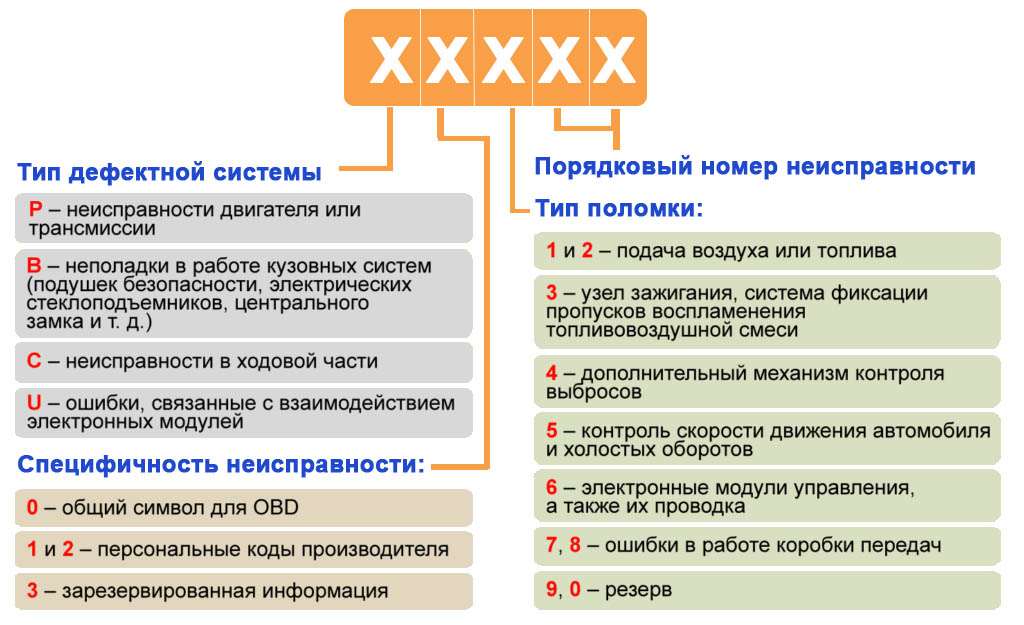
Ошибка Battery charging fault у автомобиля Renault была обновлена 17:18. Определить ошибку в автомобиле Renault можно через диагностический прибор через соединение OBD2. Если у вас определена ошибка под номером Battery charging fault — тогда прочитайте ее обозначение согласно официальным техническим регламентам автомобиля Renault.
 Battery charging fault
Неисправности в электроцепи подзарядки аккумуляторной батареи. При такой ошибке напряжение в электросети автомобиля может не соответствовать нормированным параметрам. Требуется диагностика аккумулятора, генераторной установки, а также блока управления. Проблема может состоять в монтажном модуле с предохранительными элементами.
Приветствуется любая корректная, полезная и честная информация о ремонте ошибки Battery charging fault у автомобиля Renault.
Возможно Ваш отзыв сможет кому-то помочь!
Чтобы помочь вам в решении ошибки Battery charging fault и устранить её, опишите вашу ситуацию и комментарий ниже. Обязательно оставьте почтовый ящик, ответ и помощь придет в течение дня.

Илья Сергеевич Дорофеев |
Поддержка от автовладельцев Техник по диагностике автомобилей Renault Стаж: 18 лет Помогу решить любые вопросы возникшие с ошибками Battery charging fault по автомобилю Renault. Опишите подробно ситуацию форме ниже и я лично вам отвечу в ближайшее свободное время. Обязательно укажите номера ошибок, симптомы и конечно модель, двигатель и кузов. Для ответа мастера — поделитесь обязательно ссылкой с друзьями: |
Помощь и удаление ошибок у моделей Renault
Duster (Дастер); Fluence (Флюенс); Kangoo (Кенго, Кангу); Laguna (Лагуна); Logan (Логан); Magnum (Магнум); Master (Мастер); Megan (Меган); Premium (Премиум); Sandero (Сандеро); Scenic (Сценик); Clio Symbol (Клио Симбол); Trafic (Трафик).

Автомобильный сканер для Renault
Ваш помощник в точном определении ошибки в том числе Battery charging fault и причины поломки. Дигностика любой модели Renault за 3 минуты, все показания бортового компьютера. Стирайте ошибки и выявляйте причину сами.
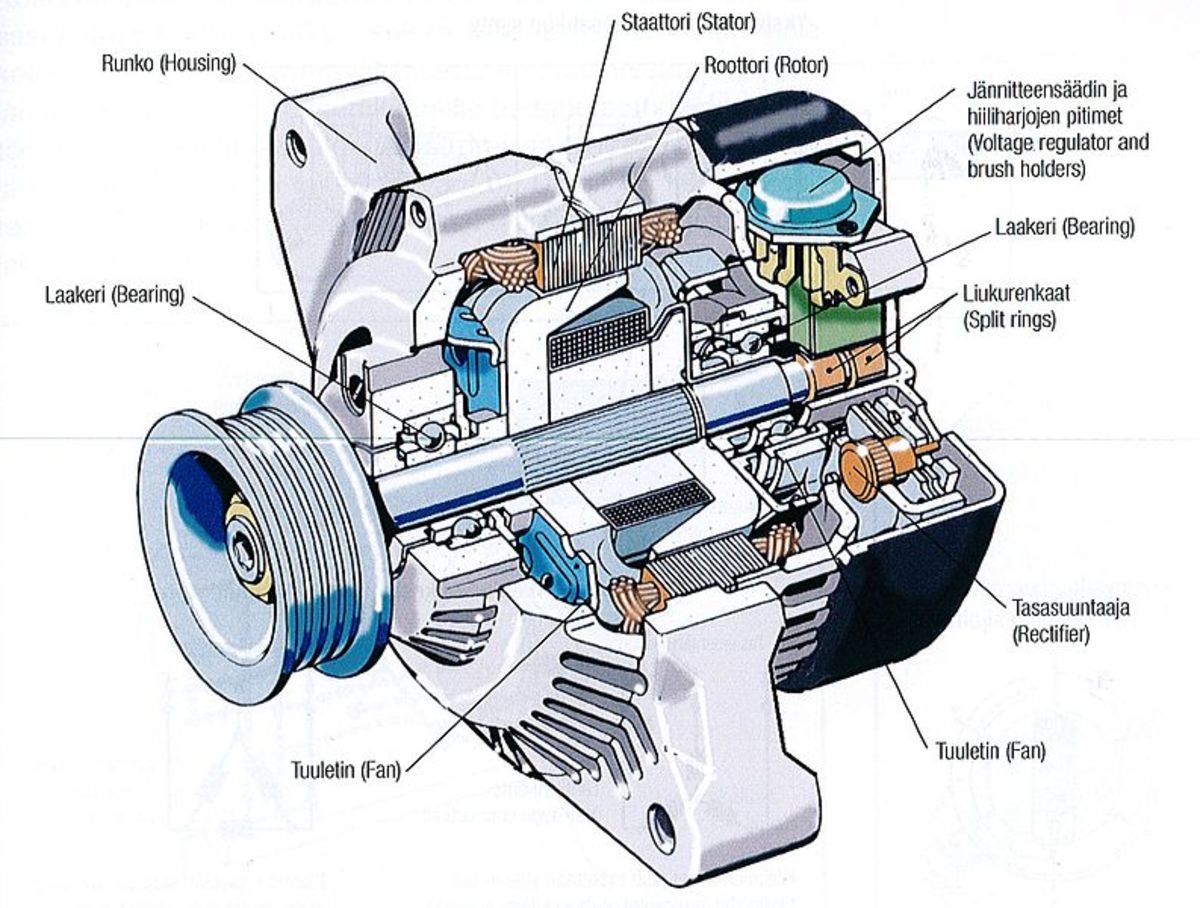
The alternator is at the heart of the charging system of your vehicle.
Photo courtesy of Pentti Immonen on Wikimedia
Alternator problems and charging system problems can affect your vehicle in different ways. You may notice:
- your ALT or CHARGE indicator light comes on,
- your engine is hard to start and cranks slowly, or doesn’t crank,
- your battery demands lots of water,
- your alternator makes noises,
- or your headlights suddenly go dim.
These and other problems may be caused by a fault in the charging system.
Before you start replacing components with the hope of fixing the problem, you need to determine which component or components are causing you trouble. Often, it is possible to diagnose and solve the problem on your own using a few simple tests and tools.
The sooner you find out what is causing trouble, the better. You’ll prevent a faulty component from ruining other parts in the system, which would make your repair more expensive.
This convenient troubleshooting guide will help you find out what you need to know, using a few simple checks you can do at home using a test light or digital multimeter (DMM) and possibly a few other common tools.
It is a good idea to have on hand the vehicle repair manual for your particular car make and model. You may buy a relatively cheap copy through Amazon.
Haynes manual include:
- Step-by-step procedures
- Photographs
- Systems descriptions
- Troubleshooting
- Parts location
- Maintenance schedule
The manual helps identify wires and specific components, and possibly suggest some specific tests recommended by your manufacturer.
If you want to test the condition of the system as a diagnostic starting point, do the tests described in the following section, «General Charging System Check.»
However, if you need help with a specific problem with your charging system—for example, an over-charge or under-charge condition, discharging battery, or noisy system—then skip over to the «Charging System Problems and Potential Causes» section.
| Index |
|---|
|
I. Common Symptoms of a Bad Alternator or Charging System |
|
II. General Charging System Checks |
|
III. Charging System Problems and Potential Causes |
|
IV. Troubleshooting for Unusual Voltage System Drops |
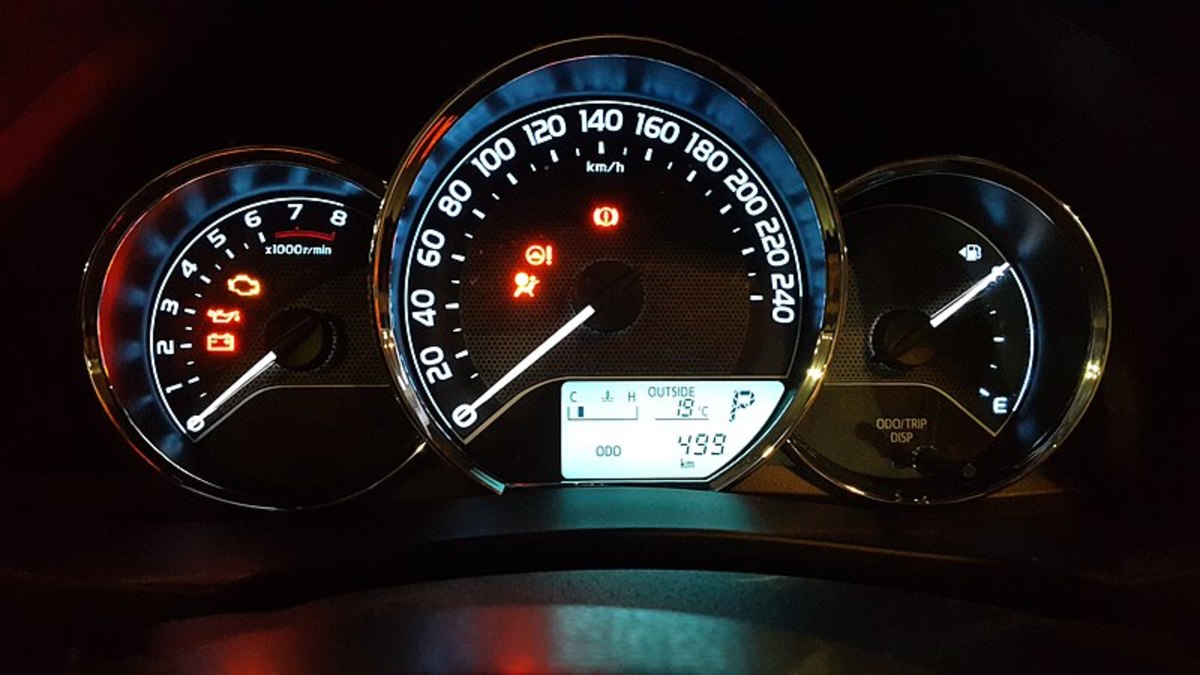
The battery indicator should turn off when your engine is running.
Photo courtesy of Kskhh on Wikipedia
I. Common Symptoms of a Bad Alternator or Charging System
Indicator Light On
Usually, the first sign that your charging system is in trouble is a «battery,» «ALT,» or «CHARGE» warning light illuminating on your instrument panel while driving. It means that the alternator voltage output is below 12 volts, or over its limit or has stopped charging the battery and your car is running on battery power.
If the light illuminates only intermittently, it usually indicates a loose or worn drive belt or serpentine belt, worn-out or bad carbon brushes in the alternator. But remember that the light doesn’t always mean there is a bad part; the light may be triggered by a sensor giving a wrong message or there’s something wrong with the circuit itself.
Engine Cranks Slowly, Doesn’t Crank or Stalls
When the battery is undercharged, you may have difficulty starting the vehicle, the engine cranks slowly or doesn’t crank at all. Also, the engine may stall if the alternator can’t produce enough power to run the ignition system. Go over the next section on «General Charging System Checks,» and, if necessary, check the section «IV. Troubleshooting for Unusual Charging System Voltage Drops.» further down in this article.
Battery Overheating and Using Too Much Water
An overcharged battery causes the battery to overheat. You find yourself adding water to the battery frequently. If the problem is not taken care of on time, it can ruin your battery. Besides going through the next section, make sure to check section IV below on «Troubleshooting for Unusual Charging System Voltage Drops»
Noises Under the Hood
Squealing, buzzing or grinding noises coming from the engine may be caused by bad alternator components, a loose or worn-out serpentine belt, or a faulty belt tensioner, loose alternator pulley or mounting bolts, worn bearings, or faulty diodes. See the «Checking for Alternator Noises» subsection further down in this article.
Dimming Lights
If you notice the headlights, instrument panel, or interior lights dimming or flickering, power windows running slow, radio or gauges don’t operate as they should, either your battery has a low charge, or there’s one or more faulty diodes inside the alternator. Check your battery and see the «Alternator AC Voltage Leak Check» subsection further down in this article.

Check the drive belt for adjustment and tensioner for proper operation.
Photo courtesy of Una Smith on Wikimedia
II. Six Tests for the Charging System in General
These series of charging system checks help diagnose the general condition of your charging system. They can help you confirm that you actually have a problem in your charging system and locate the source of the problem.
1. Make a Visual Inspection of the System
With the engine off, pop the hood open and visually inspect the different components of the charging system. Look for a worn-out or loose drive belt, alternator connection problems, loose alternator mounting bolts, and corrosion and dirt around the battery case and cables.
When inspecting the drive belt, check for adjustment. If necessary, adjust the belt with the help of your car owner’s manual or repair manual. Inspect the belt for signs of cracks, cuts, shiny spots, deterioration or other signs of wear or damage. Change the belt and belt tensioner at the manufacturer’s recommended interval.
2. Check for Wiring Problems
Inspect the wires and connections at the back of the alternator, at the remote voltage regulator (if applicable), and at the battery. Look for corrosion at the connectors, damaged wires, and burned and missing insulation that might suggest an electrical short.
3. Do This If the Indicator Light Stays On, or Goes On and Off
Follow the next steps:
- Start the engine and apply the emergency brakes. Set the transmission to Neutral (manual) or Park (automatic).
- Connect a voltmeter across the battery terminals.
- While watching the voltmeter display, start wiggling wires at the back of the alternator, the battery, and the remote voltage regulator (if there is one).
- If the voltage reading on the meter display goes up while wiggling one of the wires, you’ve found a bad electrical wire or connection.
Instead of using a voltmeter, you can have an assistant watch the indicator light on the instrument panel to see if it turns off as you wiggle various wires and connectors. Once the light turns off, you’ve found the problem connector or wire.
4. Check for Alternator Noises
Bad alternator bearings, rectifiers, rotor shaft, stator winding, slip rings, brushes and other parts inside the alternator with mechanical or electrical problems can become noisy.
Here’s a test you can do: Use a length of vacuum hose to listen for alternator noises. The hose will amplify the noise if it’s coming from the alternator. But be very careful around moving parts while you do this test.
- Start the engine.
- Place one end of the hose against your ear and move the other end around different points of the alternator body.
- Listen for whining noises (this can indicate a bad diode or an over-charging condition), grinding (bad bearing), squealing, or other abnormal noise. If necessary, have your alternator checked.
5. Check for Under-Charging and Over-Charging
The next three tests are best done using a load tester, but you still can use your digital voltmeter. You do this by measuring system voltage while loading the system.
5a. First, measure battery base voltage to make sure you have a fully charged battery.
- Turn on the high beams for 10 seconds and then turn them off.
- Wait for two minutes
- Measure battery voltage across the battery posts with your DMM. You should get between 12.4 and 12.6V. This means your battery is fully charged. If you get a reading below 12.4V, charge the battery before continuing.
5b. Measure the Charging System’s No-Load Voltage
- Ask an assistant to start the engine and hold engine speed at about 1500 RPM.
- Measure voltage across the battery with your DMM. You should get 0.5 to 2 volts higher than base voltage. If you are getting more than 2 volts above base voltage, most likely your alternator is over-charging the battery or the battery is faulty. Other potential problems are a faulty voltage regulator or a problem in the charging system wiring. As part of your wiring checks, see the section «Troubleshooting for Unusual Charging System Voltage Drops» below.
5c. Measure charging system load voltage with a high-current-condition system measurement.
- Ask an assistant to start the engine and hold engine speed at about 2000 RPM. Turn on all electrical accessories like A/C, blower motor, headlights, defroster, wipers. But don’t turn on the heated windshield if your vehicle has one; alternator voltage may increase to over 100V and this can be unsafe.
- Take a voltage reading across the battery posts. Your reading should be at least 0.5 volts above base voltage for your system to keep up with electrical system demands. Otherwise, the charging system can’t meet the demand and charge your battery. This fault could point to a faulty alternator or voltage regulator. Check the section «Troubleshooting for Unusual Charging System Voltage Drops» below to check for wiring problems that can lead to this condition.
- NOTE: These measurements correspond to an ambient temperature of about 70º F. The charging voltage will increase as temperature drops, and charging voltage will decrease as temperature goes up. So keep this in mind when making your measurements.
6. Check for Alternator AC Voltage Leak
Alternators use diodes to rectify alternating current produced by the alternator into direct current. When one or more diodes go bad or a stator winding fails, the alternator can cause all kinds of problems. AC voltage leak can cause your lights to dim and drain power from your battery, for example. Usually, you can detect this leak by measuring AC voltage at the alternator.
- Start and let the engine idle.
- Set the parking brake and your transmission to Park (automatic) or Neutral (manual).
- Set your meter to a low AC voltage range.
- Ask an assistant to increase engine RPM to 2000 rpm.
- Touch the red meter lead to the alternator battery terminal B+.
- Touch the black meter lead to the alternator case (ground).
- If your DMM reads 0.4 AC volts or less, the diodes are good.
- If your DMM reads 0.5 AC volts or more, the diodes or stator is faulty.
Once you’ve determined the condition of the system, you can go over the next section to zero in on the potential problem(s) that may be causing the condition of the charging system.
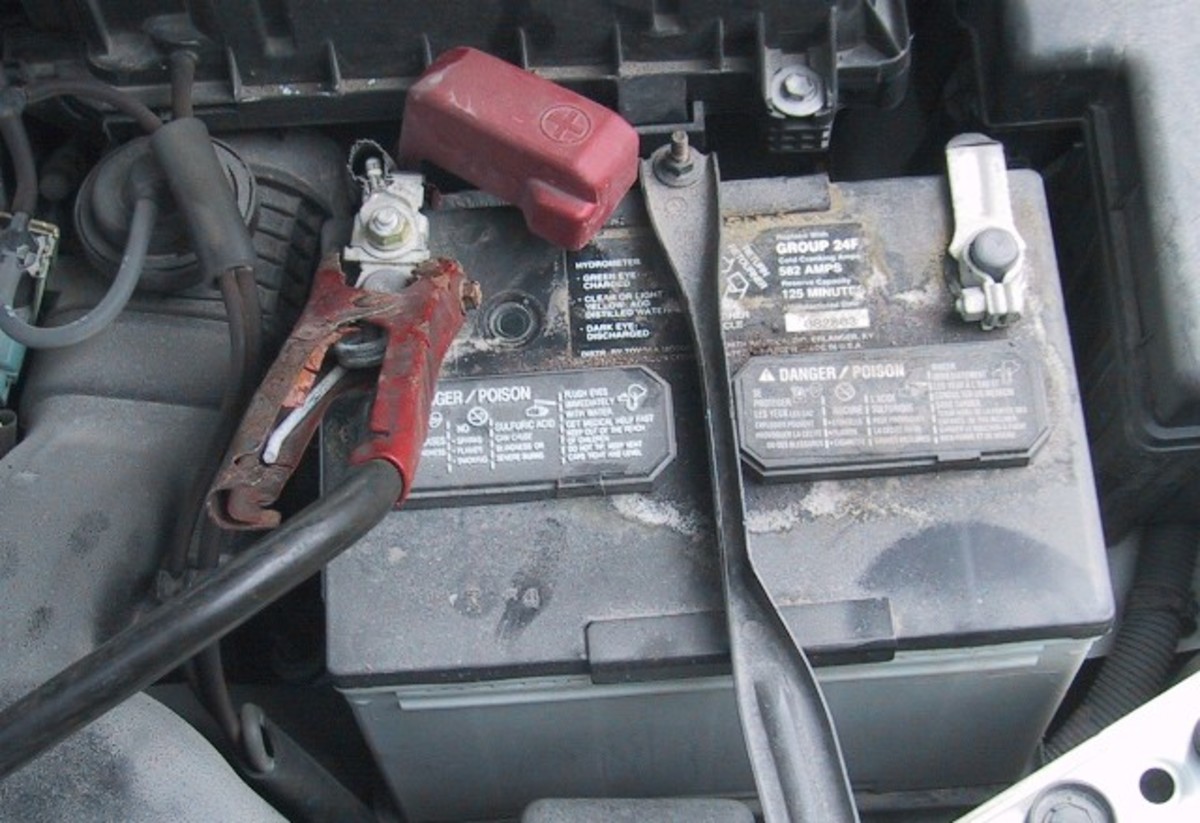
A single bad battery cell can prevent your charging system from working properly.
Photo in the public domain.
III. Charging System Problems and Potential Causes
To speed up your diagnosis and repair, look up the system condition that most resembles your problem and go over the potential causes described under that condition. Some checks or tests may be suggested as appropriate.
1. If the Battery Seems to Stay Undercharged
You have already charged your battery a couple of times and you just found out the battery is undercharged again. Before you blame your battery or the alternator, here are some preliminary checks you may want to do.
a) Check the drive belt or serpentine belt, especially if you haven’t replaced it in the last five years. Make sure the belt has the proper tension. Look for signs of wear or damage like cuts, shiny spots, and missing chunks. Today serpentine belts don’t show signs of wear, even if they need to be replaced. Use a belt wear indicator or check your maintenance schedule for the replacement interval suggested by your car manufacturer. You may find the schedule in your car owner’s manual or your repair manual.
b) Along with the drive belt, check the belt tensioner as well. Make sure it turns freely and is noise-free. Car manufacturers recommend replacing the tensioner at the same time you replace the drive belt.
c) Make sure your battery connections are tight and clean. However, just because the terminals look clean, it doesn’t mean they are tight and in good condition. Look for damage to the cable and the terminal itself that may prevent proper electrical current flow.
d) Check your battery yourself, or take it to your local auto parts store. Many of these stores will test your battery for free.
e) There’s a parasitic battery drain stealing power from your battery.
- A quick test is to connect a test light in series between the positive battery cable and the positive battery post. If the test light comes on, there is an electrical drain in one of the systems.
- First, unplug the alternator electrical connector. If the test light goes out, the alternator is causing the drain. If not, locate the parasitic drain.
f) Don’t overlook the starter motor: a failing starter motor may draw excessive current during operation, draining battery power. If necessary, have your starter motor or starting system tested.
g) If you recently added an electrical accessory to the vehicle, you may have overpassed your alternator’s capacity.
h) There could be an alternator wiring problem.
i) Have the alternator and battery checked.
2. If the System Seems to Be Over-Charging
Besides test results, another potential sign that your battery is being overcharged is that your battery terminals keep accumulating corrosion.
Here are some checks you want to do:
- Make sure that all the connections to the alternator, remote voltage regulator (if applicable) and battery are clean, tight and in good condition.
- Check your battery or have it tested at your local auto parts store. A bad battery cell can cause the alternator to over-charge the good battery cells.
- Check for a bad alternator voltage regulator and circuit. Consult your vehicle repair manual, if necessary.
- Make sure you have good ground connections at the alternator (alternator case) and voltage regulator, especially if your vehicle uses a remote voltage regulator. Grounds should be free of rust, and the alternator and remote voltage regulator mounting bolts should be clean and tight.
- Check the alternator rectifier or have your alternator checked at the auto parts store.
- Also, conduct the tests described in the Troubleshooting for Unusual Charging System Voltage Drops below.
3. If the Alternator Is Not Charging the Battery
When your tests point to an under-charge or no-charging condition:
- Make sure the drive belt is not loose or worn out.
- If necessary, borrow a good battery just to operate the engine and confirm that your drive belt and belt tensioner are operating properly.
- Manually check the belt tensioner for proper operation. Make sure the tensioner pulley turns freely and without noise. Check it for damage.
- Manually turn the alternator pulley and make sure it turns without a problem. If one of the bearings has seized, it won’t allow the alternator to turn freely.
- Check that the connections at the battery, alternator, and remote voltage regulator are clean and tight.
- Check for a blown fuse or fusible link. Consult your vehicle repair manual, if necessary, to locate the alternator fuse or fusible link.
- Do the tests described in the section «Troubleshooting for Unusual Charging System Voltage Drops» below.
4. If the Engine Makes Noises
Noise can be a sign of alternator problems when it comes from the charging system. The next checkpoints will help you isolate the source of the noise.
- Check the drive belt or serpentine belt. Look for signs of wear or damage like cuts, shiny spots or missing chunks under the belt. A worn-out belt can squeal during operation.
- Also, check the belt tensioner for proper operation and damage. It should rotate freely.
- Make sure the alternator is properly mounted. Loose mounting bolts can cause the alternator drive belt and drive pulley to become misaligned and noisy.
- Check the alternator for noises. See the General Charging System Checks section for a simple procedure for this.
5. If Lights Dim During Engine Operation
Most alternators use diodes inside a rectifier to turn Alternating Current (AC) into Direct Current (DC) for use by the system. When one or more diodes go bad, AC can leak into the electrical system. Sometimes you can notice this when the headlights, instrument panel lights, and other interior lights dim during engine operation. To test your alternator for AC current leaks, see the Alternator AC Voltage Leak Check subsection in the previous section.
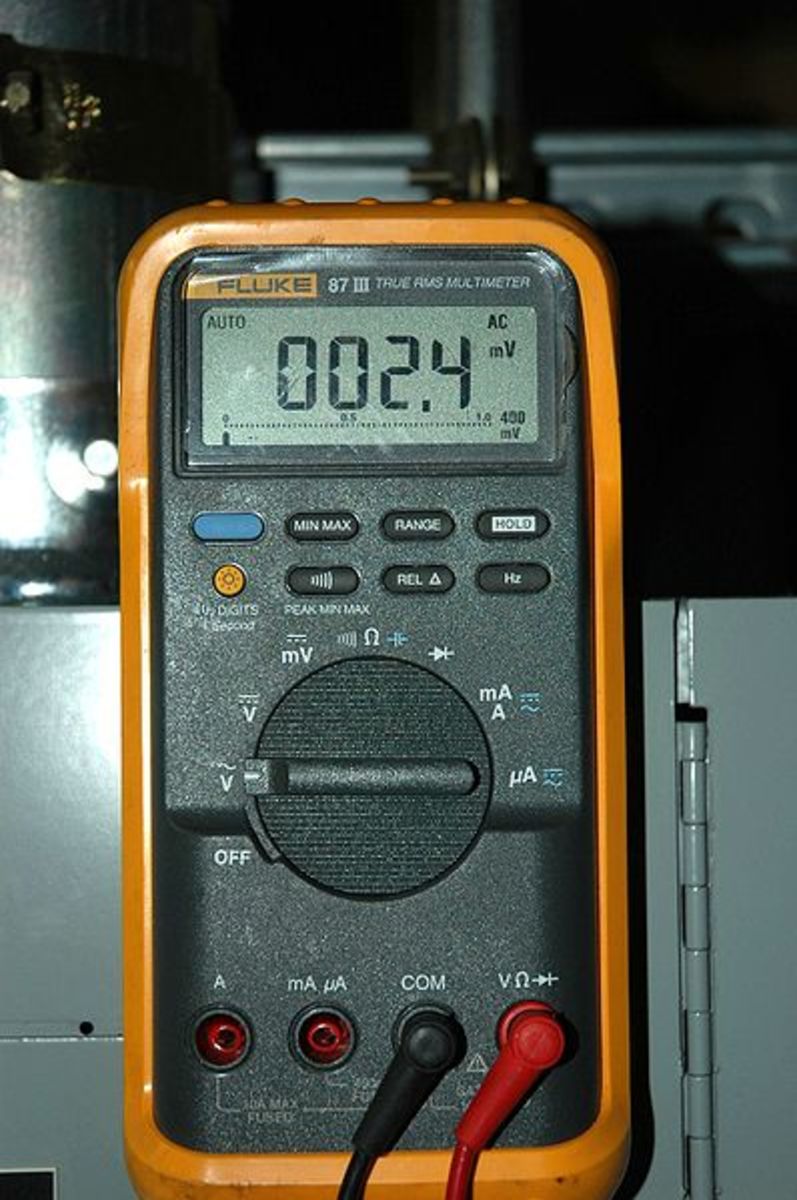
Measure system voltage and drop voltages using a digital multimeter.
Photo courtesy of Steve C on Wikimedia
IV. Troubleshooting for Unusual Charging System Voltage Drops
A charging system voltage drop check can help you locate the source of an under-charge or over-charge condition due to problems in the wiring or connections between the battery and alternator.
1. Start the engine and let it idle. Apply the parking brake and set the transmission to Neutral (manual transmission) or Park (automatic transmission).
2. Turn on the high beams to provide a system load and have an assistant raise engine speed to about 1500 RPM. If your vehicle is equipped with a heated windshield, don’t turn it on; this can make alternator voltage go over 100 V. Since you’ll be working around alternator connections, this could be dangerous.
3. With your voltmeter test leads, touch the positive battery post and the B+ terminal connector at the back of the alternator.
4. Check your meter display. You should get around 0.4V or less of voltage drop. If your voltage drop is higher, it can lead to an under-charge condition. Check the connections in that part of the circuit for a loose wire, corrosion at the connectors or wiring damage that may prevent proper current flow between the battery and alternator. Also, check the electrical connections at the back of the alternator and at the voltage regulator.
5. Now repeat the test, but this time, connect your meter leads between the battery negative post and the alternator case.
6. Check your meter display. Again, you should get a voltage reading of around 0.2V or less. If your voltage drop is higher, there’s something wrong. This can lead to an over-charging condition. Checking that part of the circuit, make sure the battery ground connection is good, clean and tight. Add a temporary ground connection from the battery to the chassis. If this removes the high voltage drop, check the engine to body grounds connections. They should be clean, tight and in good condition.
Watch the next video for a visual reference on voltage drop checks.
A Bad Alternator May Lead To More Problems
Alternator problems are not uncommon after a few years of operation. A typical alternator may last anywhere from 8 to 12 years. So don’t be surprised to find your alternator going bad or the system developing problems after a few years of trouble-free operation, even if you have maintained your car well.
The key point here is to do the proper diagnostic as soon as possible because a bad alternator can ruin an otherwise good battery and other components as well, depending on the fault.
Once you determine that your alternator is bad, you have several options. You can replace it with an original one from your dealer, an aftermarket replacement, or a rebuilt unit. Aftermarket alternators are a good option and less expensive, and many of them are just as good as their OEM counterparts. And rebuilt alternators are not as bad either. So consider your options.
This content is accurate and true to the best of the author’s knowledge and is not meant to substitute for formal and individualized advice from a qualified professional.
Questions & Answers
Question: I have a 2000 Civic EX 2 door coupe. The alternator went bad, and I replaced it along with the battery. The car runs fine. It seems to charge the battery, but then the battery light comes on. I have driven the car, and I haven’t had any problems running the AC, lights or radio. I can unplug the alternator, plug it back, and the light will go out. But as soon as I plug it in, the light comes on again. Doesn’t seem to change the engine running or idle when I unplug the alternator. What could be the problem?
Answer: If there are any DTCs, clear them from the computer memory. Also, check the fusible links. Make sure they are still well connected and good.
Question: I have an issue in the alternator. There are two error codes (0614 & 0580) that pop-up in our cluster am not able to understand why this is coming and what is that meaning of error code?
Answer: Call your local dealer. They should be able to give you a description of the codes.
Question: I installed a new 105-amp alternator in my 1982 Chevrolet C10. When I start the engine, it indicates 14.6 volts on the voltmeter connected to the battery. When I start the AC fan and the AC compressor, the voltage increases to 15.8 volts. After a while, the alternator stops charging; I think it might be defective. I changed two alternators, but I still have the same problem. What do you think?
Answer: Check the voltage regulator and the battery. An auto parts store may check the battery for you. Also, may sure the circuit connections for the charging system are clean and tight and check the engine body grounds.
Question: I have a 2001 Toyota Solara with 158,000 miles. I’ve gone through 5 alternators in about 6 yrs. Even the Toyota oem. Two reliable mechanics can’t figure it out. I’m taking it to a shop that specializes in electrical problems. Do you have any ideas?
Answer: Knowing how the previous alternators failed can give a clue about the type of issue you are dealing with (electrical, mechanical). Usually when alternators failed prematurely is because of a bad battery (electrical), voltage regulator issues, high electric loads (e.g. running AC fan at high) or a drive belt that is putting unusual stress on the alternator pulley (mechanical)(make sure the belt is not too tight). Alternator quality can be another factor of course.
Check for signs of fluid leakage around the alternator that might affect the stator or rotor or both.
Question: Replaced the alternator and serpentine belt. I have no power. What could be the problem?
Answer: Have the battery tested and check the charging circuit as well. Make sure the serpentine belt tensioner is not worn. Usually, you replace both of these items together.
Question: Our engine will take too much time to start. How can I check the alternator?
Answer: The problem might be with the battery, starting system, ignition or fuel system. Check the batter condition, check for spark and fuel pressure.
Question: I have a good alternator, but my battery runs down. It passed tests performed at two auto parts stores. When this problem occurred, I was able to get home by starting the vehicle (2000 GMC Yukon, 5.3L) by disconnecting the battery. Voltage when up close to 14 according to the gauge. When I reconnected the batter at home, it was still dead. Got a new battery and have the same problem with battery drain. Do you have any ideas?
Answer: If you have some power amplifier, or some other power accessories, this could be running down the battery if the alternator can’t keep up with the demand. Other than that, you may want to have the alternator checked in a shop, and see where the charge is going while the engine is running.
You can check for a parasitic drain that you may not be aware of. This post can help you:
https://axleaddict.com/auto-repair/car-batterydrai…
Question: I have a 2004 Taurus, and I’ve changed the battery and alternator but the charging system light is still on. Any ideas why?
Answer: Check the fusible link, you can test it with your multimeter.
Question: I have a 2005 Ford Taurus one day it wouldn’t start. It finally started and flashing lights to check the brake system in the charging system, but then it wouldn’t start once it was jumped. It kept stalling, so we had it checked at an auto parts store. They agreed alternator replaced the alternator and it is still doing the same thing do you have any idea what else could be wrong?
Answer: Check all the grounds — battery to body and body to engine. They should be clean and tight. Bad grounds can eventually, damage the alternator. Test for voltage drop on the grounds, battery and charging system.
Question: I got a 2012 Nissan Xterra. I just installed a new alternator and new battery. It starts up good and idles good now as well, but when I give it full throttle and get close to 3,000 RPMs, my battery light and park brake lights comes on and flashes at me. And the battery volt gauge goes down a whole lot. What could be the problem?
Answer: Check the alternator belt and tensioner. Belt should have the proper pressure. If it’s loose, it won’t charge properly during hard accelerations. Check voltage at the battery when accelerating (at idle and emergency brakes applied). You should get around 13.5 or so. Otherwise, there could be a problem with the voltage regulator. You may need to replace the alternator. If not, check the wires and connections between the battery and alternator.
Question: I had my alternator rebuilt. Now I am having a problem getting it to charge at idle, I get 14.5 volts at 1500 rpm, but as soon as I release the throttle it drops down to battery voltage, I’ve returned the alternator once already. He checked it again, replaced the regulator and said it’s putting out full voltage, but on the car, it’s doing exactly as I mentioned before, no voltage at idle, full voltage when revving the engine. Could this be a PCM issue?
Answer: Check the belt and belt tensioner for the correct tension. Take a look at the connections at the back of the alternator, especially the B+ connector. On early models the indicator light on the dashboard should come on when the ignition key is in the On position, otherwise, you’ll have problems at idle. There could also be a problem in the charging circuit, a loose, corroded or damaged wire can also prevent full voltage at low rpm. Take a look at the grounds and the output wiring to the battery. You may need the diagram for this. These other posts may help:
https://axleaddict.com/auto-repair/Automotive-Volt…
https://axleaddict.com/auto-repair/Charging-System…
Question: Battery tested fine, but alternator voltage would go up and down. Occasionally, a BATTERY SYSTEM FAILURE light will come on. Could it be a sensor/fuse problem since it doesn’t stay on all the time?
Answer: The alternator could be faulty. But you may want to run a voltage drop test on the circuit first. Some models, like GM, have a fusible link in the circuit. Make sure that it’s good. This other post has a voltage drop section that may help:
https://hubpages.com/auto-repair/Charging-System-C…
Question: My voltage is fine when I start the vehicle, but after driving around for about 10-15 minutes, my voltage goes from 14v to 15.5-16v. I have an aftermarket voltage regulator, and a high output 320 amp alternator and my battery dies if I don’t unhook the wire from my battery to the cars fuse box. Do you have any ideas?
Answer: You need to make sure the alternator is suited for your application. These alternators need the right pulley ratio and pulley diameter to work correctly. Also check that it has the right size battery cables hook to the battery.
Question: I have a Toyota Corolla VVTI model 2004, I have changed the alternator but the battery indicator is still present. I have checked the fuses and connections, but the problem continues. What could be the issue?
Answer: Have the battery tested, and check the connections in the charging system. Make sure they’re clean and tight. Also, the check the engine grounds.
Question: I put my OBDll reader on my car and it says my charging system output is high. What does that mean exactly?
Answer: This basically means the alternator is overcharging the battery. Usually the problem here is the voltage regulator. Before replacing the alternator, you can take the alternator to a local auto parts store and have them check it for you. Make sure the alternator is the problem.
Question: What are the most common faults likely to occur in a charging system? More than 6 points at least.
Answer: There can be a problem with the circuit, voltage regulator, ignition switch, corroded battery cables, faulty battery, worn or loose drive belt, bad car computer.
Question: I have a 06 Mustang GT. I replaced the alternator because it was causing a camshaft position sensor code. After replacing it and checking my work, the battery light with a warning «check charging system» comes on. It comes on for a minute or so then goes out for a few minutes. The battery seems to stay around 13.7 volts what could be causing the light to come on randomly? I have not driven it yet.
Answer: Check the circuit connections. This could be a loose or bad wire/connector. You may want to try a voltage drop test. This post gives you an idea of the test:
https://hubpages.com/auto-repair/Automotive-Voltag…
Question: I have a 2003 VW Eurovan. Recently, the ABS light went on, then, after a few minutes the regular red brake light lit and the car stopped. What is going on?
Answer: You need to download the trouble codes. There could be a number of things that triggered the ABS light — problems with the tone ring, wheel bearing, speed sensor (and wiring).
Question: I have a 2014 Nissan Pathfinder. I changed my alternator in July 2018. Alternator stopped working again on 2/6/2019 and replaced it on 2/7/2019. Back in the shop on 2/11/2019 with bad alternator again. This time the alternator is overcharging. The alternators were bought from O’Reilly’s auto parts. Just found out they are rebuilt alternators, and not new. Still, the price was $400 for the part. Could there be something causing the part to go bad so quick or could it just happen to be bad parts?
Answer: Make sure you are using the correct battery for your application. On some newer models using the incorrect battery can affect the alternator, especially those that interact with the ECU. Also, check the belt and pulleys. Make sure the pulleys are correctly aligned, and the alternator is properly mounted without rust accumulation, especially the ground connections, including engine and battery grounds. Also, check the wiring for signs of electrical faults. And yes, some models are very sensitive to using parts other than OEM, but first, make the previous checks.
Question: I have a 1998 Ford Mustang. I’ve changed the battery and the alternator. I’m still losing voltage from the alternator to the battery. It is just running on the battery. What can cause this problem?
Answer: You might want to make a voltage drop test on the charging circuit. There could be a bad connection or wire that is not too evident. This other post will give you an idea on how to go about the test:
https://axleaddict.com/auto-repair/Automotive-Volt…
Question: I replaced the original alternator on my 2015 Kia Forte. The replacement alternator shows that it went bad and that I replaced it with the second one, now it went down. What is the problem? I have also noticed the positive battery post on my battery gets hot. Do you have any idea what it could be?
Answer: There could be too much resistance on that side of the circuit. Check the cable for damage, or a problem at the connectors. If everything seems okay, have your battery tested.
Question: I have a GM 3500 6.0 with an overcharging problem. I ran new wires to the PCM and fuse box for the connector. I have a brand new alternator, PCM, and ACDelco battery. The power wire for the alternator to the battery reads correctly as well. But it is still charging to 15.6-16.0. What could possibly be going wrong with my car’s alternator?
Answer: The problem could be on the ground side of the circuit. Increased resistance (loose, corroded grounds) can cause this type of problem. Of course, you want to make sure you got the right alternator for your application. This other post may help:
https://axleaddict.com/auto-repair/Charging-System…
Also, make sure to watch this other video:
Question: I have a 2012 Town and Country with 110k miles. Last year at around a 100k miles I replaced the alternator due to regulator failure. This year I installed a new battery. The problem is the charging light comes on randomly. I drive around with a voltmeter to run these tests the moment it happens, but everything checks out. Why does the light come on and not go out?
Answer: Check the belt. A worn belt may slip intermittently, affecting the charging system. The problem with newer belts is they look good even if they are worn. Check the belt for tension and wear (use a belt wear gauge), tensioner, pulleys, and grounds, and especially engine grounds.
Question: I have a 2007 Cadillac CTS. I replaced the battery, cranked up and the negative connection got hot. What would cause my Cadillac’s battery to heat up?
Answer: If the negative cable gets too hot just cranking the engine, there’s too much resistance in that part of the circuit. If this happened right after installing the new battery, probably the negative cable is not well connected or is damaged or there’s some corrosion. You can also do a voltage drop test on that part of the circuit. These posts may help:
https://axleaddict.com/auto-repair/How-to-Use-Volt…
https://axleaddict.com/auto-repair/Automotive-Volt…
Question: On my way home, the alternator light came on but made it home fine. The next day, the truck was hard to crank and would only stay running if my foot remained on the gas. The next day, I charged the battery and put it back in. Thought it was fixed but now the battery is dead and won’t recharge. What’s the problem now?
Answer: Have the battery and alternator checked. If the alternator or charging system was faulty, it could’ve damaged the battery. Also checking the charging system voltage drop may help in the diagnosis.
https://axleaddict.com/auto-repair/Charging-System…
Question: What causes voltage to fluctuate?
Answer: There could be several causes behind the issue:
bad alternator, bad voltage regulator, bad connections between the battery and alternator.
First, make sure the connections are clean and tight, and the cables are good. Especially, check the grounds between the engine and body. Then, have the alternator tested in your local auto parts store.
Question: What would cause my alternator to be charging where it supposed to be, then cause it to drop all of the sudden? You can barely tap it and it goes back up.
Answer: Probably you are dealing with an alternator with worn brushes. Tapping the alternator shake the brushes a bit and help them make better contact or the copper wires connected to the brushes are damaged.
Question: I have an 03 Dakota. It needed a new battery, however, the battery gauge goes to 0, and the idiot light comes on after I drive it for a minute. It starts fine and the lights are fine; just that gauge quits working. What causes that?
Answer: Check the alternator, perhaps a bad voltage regulator.
Make sure the drive belt is not loose or the idler bad, causing the belt to slip. If the battery charge is not affected and everything else seems to work just fine, there could be a loose wire or connector in the circuit to the gauge.
Question: I have an 04 Lincoln aviator. I changed the battery, alternator and I am still getting a check charging system message. What do I do next?
Answer: Make sure you actually have a charging problem. Your local auto parts store can check the alternator and battery for you. If there’s a problem, it could be in the circuit. If not, the circuit for the warning light might be the issue.
Question: I have a 1966 Ford Mustang and have swapped out the alternator 3 times. It will work fine at times, then at other times the voltage steadily drops, especially if I turn the lights on. The belt is good, connections are good. The battery is good. Any ideas as to what the problem could be?
Answer: Make sure you have clean and tight connections to the voltage regulator. If necessary, have the regulator checked. it might not be sensing the voltage drop at the alternator when load increases. And the battery doesn’t get the required charge. Hope this helps.
Question: I have a Nissan Wingroad and I had to replace the battery before 18 months of use as it wouldn’t start without jump starting. When the measures were taken, the charging system measures were 13.560 volts on no load and loaded at 13.170. The battery vendor says that this indicates a charging system problem, but my mechanic says that there is no problem with those readings. The battery voltage was 14.09, cranking 10.590. What is the correct position, is there a charging problem or not?
Answer: Check the system specifications in your vehicle repair manual. If you don’t have the manual, your local public library may have a copy in the reference section. It’ll be more curate and you’ll avoid guessing. You can even do these measurements yourself with the manual. I don’t have the manual for the model.
Question: What would cause a new alternator to whine and have the pulley heat up excessively? Starting at ambient air and shooting up to 275+ degrees. But when the battery cables are disconnected while the engine is running, the alternator pulley runs smooth and there is no excessive heat build up. The battery is also brand new.
Answer: This is usually caused by a faulty diode(s), making alternator work extra-hard. Check voltage output; also, check the charge circuit voltage drop:
https://axleaddict.com/auto-repair/Charging-System…
Question: Can the dash charging gauge on a ’67 Pontiac Catalina cause the charging system not to work?
Answer: It might cause problems with the regulator, but I don’t have the schematics with me. If there are charging system issues, also check that the wire and connections going to the starter are all good.
Question: Why does my ’99 Bonneville’s charging system go down to 12 volts only when in drive or while idling?
Answer: Usually, the voltage goes down under load and as the engine warms up. But you might want to check the alternator, battery and charging circuit if it dips below battery voltage. Having the charging system amperage may give you a better diagnostic of the charging system, if necessary.
Question: I have a 2006 Ford Freestyle. Last year, the car didn’t want to start, so I replaced the battery. Five miles down the road, the battery light came on. I took it to the Ford Dealership to check the problem. They replaced the Alternator. A year later, I noticed the lights started to dim, then to fade back up. I took it to an Interstate battery shop to have the battery checked out. The battery was excellent, but the alternator showed low charge. What should I have the mechanics do next?
Answer: Although there is a remote possibility the alternator is failing, this may be a charging circuit (positive side) problem. If you explain to the shop when you replaced the alternator and about the battery and alternator test results, most likely, they’ll take a look into the charging circuit.
Question: Will there be any signs in a Chrysler car battery terminal, if you remove the terminal that there is a problem with the alternator and charging system?
Answer: If the alternator is overcharging, there could be signs of corrosion; but the terminal may be cracked or loose. But you may find problems while the engine is running, but don’t remove any connections while the engine is running. It can affect sensitive electronics. If you are trying to find a fault in the charging circuit connections, it’s better to do a voltage drop test. This will tell you the condition of the connections. These other two posts may help you locate this type of issues with the charging system and engine grounds:
https://axleaddict.com/auto-repair/Automotive-Volt…
https://axleaddict.com/auto-repair/Charging-System…
Question: I have a 1990 Ford F-150 and the alternator stays hot and won’t charge the battery, any suggestions on what is wrong?
Answer: First, make sure the belt is properly installed, not slipping, and accessory pulleys are running OK. Check the charging system wires for loose or corroded connections or damaged wires. This other post may help here:
https://axleaddict.com/auto-repair/Charging-System…
If necessary, have the alternator checked (worn, bad voltage regulator) and battery. Hope this helps.
Question: When my engine is at idle the voltage is around 13V, but when I turn on the headlights and AC, it drops to 11V to 11.8V. What seems to be the problem?
Answer: My guess is the AC pulley may be putting a strain on the crankshaft pulley, affecting alternator output. Or the AC pulley is affecting the belt. Check how the three operate when the AC is on.
Question: I have a 2011 Mazda 3, 2.5. The battery light turned on when I was driving at 120 km/h and would turn off if I slowed down. The light now starts at 90 km/h and will turn off if I slow down (maybe rpm related, not sure). Battery, alternator and start engine were tested at the dealership but seem to be OK. The battery seems to slowly drain within a few weeks as the speed decreases for the battery light to turn on. What could it be?
Answer: This may be an alternator issue with worn brushes, slowly losing the ability to charge the battery. A common test is to replicate engine rpm at which the light comes on. Watch the engine rpm when the battery light comes on. At home, with the transmission in Neutral or Park, increase engine speed to the same rpm and see if the light comes on. If it does, the alternator needs new brushes.
Question: I have a ‘03 Chevy Silverado alternator that whines and displays a check engine code, mainly knock sensor. Occasionally cylinder 7 and 8 are too lean. I suspect a bad ground. Do you know where I can find a visual of where all the grounds are on this truck?
Answer: If you don’t have the repair manual for your specific model, check your local public library. They may have the manual in the reference section. Alternator whining sounds may come bad bearings, bushing or misaligned, worn belt, even a bad diode on some models.
Question: I have a new but cheap alternator. What could be causing such a large fluctuation in voltage?
Answer: The diodes could be leaking or shorted. Have the alternator checked before replacing it.
Question: I have a 2003 VW beetle. I have changed the alternator more than 8 times. I finally got the right one through the VW parts, but it’s still not charging back my battery, and I bought the battery a year and a half ago. I have been charging it and it still holding battery, so it’s driving me crazy as to why is not working. Can you help?
Answer: The problem could be in the circuit. If your particular model has a fuse (check your repair manual) it may be blown. Less likely, but it could happen, a fault in the computer can prevent the alternator from charging the battery.
Question: Bought a remanufactured alternator for my 2004 Civic today. I cannot get the wiring connector to snap back into the receptacle on the alternator. Can you give me some pointers, please?
Answer: Make sure the harness clip or connector is not damaged or broken. If the connector is OK, make sure you have the correct alternator for your particular model.
Question: Just replaced alternator in 2006 Lincoln Mark lt and afternoon driving 2 hrs on the highway the truck faulted out and died at 70 mph. Could noise from the new aftermarket alternator be the cause of the truck dying?
Answer: It’s possible. If the drive belt was too tight, it probably put a lot of stress on the alternator bearing, or the belt tensioner gave out. Take a look under the hood and check the drive belt, tensioner and alternator for signs of failure. If necessary, have the alternator checked. Hope this helps.
Question: 2002 Mitsubishi Magna. Battery 12.43v, drops to 11.98v at idle. 11.95v from alternator. There seems to be no AC leakage. Fuses all good. Wiring seems all good. Voltage to alternator from battery is correct (connector tested). Is the alternator just producing low voltage because the alternator is faulty? I should mention it is absolutely covered in oil from an oil leak; wiring is dirty but working. Could oil inside the alternator be the cause?
Answer: Oil can definitely affect the alternator. If you have fixed the oil leak, check the alternator circuit voltage drop to make sure it is not interfering with current. This other post may help:
https://axleaddict.com/auto-repair/Charging-System…
Question: On my 2003 GT Mustang, when accelerating, my battery light flashes 3 times. I’ve replaced the battery, my belts are tight, and my alternator voltage is reading 14.60 v the first time I checked, and second time it was 13.90 v. Can’t figure out what it is?
Answer: Check the connections. This other post may help:
https://axleaddict.com/auto-repair/Charging-System…
Question: I have a Toyota Corolla 2011. I just changed the alternator and battery a couple of months and the battery light came on again. It’s not charging at all would you say it’s my alternator?
Answer: It could be a faulty alternator or battery. However, the most common problem is in the circuit. Check the voltage drop in the circuit. This other post may help:
https://axleaddict.com/auto-repair/Charging-System…
Also, check engine grounds, if necessary:
https://axleaddict.com/auto-repair/Automotive-Volt…
Question: I’ve got a 1982 Chevy K10 6.2L and I swapped the alternator. It’s charging but it’s charging slowly. It’s running at 12.80 volts constantly. I’m out of ideas?
Answer: Check the connections. A loose, corroded or damaged wire or connection can cause this type of problems:
https://axleaddict.com/auto-repair/Charging-System…
If the alternator was working fine in the other vehicle, have the battery tested if necessary.
Question: I have a Toyota Yaris sedan 2014 connected with an OBD 2 using torque pro to monitor. the other day, I suddenly lost power steering, the dash light came on, followed by the ABS light and the handbrake. After a while, the warning lights went off by its self, power steering was restored. It happened again yesterday. Could this be an alternator issue? My battery is new and 1 week old.
Answer: Check the serpentine belt and the pulleys it runs on. Make sure the belt is not damaged and the pulleys are working as they should. Check the pulleys for alignment as well. It seems the serpentine belt suddenly stopped spinning.
Question: I have a 2004 Chevy truck and the gauge will stay at 14 volts but sometimes it’ll drop down to 12 volts. Is this normal?
Answer: Check for a loose connection, wire or cable between the battery and the alternator. Wiggle the wires and see if the voltage changes. Also have the alternator checked, if necessary.
© 2017 Dan Ferrell
А у меня вообще косяк, если сможете помогите, сейчас опишу как всё есть:
-дня четыре назад завожу машину, стрелка уровня зарядки АКБ очнулась поднялась секунд через 30 с момента заводки
-через два дня больше: завожусь (-12°С на улице) стрелка не поднимается и не в какую, минут 5 торчал заведённым, никуда не поехал
-через день с заряженым АКБ завожу машину, нифига стрелка на панели падает на ноль уровня зарядки, проверяю тестером АКБ показывает 12 вольт, по стрелке на приборе вольт 9. Фигня дальше круче: на генераторе замыкаю толстый и тонкий провода подводящие на долю секунды и тут Питер Пен на панеле приборов переводит стрелку на обычный (нормальный) уровень заряда 13-14 вольт. Всё круто, как я подумал. Выключаю, но ключ не вынимаю, стрелка бежит НА МАКСИМУМ!!! заряда, на тесторе 12 вольт. Ещё раз повторил,заряд есть и стрелка бежит на максимум. Вынул ключ, закрыл машину, подождал 2 минуты, что б электроника в спящий режим ушла. Завожу-оба всё круто! пашет, стрелка зарядки правда показывать стала чуть больше середины, это странно, но глушишь уровеньпоказывает нормальный стрелка не на максимуме. И тут чё то мне приспичило дать газу (в машине есть такая вещь-когда обороты двигателя доводишь до максимума, то на 3500 гдето — у меня дизель, АКБ перестаёт заряжаться, а включается зарядка на 2900 гдето, вроде это якобы защита) так вот на 3500 выключается зарядка и стрелка уровня заряда на ноль (9 В) на тесторе почти 11,5 В, но когда обороты падают зарядка не включается :shok: . Я не верю в волшебство, скажите что накрылось.
Счётки и генератор чистил где то 1000км назад, там у меня косяк был муфту обгонную заклинуло и резьбу слизало :shok: ну сам виноват, но всё почистил и собрал красиво.
Что это ? — блок , табетка и в панели стрелка зарядки помехи даёт?
Предложение съездить на диагностику я уже слышал :), но я не ищу лёгких путей