Тестирование, основанное на ошибках
Цель тестирования,
основанного на ошибках, — проектирование
тестов, ориентированных на обнаружение
предполагаемых ошибок [46]. Разработчик
выдвигает гипотезу о предполагаемых
ошибках. Для проверки его предположений
разрабатываются тестовые варианты.
В качестве примера
рассмотрим булево выражение
if
(X
and
not Y
or
Z).
Инженер по
тестированию строит гипотезу о
предполагаемых ошибках выражения:
-
операция
not
сдвинулась влево от нужного места (она
должна применяться к Z); -
вместо
and
должно быть or; -
вокруг
not
Y
or
Z
должны быть круглые скобки.
Для каждой
предполагаемой ошибки проектируются
тестовые варианты, которые заставляют
некорректное выражение отказать.
Обсудим
первую предполагаемую ошибку. Значения
(X
=
false,
Y
= false,
Z
= false)
устанавливают указанное выражение в
false.
Если вместо not
Y
должно быть not
Z,
то
выражение принимает неправильное
значение, которое приводит к неправильному
ветвлению. Аналогичные рассуждения
применяются к генерации тестов по двум
другим ошибкам.
Эффективность
этой методики зависит от того, насколько
правильно инженер выделяет предполагаемую
ошибку. Если действительные ошибки
объектно-ориентированной системы не
воспринимаются как предполагаемые, то
этот подход не лучше стохастического
тестирования. Если же визуальные модели
анализа и проектирования обеспечивают
понимание ошибочных действий, то
тестирование, основанное на ошибках,
поможет найти подавляющее большинство
ошибок при малых затратах.
При тестировании
интеграции предполагаемые ошибки ищутся
в пересылаемых сообщениях. В этом случае
рассматривают три типа ошибок: неожиданный
результат, вызов не той операции,
некорректный вызов. Для определения
предполагаемых ошибок (при вызове
операций) нужно исследовать процесс
выполнения операции.
Тестирование
интеграции применяется как к свойствам,
так и к операциям. Поведение объекта
определяется значениями, которые
получают его свойства. Поэтому проверка
значений свойств обеспечивает проверку
правильности поведения.
При тестировании
интеграции ищутся ошибки в объектах-клиентах,
запрашивающих услуги, а не в
объектах-серверах, предоставляющих эти
услуги. Тестирование интеграции
определяет ошибки в вызывающем коде, а
не в вызываемом коде. Вызов операции
используют как средство, обеспечивающее
тестирование вызывающего кода.
Тестирование, основанное на сценариях
Тестирование,
основанное на ошибках, оставляет в
стороне два важных типа ошибок:
-
некорректные
спецификации; -
взаимодействия
между подсистемами.
Ошибка из-за
неправильной спецификации означает,
что продукт не выполняет то, чего хочет
заказчик. Он делает что-то неправильно,
или в нем пропущена важная функциональная
возможность. В любом случае страдает
качество — соответствие требованиям
заказчика.
Ошибки, связанные
с взаимодействием подсистем, происходят,
когда поведение одной подсистемы создает
предпосылки для отказа другой подсистемы.
Тестирование,
основанное на сценариях, ориентировано
на действия пользователя, а не на действия
программной системы [47]. Это означает
фиксацию задач, которые выполняет
пользователь, а затем применение их в
качестве тестовых вариантов. Задачи
пользователя фиксируются с помощью
элементов Use
Case.
Сценарии
элементов Use
Case
обнаруживают ошибки взаимодействия,
каждая из которых может быть следствием
многих причин. Поэтому соответствующие
тестовые варианты более сложны и лучше
отражают реальные проблемы, чем тесты,
основанные на ошибках. С помощью одного
теста, основанного на сценарии, проверяется
множество подсистем.
Рассмотрим,
например, проектирование тестов,
основанных на сценариях, для текстового
редактора.
Рабочие
сценарии опишем в
виде
спецификаций элементов Use
Case.
Элемент
Use
Case:
Исправлять черновик.
Предпосылки:
обычно
печатают черновик, читают его и
обнаруживают ошибки, которые не видны
на экране. Данный элемент Use
Case
описывает события, которые при этом
происходят.
1. Печатать весь
документ.
2. Прочитать
документ, изменить определенные страницы.
3. После внесения
изменения страница перепечатывается.
4. Иногда
перепечатываются несколько страниц.
Этот сценарий
определяет как требования тестов, так
и требования пользователя. Требования
пользователя очевидны, ему нужны:
-
метод для печати
отдельной страницы; -
метод для печати
диапазона страниц.
В ходе тестирования
проверяется редакция текста как до
печати, так и после печати. Разработчик
теста может надеяться обнаружить, что
функция печати вызывает ошибки в функции
редактирования. Это будет означать, что
в действительности две программные
функции зависят друг от друга.
Элемент
Use
Case:
Печатать новую копию.
Предпосылки:
кто-то
просит пользователя напечатать копию
документа.
1. Открыть документ.
2. Напечатать
документ.
3. Закрыть документ.
И в этом случае
подход к тестированию почти очевиден.
За исключением того, что не определено,
откуда появился документ. Он был создан
в ранней задаче. Означает ли это, что
только эта задача влияет на сценарий?
Во многих современных
редакторах запоминаются данные о
последней печати документа. По умолчанию
эту печать можно повторить. После
сценария Исправлять черновик достаточно
выбрать в меню Печать, а затем нажать
кнопку Печать в диалоговом окне — в
результате повторяется печать последней
исправленной страницы. Таким образом,
откорректированный сценарий примет
вид:
Элемент
Use
Case:
Печатать новую копию.
-
Открыть документ.
-
Выбрать в меню
пункт Печать. -
Проверить, что
печаталось, и если печатался диапазон
страниц, то выбрать опцию Печатать
целый документ. -
Нажать кнопку
Печать. -
Закрыть документ.
Этот
сценарий указывает возможную ошибку
спецификации: редактор не делает того,
что пользователь ожидает от него.
Заказчики часто забывают о проверке,
предусмотренной шагом 3. Они раздражаются,
когда рысью бегут к принтеру и находят
одну страницу вместо ожидаемых 100
страниц. Раздраженные заказчики считают,
что в спецификации допущена ошибка.
Разработчик может
опустить эту зависимость в тестовом
варианте, но, вероятно, проблема
обнаружится в ходе тестирования. И тогда
разработчик будет выкрикивать: «Я
предполагал, я предполагал это учесть!!!».
Соседние файлы в предмете [НЕСОРТИРОВАННОЕ]
- #
- #
- #
- #
- #
- #
- #
- #
- #
- #
- #
Орлов С.А. Технология разработки программного обеспечения — файл n1.doc
приобрести
Орлов С.А. Технология разработки программного обеспечения
скачать (1886.8 kb.)
Доступные файлы (1):
n1.doc
Необходимость и важность тестирования ПО трудно переоценить. Вместе с тем следует отметить, что тестирование является сложной и трудоемкой деятельностью. Об этом свидетельствует содержание глав 6, 7 и 8 глав, в которых описывались классические основы тестирования, разработанные в расчете (в основном) на процедурное ПО. В этой главе рассматриваются вопросы объектно-ориентированного тестирования [17], [18], [42], [50], [51]. Существует мнение, что объектно-ориентированное тестирование мало чем отличается от процедурно-ориентированного тестирования. Конечно, многие понятия, подходы и способы тестирования у них общие, но в целом это мнение ошибочно. Напротив, особенности объектно-ориентированных систем должны вносить и вносят существенные изменения как в последовательность этапов, так и в содержание этапов тестирования. Сгруппируем эти изменения по трем направлениям:
- расширение области применения тестирования;
- изменение методики тестирования;
- учет особенностей объектно-ориентированного ПО при проектировании тестовых вариантов.
Обсудим каждое из выделенных направлений отдельно.
Расширение области применения объектно-ориентированного тестирования
Разработка объектно-ориентированного ПО начинается с создания визуальных моделей, отражающих статические и динамические характеристики будущей системы. Вначале эти модели фиксируют исходные требования заказчика, затем формализуют реализацию этих требований путем выделения объектов, которые взаимодействуют друг с другом посредством передачи сообщений. Исследование моделей взаимодействия приводит к построению моделей классов и их отношений, составляющих основу логического представления системы. При переходе к физическому представлению строятся модели компоновки и размещения системы.
На конструирование моделей приходится большая часть затрат объектно-ориентированного процесса разработки. Если к этому добавить, что цена устранения ошибки стремительно растет с каждой итерацией разработки, то совершенно логично требование тестировать объектно-ориентированные модели анализа и проектирования.
Критерии тестирования моделей: правильность, полнота, согласованность [18], [51].
О синтаксической правильности судят по правильности использования языка моделирования (например, UML). О семантической правильности судят по соответствию модели реальным проблемам. Для определения того, отражает ли модель реальный мир, она оценивается экспертами, имеющими знания и опыт в конкретной проблемной области. Эксперты анализируют содержание классов, наследование классов, выявляя пропуски и неоднозначности. Проверяется соответствие отношений классов реалиям физического мира.
О согласованности судят путем рассмотрения противоречий между элементами в модели. Несогласованная модель имеет в одной части представления, которые противоречат представлениям в других частях модели.
Для оценки согласованности нужно исследовать каждый класс и его взаимодействия с другими классами. Для упрощения такого исследования удобно использовать модель Класс— Обязанность— Сотрудничество CRC (Class— Responsibility — Collaboration). Основной элемент этой модели — CRC-карта [9], [76]. Кстати, CRC-карты — любимый инструмент проектирования в ХР-процессах.
По сути, CRC-карта — это расчерченная карточка размером 6 на 10 сантиметров. Она помогает установить задачи класса и выявить его окружение (классы-собеседники). Для каждого класса создается отдельная карта.
В каждой CRC-карте указывается имя класса, его обязанности (операции) и его сотрудничества (другие классы, в которые он посылает сообщения и от которых он зависит при выполнении своих обязанностей). Сотрудничества подразумевают наличие ассоциаций и зависимостей между классами. Они фиксируются в других моделях — диаграмме сотрудничества (последовательности) объектов и диаграмме классов.
CRC-карта намеренно сделана простой, даже ее ограниченный размер имеет определенный смысл: если список обязанностей и сотрудников не помещается на карте, то, наверное, данный класс надо разделить на несколько классов.
Для оценки модели (диаграммы) классов на основе CRC-карт рекомендуются следующие шаги [50].
- Выполняется перекрестный просмотр CRC-карты и диаграммы сотрудничества (последовательности) объектов. Цель — проверить наличие сотрудников, согласованность информации в обеих моделях.
- Исследуются обязанности CRC-карты. Цель — определить, предусмотрена ли в карте сотрудника обязанность, которая делегируется ему из данной карты. Например, в табл. 16.1 показана CRC-карта Банкомат. Для этой карты выясняем, выполняется ли обязанность Читать карту клиента, которая требует использования сотрудника Карта клиента. Это означает, что класс Карта клиента должен иметь операцию, которая позволяет ему быть прочитанным.
Таблица 16.1. CRC-карта Банкомат
| Имя класса: Банкомат
Обязанности: |
Сотрудники: |
| Читать карту клиента
Идентификация клиента Проверка счета Выдача денег Выдача квитанции Захват карты |
Карта клиента
База данных клиентов База данных счетов Блок денег Блок квитанций Блок карт |
- Организуется проход по каждому соединению CRC-карты. Проверяется корректность запросов, выполняемых через соединения. Такая проверка гарантирует, что каждый сотрудник, предоставляющий услугу, получает обоснованный запрос. Например, если произошла ошибка и класс База данных клиентов получает от класса Банкомат запрос на Состояние счета, он не сможет его выполнить — ведь База данных клиентов не знает состояния их счетов.
- Определяется, требуются ли другие классы, или правильно ли распределены обязанности по классам. Для этого используют проходы по соединениям, исследованные на шаге 3.
- Определяется, нужно ли объединять часто запрашиваемые обязанности. Например, в любой ситуации используют пару обязанностей — Читать карту клиента и Идентификация клиента. Их можно объединить в новую обязанность Проверка клиента, которая подразумевает как чтение его карты, так и идентификацию клиента.
- Шаги 1-5 применяются итеративно, к каждому классу и на каждом шаге эволюции объектно-ориентированной модели.
Изменение методики при объектно-ориентированном тестировании
В классической методике тестирования действия начинаются с тестирования элементов, а заканчиваются тестированием системы. Вначале тестируют модули, затем тестируют интеграцию модулей, проверяют правильность реализации требований, после чего тестируют взаимодействие всех блоков компьютерной системы.
Особенности тестирования объектно-ориентированных «модулей»
При рассмотрении объектно-ориентированного ПО меняется понятие модуля. Наименьшим тестируемым элементом теперь является класс (объект). Класс содержит несколько операций и свойств. Поэтому сильно изменяется содержание тестирования модулей.
В данном случае нельзя тестировать отдельную операцию изолированно, как это принято в стандартном подходе к тестированию модулей. Любую операцию приходится рассматривать как часть класса.
Например, представим иерархию классов, в которой операция ОР() определена для суперкласса и наследуется несколькими подклассами. Каждый подкласс использует операцию ОР(), но она применяется в контексте его приватных свойств и операций. Этот контекст меняется, поэтому операцию ОР() надо тестировать в контексте каждого подкласса. Таким образом, изолированное тестирование операции ОР(), являющееся традиционным подходом в тестировании модулей, не имеет смысла в объектно-ориентированной среде.
Выводы:
- тестированию модулей традиционного ПО соответствует тестирование классов объектно-ориентированного ПО;
- тестирование традиционных модулей ориентировано на поток управления внутри модуля и поток данных через интерфейс модуля;
- тестирование классов ориентировано на операции, инкапсулированные в классе, и состояния в пространстве поведения класса.
Тестирование объектно-ориентированной интеграции
Объектно-ориентированное ПО не имеет иерархической управляющей структуры, поэтому здесь неприменимы методики как восходящей, так и нисходящей интеграции. Мало того, классический прием интеграции (добавление по одной операции в класс) зачастую неосуществим.
Р. Байндер предлагает две методики интеграции объектно-ориентированных систем [16]:
- тестирование, основанное на потоках;
- тестирование, основанное на использовании.
В первой методике объектом интеграции является набор классов, обслуживающий единичный ввод данных в систему. Иными словами, средства обслуживания каждого потока интегрируются и тестируются отдельно. Для проверки отсутствия побочных эффектов применяют регрессионное тестирование. По второй методике вначале интегрируются и тестируются независимые классы. Далее работают с первым слоем зависимых классов (которые используют независимые классы), со вторым слоем и т. д. В отличие от стандартной интеграции, везде, где возможно, избегают драйверов и заглушек.
Д. МакГрегор считает, что одним из шагов объектно-ориентированного тестирования интеграции должно быть кластерное тестирование [50]. Кластер сотрудничающих классов определяется исследованием CRC-модели или диаграммы сотрудничества объектов. Тестовые варианты для кластера ориентированы на обнаружение ошибок сотрудничества.
Объектно-ориентированное тестирование правильности
При проверке правильности исчезают подробности отношений классов. Как и традиционное подтверждение правильности, подтверждение правильности объектно-ориентированного ПО ориентировано на видимые действия пользователя и распознаваемые пользователем выводы из системы.
Для упрощения разработки тестов используются элементы Use Case, являющиеся частью модели требований. Каждый элемент Use Case задает сценарий, который позволяет обнаруживать ошибки во взаимодействии пользователя с системой.
Для подтверждения правильности может проводиться обычное тестирование «черного ящика».
Полезную для формирования тестов правильности информацию содержат диаграммы взаимодействия, диаграммы деятельности, а также диаграммы схем состояний.
Проектирование объектно-ориентированных тестовых вариантов
Традиционные тестовые варианты ориентированы на проверку последовательности: ввод исходных данных — обработка — вывод результатов — или на проверку внутренней управляющей (информационной) структуры отдельных модулей. Объектно-ориентированные тестовые варианты проверяют состояния классов. Получение информации о состоянии затрудняют такие объектно-ориентированные характеристики, как инкапсуляция, полиморфизм и наследование.
Инкапсуляция
Информацию о состоянии класса можно получить только с помощью встроенных в него операций, которые возвращают значения свойств класса.
Полиморфизм
При вызове полиморфной операции трудно определить, какая реализация будет проверяться. Пусть нужно проверить вызов функции
y=functionA(x).
В стандартном ПО достаточно рассмотреть одну реализацию поведения, которая обеспечивает вычисление функции. В объектно-ориентированном ПО придется рассматривать поведение реализации Базовый_класс :: functionA(х), Производный_клacc :: functionA(x), Наследиик_Производного_класса :: functionA(х). Здесь двойным двоеточием от имени операции отделяется имя класса, в котором размещена операция (это обозначение UML). Таким образом, в объектно-ориентированном контексте каждый раз при вызове functionA(x) следует рассматривать набор различных поведений. Конечно, подход к тестированию базовых и производных классов в основном одинаков. Разница состоит только в учете используемых системных ресурсов.
Наследование
Наследование также может усложнить проектирование тестовых вариантов. Пусть Родительский_класс содержит операции унаследована() и переопределена(). Дочерний_класс переопределяет операцию переопределена() по-своему. Очевидно, что реализация Дочерний_класс::переопределена() должна повторно тестироваться, ведь ее содержание изменилось. Но надо ли повторно тестировать операцию Дочерний_класс::унаследована()?
Рассмотрим следующий случай. Положим, что операция Дочерний_класс::унаследована() вызывает операцию переопределен(). К чему это приводит? Поскольку реализация операции переопределен() изменена, операция Дочерний_класс::унаследована() может не соответствовать этой новой реализации. Поэтому нужны новые тесты, хотя содержание операции унаследована() не изменено.
Важно отметить, что для операции Дочерний_класс::унаследована() может проводиться только подмножество тестов. Если часть операции унаследована() не зависит от операции переопределен(), то есть нет ее вызова или вызова любого кода, который косвенно ее вызывает, то ее не надо повторно тестировать в дочернем классе.
Родительский_класс::переопределена() и Дочерний_класс::переопределена() —это две разные операции с различными спецификациями и реализациями. Каждая из них проверяется самостоятельным набором тестов. Эти тесты нацелены на вероятные ошибки: ошибки интеграции, ошибки условий, граничные ошибки и т. д. Однако сами операции, как правило, похожи. Наборы их тестов будут перекрываться. Чем лучше качество объектно-ориентированного проектирования, тем больше перекрытие. Таким образом, новые тесты надо формировать только для тех требований к операции Дочерний_класс::переопределена(), которые не покрываются тестами для операции Родительский_класс::переопределена().
Выводы:
- тесты для операции Родительский_класс::переопределена() частично применимы к операции Дочерний_класс::переопределена();
- входные данные тестов подходят к операциям обоих классов;
- ожидаемые результаты для операции Родительского_класса отличаются от ожидаемых результатов для операции Дочернего_класса.
К операциям класса применимы классические способы тестирования «белого ящика», которые гарантируют проверку каждого оператора и их управляющих связей. При большом количестве операций от тестирования по принципу «белого ящика» приходится отказываться. Меньших затрат потребует тестирование на уровне классов.
Способы тестирования «черного ящика» также применимы к объектно-ориентированным системам. Полезную входную информацию для тестирования «черного ящика» и тестирования состояний обеспечивают элементы Use Case.
Тестирование, основанное на ошибках
Цель тестирования, основанного на ошибках, — проектирование тестов, ориентированных на обнаружение предполагаемых ошибок [46]. Разработчик выдвигает гипотезу о предполагаемых ошибках. Для проверки его предположений разрабатываются тестовые варианты.
В качестве примера рассмотрим булево выражение
if (X and not Y or Z).
Инженер по тестированию строит гипотезу о предполагаемых ошибках выражения:
- операция not сдвинулась влево от нужного места (она должна применяться к Z);
- вместо and должно быть or;
- вокруг not Y or Z должны быть круглые скобки.
Для каждой предполагаемой ошибки проектируются тестовые варианты, которые заставляют некорректное выражение отказать.
Обсудим первую предполагаемую ошибку. Значения (X = false, Y = false, Z = false) устанавливают указанное выражение в false. Если вместо not Y должно быть not Z, то выражение принимает неправильное значение, которое приводит к неправильному ветвлению. Аналогичные рассуждения применяются к генерации тестов по двум другим ошибкам.
Эффективность этой методики зависит от того, насколько правильно инженер выделяет предполагаемую ошибку. Если действительные ошибки объектно-ориентированной системы не воспринимаются как предполагаемые, то этот подход не лучше стохастического тестирования. Если же визуальные модели анализа и проектирования обеспечивают понимание ошибочных действий, то тестирование, основанное на ошибках, поможет найти подавляющее большинство ошибок при малых затратах.
При тестировании интеграции предполагаемые ошибки ищутся в пересылаемых сообщениях. В этом случае рассматривают три типа ошибок: неожиданный результат, вызов не той операции, некорректный вызов. Для определения предполагаемых ошибок (при вызове операций) нужно исследовать процесс выполнения операции.
Тестирование интеграции применяется как к свойствам, так и к операциям. Поведение объекта определяется значениями, которые получают его свойства. Поэтому проверка значений свойств обеспечивает проверку правильности поведения.
При тестировании интеграции ищутся ошибки в объектах-клиентах, запрашивающих услуги, а не в объектах-серверах, предоставляющих эти услуги. Тестирование интеграции определяет ошибки в вызывающем коде, а не в вызываемом коде. Вызов операции используют как средство, обеспечивающее тестирование вызывающего кода.
Тестирование, основанное на сценариях
Тестирование, основанное на ошибках, оставляет в стороне два важных типа ошибок:
- некорректные спецификации;
- взаимодействия между подсистемами.
Ошибка из-за неправильной спецификации означает, что продукт не выполняет то, чего хочет заказчик. Он делает что-то неправильно, или в нем пропущена важная функциональная возможность. В любом случае страдает качество — соответствие требованиям заказчика.
Ошибки, связанные с взаимодействием подсистем, происходят, когда поведение одной подсистемы создает предпосылки для отказа другой подсистемы.
Тестирование, основанное на сценариях, ориентировано на действия пользователя, а не на действия программной системы [47]. Это означает фиксацию задач, которые выполняет пользователь, а затем применение их в качестве тестовых вариантов. Задачи пользователя фиксируются с помощью элементов Use Case.
Сценарии элементов Use Case обнаруживают ошибки взаимодействия, каждая из которых может быть следствием многих причин. Поэтому соответствующие тестовые варианты более сложны и лучше отражают реальные проблемы, чем тесты, основанные на ошибках. С помощью одного теста, основанного на сценарии, проверяется множество подсистем.
Рассмотрим, например, проектирование тестов, основанных на сценариях, для текстового редактора.
Рабочие сценарии опишем в виде спецификаций элементов Use Case.
Элемент Use Case: Исправлять черновик.
Предпосылки: обычно печатают черновик, читают его и обнаруживают ошибки, которые не видны на экране. Данный элемент Use Case описывает события, которые при этом происходят.
1. Печатать весь документ.
2. Прочитать документ, изменить определенные страницы.
3. После внесения изменения страница перепечатывается.
4. Иногда перепечатываются несколько страниц.
Этот сценарий определяет как требования тестов, так и требования пользователя. Требования пользователя очевидны, ему нужны:
- метод для печати отдельной страницы;
- метод для печати диапазона страниц.
В ходе тестирования проверяется редакция текста как до печати, так и после печати. Разработчик теста может надеяться обнаружить, что функция печати вызывает ошибки в функции редактирования. Это будет означать, что в действительности две программные функции зависят друг от друга.
Элемент Use Case: Печатать новую копию.
Предпосылки: кто-то просит пользователя напечатать копию документа.
1. Открыть документ.
2. Напечатать документ.
3. Закрыть документ.
И в этом случае подход к тестированию почти очевиден. За исключением того, что не определено, откуда появился документ. Он был создан в ранней задаче. Означает ли это, что только эта задача влияет на сценарий?
Во многих современных редакторах запоминаются данные о последней печати документа. По умолчанию эту печать можно повторить. После сценария Исправлять черновик достаточно выбрать в меню Печать, а затем нажать кнопку Печать в диалоговом окне — в результате повторяется печать последней исправленной страницы. Таким образом, откорректированный сценарий примет вид:
Элемент Use Case: Печатать новую копию.
- Открыть документ.
- Выбрать в меню пункт Печать.
- Проверить, что печаталось, и если печатался диапазон страниц, то выбрать опцию Печатать целый документ.
- Нажать кнопку Печать.
- Закрыть документ.
Этот сценарий указывает возможную ошибку спецификации: редактор не делает того, что пользователь ожидает от него. Заказчики часто забывают о проверке, предусмотренной шагом 3. Они раздражаются, когда рысью бегут к принтеру и находят одну страницу вместо ожидаемых 100 страниц. Раздраженные заказчики считают, что в спецификации допущена ошибка.
Разработчик может опустить эту зависимость в тестовом варианте, но, вероятно, проблема обнаружится в ходе тестирования. И тогда разработчик будет выкрикивать: «Я предполагал, я предполагал это учесть!!!».
Тестирование поверхностной и глубинной структуры
Поверхностная структура — это видимая извне структура объектно-ориентированной системы. Она отражает взгляд пользователя, который видит не функции, а объекты для обработки. Тестирование поверхностной структуры основывается на задачах пользователя. Главное — выяснить задачи пользователя. Для разработчика это нетривиальная проблема, поскольку требует отказа от своей точки зрения.
Глубинная структура отражает внутренние технические подробности объектно-ориентированной системы (на уровне проектных моделей и программного текста). Тесты глубинной структуры исследуют зависимости, поведение и механизмы взаимодействия, которые создаются в ходе проектирования подсистем и объектов.
В качестве базиса для тестирования глубинной структуры используются модели анализа и проектирования. Например, разработчик исследует диаграмму взаимодействия (невидимую извне) и спрашивает: «Проверяет ли тест сотрудничество, отмеченное на диаграмме?»
Диаграммы классов обеспечивают понимание структуры наследования, которая используется в тестах, основанных на ошибках. Рассмотрим операцию ОБРАБОТАТЬ (Ссылка_на_РодительскийКласс). Что произойдет, если в вызове этой операции указать ссылку на дочерний класс? Есть ли различия в поведении, которые должны отражаться в операции ОБРАБОТАТЬ? Эти вопросы инициируют создание конкретных тестов.
Способы тестирования содержания класса
Описываемые ниже способы ориентированы на отдельный класс и операции, которые инкапсулированы классом.
Стохастическое тестирование класса
При стохастическом тестировании исходные данные для тестовых вариантов генерируются случайным образом. Обсудим методику, предложенную С. Кирани и В.Тсай[43].
Рассмотрим класс Счет, который имеет следующие операции: Открыть, Установить, Положить, Снять, Остаток, Итог, ОграничитьКредит, Закрыть.
Каждая из этих операций применяется при определенных ограничениях:
- счет должен быть открыт перед применением других операций;
- счет должен быть закрыт после завершения всех операций.
Даже с этими ограничениями существует множество допустимых перестановок операций. Минимальная работа экземпляра Счета включает следующую последовательность операций:
Открыть ► Установить ► Положить ► Снять ► Закрыть.
Здесь стрелка обозначает операцию следования. Иначе говоря, здесь записано, что экземпляр Счета сначала выполняет операцию открытия, затем установки и т. д. Эта последовательность является минимальным тестовым вариантом для Счета. Впрочем, в эту последовательность можно встроить группировку, обеспечивающую создание других вариантов поведения:
Открыть ► Установить ► Положить ► [Остаток●Снять●Итог●ОграничитьКредит●Положить]n ► Снять ► Закрыть.
Здесь приняты дополнительные обозначения: точка означает операцию И/ИЛИ, пара квадратных скобок — группировку, а показатель степени — количество повторений группировки.
Набор различных последовательностей может генерироваться случайным образом:
Тестовый вариант N:
Открыть ► Установить ► Положить ► Остаток ► Снять ►Итог ► Снять ► Закрыть.
Тестовый вариант М:
Открыть ► Установить ► Положить ► Итог ► ОграничитьКредит ► Снять ► Остаток ► Снять ► Закрыть.
Эти и другие тесты случайных последовательностей проводятся для проверки различных вариантов жизни объектов.
Тестирование разбиений на уровне классов
Тестирование разбиений уменьшает количество тестовых вариантов, требуемых для проверки классов (тем же способом, что и разбиение по эквивалентности для стандартного ПО). Области ввода и вывода разбивают на категории, а тестовые Варианты разрабатываются для проверки каждой категории.
Обычно используют одну из трех категории разбиения [43]. Категории образуются операциями класса.
Первый способ — разбиение на категории по состояниям. Основывается на способности операций изменять состояние класса. Обратимся к классу Счет. Операции Снять, Положить изменяют его состояние и образуют первую категорию. Операции Остаток, Итог, ОграничитьКредит не меняют состояние Счета и образуют вторую категорию. Проектируемые тесты отдельно проверяют операции, которые изменяют состояние, а также те операции, которые не изменяют состояние. Таким образом, для нашего примера:
Тестовый вариант 1:
Открыть ►Установить ►Положить ►Положить ►Снять ►Снять ►Закрыть.
Тестовый вариант 2:
Открыть ►Установить ►Положить ►Остаток ►Итог ►ОграничитьКредит ►Снять ►Закрыть.
ТВ1 изменяет состояние объекта, в то время как ТВ2 проверяет операции, которые не меняют состояние. Правда, в ТВ2 пришлось включить операции минимальной тестовой последовательности, поэтому для нейтрализации влияния операций Снять и Положить их аргументы должны иметь одинаковые значения.
Второй способ —разбиение на категории по свойствам. Основывается на свойствах, которые используются операциями. В классе Счет для определения разбиений можно использовать свойства остаток и ограничение кредита. Например, на основе свойства ограничение кредита операции подразделяются на три категории:
1) операции, которые используют ограничение кредита;
2) операции, которые изменяют ограничение кредита;
3) операции, которые не используют и не изменяют ограничение кредита.
Для каждой категории создается тестовая последовательность.
Третий способ — разбиение на категории по функциональности. Основывается на общности функций, которые выполняют операции. Например, операции в классе Счет могут быть разбиты на категории:
- операции инициализации (Открыть, Установить);
- вычислительные операции (Положить, Снять);
- запросы (Остаток, Итог, ОграничитьКредит);
- операции завершения (Закрыть).
Способы тестирования взаимодействия классов
Для тестирования сотрудничества классов могут использоваться различные способы [43]:
- стохастическое тестирование;
- тестирование разбиений;
- тестирование на основе сценариев;
- тестирование на основе состояний.
В качестве примера рассмотрим программную модель банковской системы, в состав которой входят классы Банк, Банкомат, ИнтерфейсБанкомата, Счет, Работа с наличными, ПодтверждениеПравильности, имеющие следующие операции:
| Банк: | ||
| ПроверитьСчет( ); | ЗапросДепозита ( ); | РазрешитьКарту( ); |
| ПроверитьРIN( ); | ИнфоСчета( ); | СнятьРазрешен( ); |
| ПроверитьПолис( ); | ОткрытьСчет( ); | ЗакрытьСчет( ). |
| ЗапросСнятия( ); | НачальнДепозит( ); | |
| Банкомат: | ||
| КартаВставлена( ); | Положить( ); | СостояниеСчета( ); |
| Пароль( ); | Снять( ); | Завершить( ). |
| ИнтерфейсБанкомата: | ||
| ПроверитьСостояние( ); | ВыдатьНаличные( ); | ЧитатьИнфоКарты( ); |
| СостояниеПоложить( ); | ПечатьСостСчета( ); | ПолучитьКолвоНалич( ). |
| Счет: | ||
| ОграничКредит( ); | Остаток) ); | Положить( ); |
| ТипСчета( ); | Снять( ); | Закрыть( ). |
| ПодтверждениеПравильности: | ||
| ПодтвРIN( ); | ПодтвСчет( ). |
Диаграмма сотрудничества объектов банковской системы представлена на рис. 16.1. На этой диаграмме отображены связи между объектами, стрелки передачи сообщений подписаны именами вызываемых операций.

Рис. 16.1. Диаграмма сотрудничества банковской системы
Стохастическое тестирование
Стохастические тестовые варианты генерируются следующей последовательностью шагов.
- Для создания тестов используют списки операций каждого класса-клиента. Операции будут посылать сообщения в классы-серверы.
- Для каждого созданного сообщения определяется класс-сотрудник и соответствующая операция в классе-сервере.
- Для каждой операции в классе-сервере, которая вызывается сообщением из класса-клиента, определяются сообщения, которые она, в свою очередь, посылает.
- Для каждого из сообщений определяется следующий уровень вызываемых операций; они вставляются в тестовую последовательность.
В качестве примера приведем последовательность операций для класса Банк, вызываемых классом Банкомат:
ПроверитьСчет ►ПроверитьРIN ►[[ПроверитьПолис ►
ЗапросСнятия]●ЗапросДепозита●ИнфоСчета]n.
ПРИМЕЧАНИЕ
Здесь приняты следующие обозначения: стрелка означает операцию следования, точка — операцию И/ИЛИ, пара квадратных скобок — группировку операций классов, показатель степени — количество повторений группировки из операций классов.
Случайный тестовый вариант для класса Банк может иметь вид
Тестовый вариант N: ПроверитьСчет ►ПроверитьРШ ►ЗапросДепозита.
Для выявления сотрудников, включенных в этот тест, рассматриваются сообщения, связанные с каждой операцией, записанной в ТВ N. Для выполнения заданий ПроверитьСчет и ПроверитьРТМ Банк должен сотрудничать с классом ПодтверждениеПравильности. Для выполнения задания ЗапросДепозита Банк должен сотрудничать с классом Счет. Отсюда новый ТВ, который проверяет отмеченные сотрудничества:
Тестовый вариант М: ПроверитьСчетБанк ►(ПодтвСчетПодтвПрав) ►ПроверитьРINБанк ►(ПодтвРШПодтвПрав) ►ЗапросДепозитаБанк ►(ПоложитьСчет).
В этой последовательности операции классов-сотрудников Банка помещены в круглые скобки, индексы отображают принадлежность операций к конкретным классам.
Тестирование разбиений
В основу этого метода положен тот же подход, который применялся к отдельному классу. Отличие в том, что тестовая последовательность расширяется для включения тех операций, которые вызываются с помощью сообщений для сотрудничающих классов.
Другой подход к тестированию разбиений основан на взаимодействиях с конкретным классом. Как показано на рис. 16.1, Банк получает сообщения от Банкомата и класса Работа с наличными. Поэтому операции внутри Банка тестируются разбиением их на те, которые обслуживают класс Банкомат, и на те, которые обслуживают класс Работа с наличными. Для дальнейшего уточнения может быть использовано разбиение на категории по состояниям.
Тестирование на основе состояний
В качестве источника исходной информации используют диаграммы схем состояний, фиксирующие динамику поведения класса. Данный способ позволяет получить набор тестов, проверяющих поведение класса и тех классов, которые сотрудничают с ним [43]. В качестве примера на рис. 16.2 показана диаграмма схем состояний класса Счет.

Рис. 16.2. Диаграмма схем состояний класса Счет
Видим, что объект Счета начинает свою жизнь в состоянии Пустой счет, а заканчивает жизнь в состоянии Удалить счет. Наибольшее количество событий (и действий) связано с состоянием Работа счета. Для упрощения рисунка здесь принято, что имена событий совпадают с именами действий (поэтому действия не показаны).
Проектируемые тесты должны обеспечить покрытие всех состояний. Это значит, что тестовые варианты должны инициировать переходы через все состояния объекта:
Тестовый вариант 1: Открыть ►УстановитьСчет ►Положить (начальное) ►Снять (конечное) ►Закрыть.
Отметим, что эта последовательность аналогична минимальной тестовой последовательности. Добавим к минимальной последовательности дополнительные тестовые варианты:
Тестовый вариант 2: Открыть ►УстановитьСчет ►Положить (начальное) ►Положить ►Остаток ►Кредит ►Снять (конечное) ►Закрыть
Тестовый вариант 3: Открыть ►Установить ►Положить (начальное) ►Положить ►Снять ►ИнфоСчета ►Снять (конечное) ►Закрыть
Для гарантии проверки всех вариантов поведения количество тестовых вариантов может быть увеличено. Когда поведение класса определяется в сотрудничестве с несколькими классами, для отслеживания «потока поведения» используют набор диаграмм схем состояний, характеризующих смену состояний других классов.
Возможна другая методика исследования состояний.— «преимущественно в ширину».
В этой методике:
- каждый тестовый вариант проверяет один новый переход;
- новый переход можно проверять, если полностью проверены все предшествующие переходы, то есть переходы между предыдущими состояниями.
Рассмотрим объект Карта клиента (рис. 16.3). Начальное состояние карты Не определена, то есть не установлен номер карты. После чтения карты (в ходе диалога с банкоматом) объект переходит в состояние Определена. Это означает, что определены банковские идентификаторы Номер Карты и Дата Истечения Срока. Карта клиента переходит в состояние Предъявляется на рассмотрение, когда проводится ее авторизация, и в состояние Разрешена, когда авторизация подтверждается. Переход карты клиента из одного состояния в другое проверяется отдельным тестовым вариантом.

Рис. 16.3. Тестирование «преимущественно в ширину»
Подход «преимущественно в ширину» требует: нельзя проверять Разрешена перед проверкой Не определена, Определена и Предъявляется на рассмотрение. В противном случае нарушается условие этого подхода: перед тестированием текущего перехода должны быть протестированы все переходы, ведущие к нему.
Предваряющее тестирование при экстремальной разработке
Предваряющее тестирование и рефакторинг (реорганизация) — основной способ разработки при экстремальном программировании.
Обычно рефакторингом называют внесение в код небольших изменений, сохраняющих функциональность и улучшающих структуру программы. Более широко рефакторинг определяют как технику разработки ПО через множество изменений кода, направленных на добавление функциональности и улучшение структуры.
Предваряющее (test-first) тестирование и рефакторинг — это способ создания и последующего улучшения ПО, при котором сначала пишутся тесты, а затем программируется код, который будет подвергаться этим тестам. Программист выбирает задачу, затем пишет тестовые варианты, которые приводят к отказу программы, так как программа еще не выполняет данную задачу. Далее он модифицирует программу так, чтобы тесты проходили и задача выполнялась. Программист продолжает писать новые тестовые варианты и модифицировать программу (для их выполнения) до тех пор, пока программа не будет исполнять все свои обязанности. После этого программист небольшими шагами улучшает ее структуру (проводит рефакторинг), после каждого из шагов запускает все тесты, чтобы убедиться, что программа по-прежнему работает.
Для демонстрации такого подхода рассмотрим пример конкретной разработки. Будем опираться на технику, описанную Робертом Мартином (с любезного разрешения автора)*.
* Robert C. Martin. RUP/XP Guidelines: Test-first Design and Refactoring. — Rational Software White Paper, 2000.
Создадим программу для регистрации посещений кафе-кондитерской. Каждый раз, когда лакомка посещает кафе, вводится количество купленных булочек, их стоимость и текущий вес любителя (любительницы) сладостей. Система отслеживает эти значения и выдает отчеты. Программу будем писать на языке Java.
Для экстремального тестирования удобно использовать среду Junit, авторами которой являются Кент Бек и Эрик Гамма (Kent Beck и Erich Gamma). Прежде всего создадим среду для хранения тестов модулей. Это очень важно для предваряющего тестирования: вначале пишется тестовый вариант, а только потом — код программы. Необходимый код имеет следующий вид:
Листинг 16.1. ТестЛакомки. java
import junit.framework.*;
public class ТестЛакомки extends TestCase
{
public ТестЛакомки (String name)
{
super(name);
}
}
Видно, что при использовании среды Junit класс-контейнер тестовых вариантов должен быть наследником от класса TestCase. Кстати, условимся весь новый код выделять полужирным шрифтом.
Создадим первый тестовый вариант. Одна из целей создаваемой программы — запись количества посещений кафе. Поэтому должен существовать объект ПосещениеКафе, содержащий нужные данные. Следовательно, надо написать тест, создающий этот объект и опрашивающий его свойства. Тесты будем записывать как тестовые функции (их имена должны начинаться с префикса тест). Введем тестовую функцию тестСоздатьПосещениеКафе (листинг 16.2).
Листинг 16.2. ТестЛакомки.jауа
import junit.framework.*;
public class ТестЛакомки extends TestCase
{
public ТестЛакомки (String name)
{
super(name);
}
public void тестСоздатьПосещениеКафе()
{
ПосещениеКафе v = new-ПосещениеКафе();
}
}
Для компиляции этого фрагмента подключим класс ПосещениеКафе.
Листинг 16.3. ТестЛакомки.jаvа и ПосещениеКафе.jаvа
ТестЛакомки.jаvа
import junit. framework.*;
import ПосещениеКафе;
public class ТестЛакомки extends TestCase
{
public ТестЛакомки (String name)
{
super(name);
}
public void тестСоздатьПосещениеКафе()
{
ПосещениеКафе v = new ПосещениеКафе();
}
}
ПосещениеКафе.java
public class ПосещениеКафе
{
}
Этот код компилируется, тест проходит, и мы готовы добавить необходимую функциональность.
Листинг 16.4. ТестЛакомки.jауа и ПосещениеКафе.jауа
ТестЛакомки.java
import junit.framework.*;
import ПосещениеКафе;
import java.util.Date
public class ТестЛакомки extends TestCase
{
public TecтЛакомки(String name)
{
super(name):
}
public void тестСоздатьПосещениеКафе()
{
Date дата = new Date();
double булочки = 7.0; // 7 булочек
double стоимость = 12.5 * 7;
// цена 1 булочки — 12.5 руб.
double вес = 60.0; // взвешивание лакомки
double дельта = 0.0001; // точность
ПосещениеКафе v =
new ПосещениеКафе(дата, булочки, стоимость, вес);
assertEquals(дата, v.получитьДату( ));
assertEquals(12.5 * 7, v.получитьСтоииость(), дельта);
assertEquals(7.0, v.получитьБулочки(), дельта);
assertEquals(60.0, v.получитьВес(), дельта);
assertEquals(12.5, v.получитьЦену(). дельта);
}
}
ПосещениеКафе.java
import Java.uti1.Date;
public class ПосещениеКафе
{
private Date егоДата;
private double егоБулочки;
private double егоСтоимость;
private double eroBec;
public ПосещениеКафе(Date дата, double булочки,
double стоимость, double вес)
{
егоДата = дата;
егоБулочки = булочки;
егоСтоимость = стоимость;
егоВес = вес;
}
public Date получитьДату() {return егоДата;}
public double получитьБулочки() {return егоБулочки;}
public double получитьСтоимость() {return егоСтоимость;}
public double получитьЦену(){return егоСтоимость/егоБулочки;}
public double получитьВес() {return eroBec;}
}
На этом шаге мы добавили тесты в класс ТестЛакомки, а также добавили методы в класс ПосещениеКафе. Унаследованные методы assertEquals позволяют проводить сравнение ожидаемых и фактических результатов тестирования.
Очевидно, вы удивитесь этому подходу. Неужели нельзя вначале написать весь код класса ПосещениеКафе, а потом создать тесты? Ответ достаточно прост. Написание тестов перед написанием программного кода дает важное преимущество: мы знаем, что весь ранее созданный код компилируется и выполняется. Следовательно, любая ошибка вызывается текущими изменениями, а не более ранним кодом. И значимость этого преимущества усиливается по мере продвижения вперед.
Далее определимся с хранением объектов класса ПосещениеКафе. Очевидно, что свойство егоВес характеризует лакомку. Таким образом, объект ПосещениеКафе записывает часть состояния лакомки па момент посещения кафе. Следовательно, нужно создать объект Лакомка и содержать объекты класса ПосещениеКафе в нем.
Листинг 16.5. ТестЛакомки.java и Лакомка.java
ТестЛакомки.java
import junit.framework.*;
import ПосещениеКафе;
import java.util.Date
public class ТестЛакомки extends TestCase
{
public TecтЛакомки(String name)
{
super(name);
}
…
public void тестСоздатьЛакомку()
{
Лакомка g = new Лакомка();
assertEquals(0, д.получитьЧислоПосещений());
}
}
Лакомка.Java
public class Лакомка
{
public int получитьЧислоПосещений()
{
return 0;
}
}
Листинг 16.5 показывает начальный шаг. Мы написали новую тестовую функцию тестСоздатьЛакомку. Эта функция создает объект класса Лакомка и затем убеждается, что хранимое количество посещений равно 0. Конечно, реализация метода получитьЧислоПосещений неверна, но она обеспечивает прохождение теста. Это позволит нам в будущем выполнить рефакторинг (для улучшения решения).
Введем в класс Лакомку объект-контейнер, хранящий данные о разных посещениях (как элементы списка в массиве изменяемого размера). Для его создания используем класс-контейнер Array List из библиотеки Java 2. В будущем нам потребуются три метода контейнера: add (добавить элемент в контейнер), get (получить элемент из контейнера), size (вернуть количество элементов в контейнере).
Листинг 16.6. ЛАKOMKА.java
import java.util.ArrayList;
public class Лакомка
{
private ArrayList егоПосещения = new ArrayList();
// создание объекта егоПосещения — контейнера посещений
public int получитьЧислоПосещений ()
{
return егоПосещения.size();
// возврат количества элементов в контейнере
// оно равно количеству посещений кафе
}
}
Отметим, что после каждого изменения мы прогоняем все тесты, а не только функцию тестСоздатьЛакомку. Это дает гарантию, что изменения не испортили уже работающий код.
На следующем шаге следует определить, как к Лакомке добавляется посещение кафе. Так будет выглядеть простейший тестовый вариант:
Листинг 16.7. TecтЛакомки.java
public void тестДобавитьПосещение()
{
double булочки = 7.0; // 7 булочек
double стоимость = 12.5 * 7; // цена 1 булочки = 12.5 руб.
double вес = 60.0; // взвешивание лакомки
double дельта = 0.0001; // точность
Лакомка g = new Лакомка();
g.добавитьПосещениеКафе(булочки, стоимость, вес);
assertEquals(1, g.получитьЧислоПосещений());
}
В этом тесте объект класса ПосещениеКафе не создается. Очевидно, что создавать объект и добавлять его в список должен метод добавитьПосещениеКафе объекта Лакомка.
Листинг 16.8. Лакомка.jауа
public void добавитьПосещениеКафе((double булочки, double стоимость, double вес)
{
ПосещениеКафе v =
new ПосещениеКафе(new Date(), булочки, стоимость, вес);
егоПосещения.add(v);
// добавление эл-та v в контейнер посещений
}
Опять прогоняются все тесты. Анализ программного кода в функциях тестДобавитьПосещение и тестСоздатьПосещениеКафе показывает, что он частично дублируется. Обе функции создают одинаковые локальные переменные и инициализируют их одинаковыми значениями. Чтобы избавиться от дублирования, проведем рефакторинг тестируемой программы и сделаем локальные переменные свойствами класса.
Листинг 16.9. ТестЛакомки.jауа
import junit.framework.*;
import ПосещениеКафе;
import java.util.Date;
public class ТестЛакомки extends TestCase
{
private double булочки — 7.0; // 7 булочек
private double стоимость = 12.5 * 7;
// цена 1 булочки = 12.5 p.
private double вес = 60.0; // взвешивание лакомки
private double дельта = 0.0001; // точность
public ТестЛакомки(String name)
{
super(name);
}
public void тестСоздатьПосещениеКафе()
{
Date дата = new Date();
ПосещениеКафе v = new ПосещениеКафе(дата. булочки.
стоимость, вес);
assertEquals(date, v.получитьДату());
assertEquals(12.5 * 7. v.получитьСтоимость(). дельта);
assertEquals(7.0. v.получитьБулочки(). дельта);
assertEquals(60.0. v.получитьВес(), дельта);
assertEquals(12.5. v.получитьЦену(). дельта):
}
public void тестСоздатьЛакомку()
{
Лакомка g = new Лакомка ();
assertEquals(0. g.получитьЧислоПосещений());
}
public void тестДобааитьПосещение()
{
Лакомка g = new Лакомка();
g.добавитьПосещениеКафе(булочки. стоимость, вес);
assertEquals(1. g.получитьЧислоПосещениРК));
}
}
Еще раз подчеркнем: наличие тестов позволяет определить, что этот рефакторинг ничего не разрушил в программе. Мы будем убеждаться в этом преимуществе постоянно, после очередного применения рефакторинга для реструктуризации программы. Каждый раз после внесения в код изменений запускаются тесты и проверяется работоспособность программы.
Очередная задача — после добавления к Лакомке объектов ПосещениеКафе у Лакомки можно запрашивать генерацию отчетов. Сначала напишем тесты, начнем с простейшего теста.
Листинг 16.10. TecтЛакомки.java
public void тестОтчетаОдногоПосещения()
{
Лакоика g = new Лакоика();
g.добавитьПосещениеКафе(булочки. стоимость, вес);
Отчет r = g.создатьОтчет();
assertEquals(0. r.получитьИзменениеВеса(), дельта);
assertEqualз(булочки, г.получитьПотреблениеБулочек(),
дельта);
assertEquals(0, r.получитьВесНаБулочку(), дельта);
assertEquals(стоимость. r.получитьСтоимостьБулочек(),
дельта);
}
При создании этого тестового варианта мы обдумали детали генерации отчета. Во-первых, Лакомка должна обладать методом создатьОтчет. Во-вторых, этот метод должен возвращать объект класса с именем Отчет. В-третьих, Отчет должен иметь несколько методов-селекторов.
Значения, возвращаемые методами-селекторами, следует проанализировать. Для вычисления изменения веса (или приращения веса на одну булочку) одного посещения кафе недостаточно. Чтобы вычислить эти значения, необходимы, как минимум, два посещения, С другой стороны, одного визита достаточно, чтобы сосчитать потребление и стоимость булочек.
Разумеется, тестовый вариант не компилируется. Поэтому необходимо добавить соответствующие методы и классы. Сначала добавим код, обеспечивающий компиляцию, но не обеспечивающий выполнение тестов.
Листинг 16.11. Лакомка.java, TecтЛакомки.java и Отчет.jаvа
Лакомка.java
public Отчет создатьОтчет()
{
return new Отчет();
}
ТестЛакомки.java
public void тестОтчетаОдногоПосещения()
{
Лакомка g = new Лакомка();
g.добавитьПосещениеКафе(булочки, стоимость, вес);
Отчет r = g.создатьОтчет();
assertEquals(0, r.получитьИзменениеВеса(), дельта);
assertEquals(булочки. r.получитьПотреблениеБулочек(),
дельта);
assertEquals(0. r.получитьВесНаБулочку(), дельта);
assertEquals(cтоимость,. r.получитьСтоимостьБулочек(),.
дельта);
}
Отчет.java
public class Отчет
{
public double получитьИзменениеВеса()
{return егоИзменениеВеса;}
public double получитьВесНаБулочку()
{return егоВесНаБулочку;}
public double получитьСтоииостьБулочек()
{return егоСтоимостьБулочек;}
public double получитьЛотреблениеБулочек()
{return егоПотреблениеБулочек;}
private double егоИзменениеВеса;
private double егоВесНаБулочку;
private double егоСтоимостьБулочек;
private double егоПотреблениеБулочек;
}
Код в листинге 16.11 компилируется и запускается, но его недостаточно для того, чтобы прошли тесты. Нужен рефакторинг кода. Для начала сделаем минимально возможные изменения.
Листинг 16.12. Лакомка.java и Отчет.java
Лакомка.java
public Отчет создатьОтчет()
{
Отчет r = new Отчет();
ПосещениеКафе v = (ПосещениеКафе) егоПосещения. Get(0);
// занести в v первый элемент из контейнера посещений
r.устВесНаБулочку(0);
r.устИзменениеВеса(0);
r.устСтоимостьБулочек(v.получитьСтоимость());
r.устПотреблениеБулочек(v.получитьБулочки()):
return r;
}
Отчет.java
public void устВесНаБулочку (double wpb)
{егоВесНаБулочку = wpb;}
public void устИзменениеВес(double kg)
{егоИзменениеВеса = kg;}
public void устСтоимостьБулочек(double ct)
(егоСтоимостьБулочек = ct;}
public void устПотреблениеБулочек (double b)
{егоПотреблениеБулочек = b;}
Предполагаем, что Лакомке разрешено только одно посещение. В этой версии метода создатьОтчет устанавливаются и возвращаются значения свойств Отчета.
Такой способ разработки метода создатьОтчет может показаться странным, ведь его реализация не завершена. Однако преимущество по-прежнему в том, что между каждой компиляцией и тестированием вносятся только контролируемые добавления. Если что-то отказывает, можно просто вернуться к предыдущей версии и начать сначала, необходимость в сложной отладке отсутствует.
Для завершения кода продумаем тесты для Лакомки без посещений и с несколькими посещениями кафе. Начнем с теста и кода для варианта без посещений.
Листинг 16.13. TecтЛакомки.java и Лакомка.jауа
ТестЛакомки.java
public void тестОтчетаБезПосещений()
{
Лакомка g = new Лакомка();
Отчет r= g.создатьОтчет();
assertEquals(0, r.получитьИзменениеВеса(). дельта);
assertEquals(0, r.получитьПотреблениеБулочек(), дельта);
assertEquals(0, r.получитьВесНаБулочку()), дельта;
assertEquals(0, r.получитьСтоимостьБулочек(), дельта);
}
Лакомка.Java
public Отчет создатьОтчет()
{
Отчет r = new Отчет();
if (егоПосещения.size() = 0)
{
r.устВесНаБулочку(0);
r.устИзиенениеВеса(0);
r.устСтоимостьБулочек(0);
r.устПотреблениеБулочек(0);
}
else
{
ПосещениеКафе v = (ПосещениеКафе) егоПосещения.get(0);
// занести в v первый элемент из контейнера посещений
r.устВесНаБулочку(0);
r.устИзменениеВеса(0);
r.устСтоимостьБулочек(v.получитьСтоимость());
r. устПотреблениеБулочек (v.получитьБулочки ()):
}
return r;
}
Теперь начнем создавать тестовый вариант для нескольких посещений.
Листинг 16.14. ТестЛакомки.jауа
public void тестОтчетаНесколькихПосещений()
{
Лакомка g = new Лакомка();
g.добавить(ПосещениеКафе(7. 87.5, 60.7);
g.добавитьПосещениеКафе(14. 175, 62.1);
g.добавитьПосещениеКафе(28, 350. 64.9);
Отчет r= g.создатьОтчет();
assertEquals(4.2, r.получитьИзменениеВеса(), дельта);
assertEquals(49. r.получитьПотреблениеБулочек(), дельта);
assertEquals(0.086, r.получитьВесНаБулочку(), дельта);
assertEquals(612.5, r.получитьСтоииостьБулочек(), дельта);
}
Мы установили число посещений для Лакомки равным трем. Предполагается, что цена булочки составляет 12,5 руб., а изменение веса — 0,1 кг на одну булочку. Таким образом, за 175 руб. лакомка покупает и съедает 14 булочек, полнея на 1,4 кг.
Но здесь какая-то ошибка. Скорость изменения веса должна определяться коэффициентом 0,1 кг на одну булочку. А если разделить 4,2 (изменение веса) на 49 (количество булочек), то получаем коэффициент 0,086. В чем причина несоответствия?
После размышлений становится понятно, что вес лакомки регистрируется на выходе из кафе. Поэтому приращение веса и потребление булочек во время первого посещения не учитывается. Изменим исходные данные теста.
Листинг 16.15. ТестЛакомки.jауа
public void тестОтчетаНесколькихПосещений()
{
Лакомка g = new Лакомка();
g.добавитьПосещениеКафе(7. 87.5. 60.7);
g.добавитьПосещениеКафе(14. 175. 62.1);
g.добавитьПосещениеКафе(28. 350. 64.9);
Отчет r — g.создатьОтчет();
assertEquals(4.2, r.получитьИзменениеВеса(), дельта);
assertEquals(42, r.получитьПотреблениеБулочек(), дельта);
assertEquals(0.1, r.получитьВесНаБулочку(), дельта);
assertEquals(612.5, r.получитьСтоимостьБулочек(), дельта);
}
Этот тест корректен. Никогда не известно, с чем встретишься при написании тестов. Можно быть уверенным лишь в том, что, определяя понятия дважды (при написании тестов и кода), вы найдете больше ошибок, чем при простом написании кода.
Теперь добавим код, обеспечивающий прохождение теста из листинга 16.15.
Листинг 16.16. Лакомка.java
public Отчет создатьОтчет()
{
Отчет r = new Отчет ();
if (егоПосещения.size() = 0)
{
r.устВесНаБулочку(0);
r.устИзменениеВеса(0);
r.устСтоимостьБулочек(0);
r.устПотреблениеБулочек(0);
}
else if (егоПосещения.size() = 1)
{
ПосещениеКафе v = (ПосещениеКафе) егоПосещения.get(0);
// занести в v первый элемент из контейнера посещений
r.устВесНаБулочку(0);
r.устИзменениеВеса(0);
r.устСтоимостьБулочек(v.получитьСтоимость());
r.устПотреблениеБулочек(v.получитьБулочки());
}
else
{
double первыйЗамер = 0;
double последнийЗамер = 0;
double общаяСтоиность = 0;
double потреблениеБулочек = 0;
for (int i = 0; i < егоПосещения.size(); i++)
// проход по всем элементам контейнера посещений
{
ПосещениеКафе v = (ПосещениеКафе)
егоПосещения.get(i);
// занести в v 1-й элемент из контейнера посещений
if (i = = 0)
{
первыйЗамер = v.получитьВес();
// занести в первыйЗамер вес при 1-м посещении
потреблениеБулочек -= v.получитьБулочки();
}
if (i= = егоПосещения.size()- 1) последнийЗамер =
v.получитьВес();
// занести в последнийЗамер вес при послед, посещении
общаяСтоимость += v.получитьСтоиность();
потреблениеБулочек += v.получитьБулочки();
}
double изменение = последнийЗамер — первыйЗамер;
r.устВесНаБулочкуСизменение/потреблениеБулочек);
r.устИзненениеВеса(иэненение);
r.устСтоиностьБулочек(общаяСтоиность):
r.устПотреблениеБулочек(потреблениеБулочек);
}
return r;
}
Данный код из-за множества специальных случаев выглядит неуклюже. Для устранения специальных случаев нужно провести рефакторинг. Поскольку третий специальный случай наиболее универсален, надо убрать первые два случая.
Когда мы это сделаем, запуск тестового варианта тестОтчетаОдногоПосещения завершится неудачей. Причина в том, что обработка одного посещения включала булочки, купленные только во время первого посещения. А как мы уже обнаружили, если число посещений равно единице, то потребление булочек должно быть равно нулю. Поэтому исправим тестовый вариант и код.
Листинг 16.17. Лакомка.java
public Отчет создатьОтчет()
{
Отчет r = new Отчет();
double первыйЗамер = 0;
double последнийЗамер = 0;
double общаяСтоимость = 0;
double потреблениеБулочек = 0;
for (int i= 0; i< егоПосещения.size(); i++)
// проход по всем элементам контейнера посещений
{
ПосещениеКафе v = (ПосещениеКафе) егоПосещения.get(i);
// занести в v i-й элемент из контейнера посещений
if (i = = 0)
{
первыйЗамер = v. ПолучитьВес();
//занести в первыйЗамер вес при 1-м посещении
потреблениеБулочек -= v.получитьБулочки();
}
if (i= = егоПосещения.size()- 1) последнийЗамер =
v. получитьВес();
// занести в последнийЗамер вес при послед. посещении
общаяСтоимость += v.получитьСтоимость();
потреблениеБулочек += v.получитьБулочки();
}
double изменение = последнийЗамер – первыйЗамер;
r.устВесНаБулочку(изменение/потреблениеБулочек);
r.устИзменениеВеса(изменение);
r.устСтоимостьБулочек(общаяСтоимость);
r.устПотреблениеБулочекСпотреблениеБулочек);
return r;
}
Теперь попытаемся сделать функцию короче и понятнее. Переместим фрагменты кода так, чтобы их можно было вынести в отдельные функции.
Листинг 16.18. Лакомка.java
public Отчет создатьОтчет()
{
Отчет г = new Отчет();
double изменение = 0;
double общаяСтоимость = 0;
double потреблениеБулочек =0;
double первыеБулочки = 0; double wpb =0;
if (егоПосещения.size() > 0)
{
ПосещениеКафе первоеПосещение =
(ПосещениеКафе) егоПосещения.get(0);
ПосещениеКафе последнееПосещение = (ПосещениеКафе)
егоПосещения.get(егоПосещения.size() — 1);
double первыйЗамер = первоеПосещение.получитьВес();
double последнийЗамер =
последнееПосещение. ПолучитьВес();
изменение = последнийЗамер – первыйЗамер;
первыеБулочки = первоеПосещение.получитьБулочки();
for (int i = 0; i < егоПосещения.size(); i++)
{
ПосещениеКафе v = (ПосещениеКафе)
егоПосещения.get(i);
общаяСтоимость += v.получитьСтоимость();
потреблениеБулочек += v.получитьБулочки();
}
потреблениеБулочек -= первыеБулочки;
if (потреблениеБулочек > 0)
wpb = изменение / потреблениеБулочек;
}
r.устВесНаБулочку(wpb );
r.устИзменениеВеса(изненение);
r.устСтоимостьБулочек(общаяСтоиность);
r.устПотреблениеБулочек(потреблениеБулочек);
return r;
}
Листинг 16.18 иллюстрирует промежуточный шаг в перемещении фрагментов кода. На пути к нему мы выполнили несколько более мелких шагов. Каждый из этих шагов тестировался. И вот теперь тесты стали завершаться успешно. Облегченно вздохнув, мы увидели, как можно улучшить код. Начнем с разбиения единственного цикла на два цикла.
Листинг 16.19. Лакомка.java
if (егоПосещения.size() > 0)
{
ПосещениеКафе первоеПосещение =
(ПосещениеКафе) егоПосещения.get(0);
ПосещениеКафе последнееПосещение = (ПосещениеКафе)
егоПосещения.get(егоПосещения.size() — 1):
double первыйЗамер = первоеПосещение.получитьВес();
double последнийЗамер = последнееПосещение.получитьВес();
изменение = последнийЗамер – первыйЗамер;
первыеБулочки = первоеПосещение.получитьБулочки();
for (int i =0; i < егоПосещения.size(); i++)
{
ПосещениеКафе v = (ПосещениеКафе) егоПосещения.get(i);
потреблениеБулочек += v.получитьБулочки();
}
for (int i =0; i < егоПосещения.size(); i++)
{
ПосещениеКафе v = (ПосещениеКафе) егоПосещения.get(i);
общаяСтоимость += v.получитьСтоимость();
}
потреблениеБулочек -= первыеБулочки;
if (потреблениеБулочек > 0)
wpb = изменение / потреблениеБулочек;
}
Выполним тестирование. На следующем шаге поместим каждый цикл в отдельный приватный метод.
Листинг 16.20. Лакомка.java
public Отчет создатьОтчет()
{
Отчет г = new Отчет();
double изменение = 0;
double общаяСтоимость = 0;
double потреблениеБулочек = 0;
double первыеБулочки =0;
double wpb = 0;
if (егоПосещения. Size() > О)
{
ПосещениеКафе первоеПосещение =
(ПосещениеКафе) егоПосещения.get(0);
ПосещениеКафе последнееЛосещение = (ПосещениеКафе)
егоПосещения.get(егоПосещения.size() — 1);
double первыйЗамер = первоеПосещение.получитьВес();
double последнийЗамер =
последнееПосещение.получитьВес();
изменение — последнийЗамер – первыйЗамер;
первыеБулочки = первоеПосещение.получитьБулочки();
потреблениеБулочек = вычПотреблениеБулочек();
общаяСтоимость = вычОбщуюСтоимость();
потреблениеБулочек -= первыеБулочки;
if (потреблениеБулочек > 0)
wpb = изменение / потреблениеБулочек;
}
r.устВесНаБулочку(wpb);
r.устИзменениеВеса(изменение);
r.устСтоимостьБулочек(общаяСтоимость);
r.устПотреблениеБулочек(потреблениеБулочек);
return r;
}
private double вычОбщуюСтоимость()
{
double общаяСтоииость = 0;
for (int i = 0; i < егоПосещения.size(); i++);
{
ПосещениеКафе v = (ПосещениеКафе) егоПосещения.get(i);
общаяСтоимость += v.получитьСтоимость();
}
return общаяСтоимость;
}
private double вычПотреблениеБулочек()
{
double потреблениеБулочек = 0;
for (int i — 0; i < егоПосещения.size(); i++)
{
ПосещениеКафе v = (ПосещениеКафе) егоПосещения.get(i);
потреблениеБулочек += v.получитьБулочки();
}
return потреблениеБулочек;
}
После соответствующего тестирования перенесем обработку вариантов потребления булочек в метод вычПотреблениеБулочек.
Листинг 16.21. Лакомка.java
public Отчет создатьОтчет()
{
…
if (егоПосещения.size() > 0)
{
ПосещениеКафе первоеПосещение =
(ПосещениеКафе) егоПосещения.get(0);
ПосещениеКафе последнееПосещение — (ПосещениеКафе)
егоПосещения.get(егоПосещения.size() — 1);
double первыйЗамер = первоеПосещение.получитьВес();
double последнийЗамер =
последнееПосещение.получитьВес();
изменение = последнийЗамер — первыйЗамер;
потреблениеБулочек = вычПотреблениеБулочек();
общаяСтоимость — вычОбщуюС тонкость ();
if (потреблениеБулочек > 0)
wpb = изменение / потреблениеБулочек;
}
…
return r;
}
private double вычОбщуюСтоимость()
{
double общаяСтоимость = 0;
for (int i= 0; i < егоПосещения.size(); i++);
{
ПосещениеКафе v = (ПосещениеКафе) егоПосещения.get(i);
общаяСтоимость += v.получитьСтоимость();
}
return общаяСтоимость;
}
private double вычПотреблениеБулочек()
{
double потреблениеБулочек = 0;
if (егоПосещения.size() > 0)
{
for (int i = 1; i < егоПосещения.size(); i++)
{
ПосещениеКафе v = (ПосещениеКафе)
егоПосещения.get(i);
потреблениеБулочек += v.получитьБулочки();
}
}
return потреблениеБулочек;
}
Заметим, что функция вычПотреблениеБулочек теперь суммирует потребление булочек, начиная со второго посещения. И опять выполняем тестирование. На следующем шаге выделим функцию для расчета изменения веса.
Листинг 16.22. Лакомка.java
public Отчет создатьОтчет()
{
Отчет r = new Отчет ();
double изменение = 0;
double общаяСтоимость = 0;
double потреблениеБулочек = 0;
double первыеБулочки = 0;
double wpb = 0;
if (егоПосещения.size() > 0)
{
изменение = вычИзменение();
потреблениеБулочек = вычПотреблениеБулочек();
общаяСтоимость = вычОбщуюСтоимость();
if (потреблениеБулочек > 0)
wpb = изменение / потреблениеБулочек;
}
r.устВесНаБулочку(wpb);
r.устИзменениеВеса(изменение);
r.устСтоимостьБулочек(общаяСтоимость);
r.устПотреблениеБулочек(потреблениеБулочек):
return r;
}
private double вычИзменение()
{
double изменение = 0;
if (егоПосещения.size() > 0)
{
ПосещениеКафе первоеПосещение =
(ПосещениеКафе) егоПосещения.get(0);
ПосещениеКафе последнееПосещение = (ПосещениеКафе)
егоПосещения.get;(егоПосещения.sizе() — 1);
double первыйЗамер = первоеПосещение.получитьВес();
double последнийЗамер =
последнееПосещение. получитьВес();
изменение = последнийЗамер — первыйЗамер;
}
return изменение;
}
После очередного запуска тестов переместим условия в главном методе создатьОтчет и подчистим лишние места.
Листинг 16.23. Лакомка.java
public Отчет создатьОтчет()
{
double изменение = вычИзменение();
double потреблениеБулочек = вычПотреблениеБулочек();
double общаяСтоимость = вычОбщуюСтоимость();
double wpb = 0;
if (потреблениеБулочек > 0)
wpb = изменение / потреблениеБулочек;
Отчет г = new Отчет ();
r.устВесНаБулочку(wpb);
r.устИзменениеВеса(изменение);
r.устСтоимостьБулочек(общаяСтоимость);
r.устПотреблениеБулочек(потреблениеБулочек);
return r;
}
private double вычИзменение()
{
double изменение = 0;
if (eroПосещения.size() > 1)
{
ПосещениеКафе первоеПосещение =
(ПосещениеКафе) егоПосещения.get(0);
ПосещениеКафе последнееПосещение = (ПосещениеКафе)
егоПосещения.get(егоПосещения.size() — 1);
double первыйЗамер = первоеПосещение.получитьВес(0;
double последнийЗамер =
последнееПосещение. получитьВес();
изменение = последнийЗамер – первыйЗамер;
}
return изменение;
}
private double вычОбщуюСтоимость()
{
double общаяСтоимость =0;
for (int i= 0; i < егоПосещения.size(); i++);
{
ПосещениеКафе v = (ПосещениеКафе) егоПосещения.get(i);
общаяСтоимость += v.получитьСтоимость();
}
return общаяСтоимость;
}
private double вычПотреблениеБулочек()
{
double потреблениеБулочек = 0;
if (егоПосещения.size() > 1)
{
for (int i = 1; i < егоПосещения.size(); i++)
{
ПосещениеКафе v = (ПосещениеКафе)
егоПосещения.get(i);
потреблениеБулочек += v.получитьБулочки();
}
}
return потреблениеБулочек;
}
После окончательного прогона тестов констатируем, что цель достигнута — код стал компактным и понятным, обязанности разнесены по отдельным функциям.
Таким образом, в рассмотренном подходе программа считается завершенной не тогда, когда она заработала, а когда она стала максимально простой и ясной.
Контрольные вопросы
- Что такое CRC-карта? Как ее применить для тестирования визуальных моделей?
- Поясните особенности тестирования объектно-ориентированных модулей.
- В чем состоит суть методики тестирования интеграции объектно-ориентированных систем, основанной на потоках?
- Поясните содержание методики тестирования интеграции объектно-ориентированных систем, основанной на использовании.
- В чем заключаются особенности объектно-ориентированного тестирования правильности?
- К чему приводит учет инкапсуляции, полиморфизма и наследования при проектировании тестовых вариантов?
- Поясните содержание тестирования, основанного на ошибках.
- Поясните содержание тестирования, основанного на сценариях.
- Чем отличается тестирование поверхностной структуры от тестирования глубинной структуры системы?
- В чем состоит стохастическое тестирование класса?
- Охарактеризуйте тестирование разбиений на уровне классов. Как в этом случае получить категории разбиения?
- Поясните на примере разбиение на категории по состояниям.
- Приведите пример разбиения на категории по свойствам.
- Перечислите известные вам методы тестирования взаимодействия классов. Поясните их содержание.
- Приведите пример стохастического тестирования взаимодействия классов.
- Приведите пример тестирования взаимодействия классов путем разбиений.
- Приведите пример тестирования взаимодействия классов на основе состояний. В чем заключается особенность методики «преимущественно в ширину»?
- Поясните суть предваряющего тестирования.
- Какую роль в процессе экстремальной разработки играет рефакторинг?
ГЛАВА 16. Объектно-ориентированное тестирование
- Research
- Open Access
- Published: 20 November 2015
- Bruno B. P. Cafeo2,
- Thiago G. Levin1,
- Jésus T. S. Lacerda1,
- Otávio A. L. Lemos3,
- José C. Maldonado4 &
- …
- Paulo C. Masiero4
Journal of the Brazilian Computer Society
volume 21, Article number: 20 (2015)
Cite this article
-
4364 Accesses
-
2 Citations
-
Metrics details
Abstract
Background
Since the first discussions of new challenges posed by aspect-oriented programming (AOP) to software testing, the real difficulties of testing aspect-oriented (AO) programs have not been properly analysed. Firstly, despite the customisation of traditional testing techniques to the AOP context, the literature lacks discussions on how hard it is to apply them to (even ordinary) AO programs based on practical experience. Secondly, and equally important, due to the cautious AOP adoption focused on concern refactoring, test reuse is another relevant issue that has been overlooked so far. This paper deals with these two issues. It discusses the difficulties of testing AO programs from three perspectives: (i) structural-based testing, (ii) fault-based testing and (iii) test set reuse across paradigms.
Methods
Perspectives (i) and (ii) are addressed by means of a retrospective of research done by the authors’ group. We analyse the impact of using AOP mechanisms on the testability of programs in terms of the underlying test models, the derived test requirements and the coverage of such requirements. The discussion is based on our experience on developing and applying testing approaches and tools to AspectJ programs at both unit and integration levels. Perspective (iii), on the other hand, consists of recent exploratory studies that analyse the effort to adapt test sets for refactored systems and the quality of such test sets in terms of structural coverage.
Results
Building test models for AO programs imposes higher complexity when compared to the OO paradigm. Besides this, adapting test suites for OO programs to AO equivalent programs tends to require less effort than doing the other way around, and resulting suites achieve similar quality levels for small-sized aplications.
Conclusions
The conclusion is that building test models for AO programs, as well as deriving and covering paradigm-specific test requirements, is not straightforward as it has been for procedural and object-oriented (OO) programs at some extent. Once you have test suites in conformance with programs implemented in both paradigms, the quality of such suited in termos of code coverage may vary depending on the size and characteristics of the applications under testing.
Introduction
In 2004, Alexander et al. [1] first discussed the challenges posed by aspect-oriented programming (AOP) to the software testing researchers. They enumerated potential sources of faults in aspect-oriented (AO) programs, ranging from the base code itself (i.e. not directly related to aspectual code) to emerging properties due to multiple aspect interactions. In the same report, they proposed a candidate, coarse-grained fault taxonomy for AO programs. Ever since, the software testing community has been investigating ways of dealing with the challenges described by them. In summary, research on testing of AO programs (hereafter called AO testing) has been mainly concerned with: (i) the characterisation of fault types and bug patterns [2–7], (ii) the definition of underlying test models and test selection criteria [8–18] and (iii) the provision of automated tool support [11, 14, 16, 18–22]. In particular, structural-based and mutation-based testing have been on focus by several research initiatives [8, 9, 11–29].
Despite the variety of approaches for testing AO software, too little has been reported about the difficulties of applying them based on practical experience. In other words, researchers rarely discuss the difficulty of fulfilling AO-specific test requirements and the ability of their approaches in revealing faults in AO programs. For example, questions like “how hard is for one to create a test case to traverse a specific path in an AO program graph (in structural-based testing)?” and “how hard is for one to kill an AO mutant (in mutation-based testing)?” can hardly be answered based on the analysis and discussions presented in the existing literature. Besides this, we observe that, even after almost two decades of the AOP dissemination, it is still adopted with caution by practitioners and researchers. This fact was observed in two relatively recent reports [30, 31]. From our experience and observations, when adopted, AOP is applied to refactor existing object-oriented (OO) systems to achieve better modularisation of behaviour that appears intertwined or spread across the system modules (these are the so-called crosscutting concerns [32]). Examples of AOP applied in this context can be found in the work of van Deursen et al. [2], Mortensen et al. [33], Ferrari et al. [34] and Alves et al. [35, 36], not limited to particular technologies such as Java and AspectJ.
Our previous research investigated the fault-proneness of AO programs based on faults identified during the testing of real-world AO applications [34]. This is related to the first aforementioned topic (i.e. fault characterisation). The conclusion was that, amongst the main mechanisms commonly used in AO programs, none of them stands out in terms of fault-proneness. In that exploratory study, we used test sets built upon the OO versions of the applications and then used such test sets to evaluate the AO counterparts with some test set customisations. Even though that study [34] addressed the reuse of test suites in refactoring scenarios, we did not provide any discussion with respect to the achieved code coverages, neither with respect to effort required for reusing test sets.
In this paper, we revisit our contributions on AO testing achieved by our research group along the last decade. We discuss the challenges and difficulties of testing AO programs from three perspectives: (i) structural-based testing, (ii) fault-based testing and (iii) test set reuse across programming paradigms. Regarding perspectives (i) and (ii), we analyse the impact of using AOP mechanisms on the testability of programs in terms of the definition of the underlying models, the derivation of test requirements and the coverage of the requirements. In regard to the perspective (iii), considering the OO and AO paradigms, we address the effort for adapting test suites from one paradigm to the other and analyse the quality of reused test sets in both paradigms.
We highlight upfront that this paper extends the discussions and results presented in a previous publication [37]. In order to extend our previous work, we focused on the aforementioned perspective (iii)—test set reuse across programming paradigms. We report on the results of a recently performed exploratory study that measures the effort (in terms of code changes) required to adapt test suites from one paradigm to the other and vice versa. Beyond this, we measure the structural coverage that results from the applied test sets. The reader should notice the points presented in this paper rely on our practical experience of establishing and applying approaches to test AO programs by means of theoretical definitions and exploratory assessments.
The remainder of this paper is organised as follows: section ‘Background’ describes basic background on structural and fault-based testing. It also presents basic concepts of aspect-oriented programming and the AspectJ language. Sections ‘Structural-based viewpoint analysis’ and ‘Mutation-based viewpoint analysis’ revisit the contributions of our research group on structural and mutation testing of AO programs, respectively. Section ‘Reuse-centred viewpoint analysis’ brings novel results of an exploratory study that addressed the reuse of test sets across the OO and AO paradigms. Examples and experimental results are presented along sections ‘Structural-based viewpoint analysis’, ‘Mutation-based viewpoint analysis’ and ‘Reuse-centred viewpoint analysis’. Section ‘Related work’ summarises related research. Finally, section ‘Final remarks, limitations and research directions’ points out future research directions and concludes this work.
Background
Structural testing
Structural testing—also called white-box testing—is a technique based on internal implementation details of the software. In other words, this technique establishes testing requirements based on internal structures of an application. As a consequence, the main concern of this technique is with the coverage degree of the program logic yielded by the tests [38].
In structural testing, a control flow graph (CFG) is typically used to represent the control flow of a program. A CFG is a directed graph representing the order in which the individual statements, instructions or function calls of program are executed. In a CFG, nodes represent a statement or a block of statements, and edges represent the flow of control from one statement or block of statements to another. In the context of this paper, we define a block of statement as a set of statements of a program. After the execution of the first statement of the block, the other statements within the block are sequentially executed according to the control flow. Each block corresponds to a node in the CFG and the transfer of control from one node to another is represented by directed edges between nodes.
Test selection criteria (or simply testing criteria) based on control flow use only information about the execution flow of the program such as statements and branches to determine which structures need to be tested. Typical structural-based testing criteria defined based on a CFG are all-nodes, all-edges and all-paths [38]. These criteria require test cases that exercises all nodes (i.e. all statements), all edges (i.e. all branches), and all paths (i.e. all possible combination of nodes and edges) that compose a CFG, respectively. It is important to notice that, although desirable, the coverage of all of these criteria is unfeasible in general. For instance, the coverage of the all-paths criterion may be impracticable due to the high number of paths in a CFG. This and other limitations of the control flow-based criteria motivated the introduction of data flow-based criteria.
For data flow-based testing, the def-use graph extends the CFG with information about the definitions and uses of variables [39]. Data flow-based testing uses data flow analysis as source of information to derive testing requirements. In other words, the interactions involving definition of variables and use of such definitions are explored to derive test requirements. For our purposes, the occurrence of a variable in a program is classified either as a definition or a use. We consider as a definition a value assignment to a variable. With respect to use occurrences, we consider as a predicate use (p-use), a use of a variable associated with the decision outcome of the predicate portion of a decision statement—e.g. if (x == 0)—and as a computational use (c-use), a use of a variable that directly affects a computation and it is not a p-use—e.g. y = x + 1. P-uses are associated to the def-use graph edges and c-uses are associated to the nodes. A definition clear path (def-clear path) is a path that goes from the definition place of a variable to a subsequent c-use or p-use, such that the variable is not redefined along the way. A def-use pair with respect to some variable is then a pair of definition and subsequent use locations such that there is a def-clear path with respect to that same variable from the definition to the use location [39]. If a def-use graph is used as the underlying model, typical criteria are all-defs and all-uses [39]. In short, such data flow-based criteria require test cases that traverse paths that include the definition and subsequent uses of variables of the program. For more information about the structural-testing criteria mentioned in this section, the reader may refer to seminal studies of structural testing [38, 39]).
Fault-based testing and mutation testing
The fault-based testing technique derives test requirements based on information about recurring errors made by programmers during the software development process. It focuses on types of faults which designers and programmers are likely to insert into the software and on how to deal with this issue in order to demonstrate the absence of such prespecified faults [40]. In this technique, fault models (or fault taxonomies) guide the selection or design of test cases that are able to reveal fault types characterised on such models. Fault models and taxonomies can be devised from a combination of historical data, researchers’ and practitioners’ expertise and specific programming paradigm concepts and technologies.
The most investigated and applied fault-based test selection criterion is the mutant analysis [41], also known as mutation testing. Basically, it consists in creating several versions of the program under testing, each one containing a simple fault. Such modified versions of the program are called mutants and are expected to behave differently from the original program. Each mutant is executed against the test data and is expected to produce a different output when compared to the execution of the original program.
In mutation testing, given an original program P, mutation operators encapsulate a set of modification rules applied to P in order to create a set of mutants M. Then, for each mutant m,(m∈M), the tester runs a test suite T originally designed for P. If ∃t,(t∈T) | m(t)≠P(t), this mutant is considered killed. If not, the tester should enhance T with a test case that reveals the difference between m and P. If m and P are equivalent, then P(t)=m(t) for all test cases that can be derived from P’s input domain.
Mutation testing can be applied with two goals: (i) evaluation of the program under test (i.e. P) or (ii) evaluation of the test data (i.e. T). In the first case, faults in P are uncovered when fault-revealing mutants are identified. Given that S is the specification of P, a mutant is said to be fault-revealing when it leads to the creation of a test case that shows that P(t)≠S(t),(t∈T) ([42] p. 536).
In the second case, mutation testing evaluates how sensitive the test set is in order to identify as many faults simulated by mutants as possible.
Mutation testing is usually performed in four steps [41]: (1) execution of the original program, (2) generation of mutants, (3) execution of the mutants and (4) analysis of the mutants. After each cycle of mutation testing, the current result is calculated through the mutation score, which is the ratio of the number of killed mutants to the total number of generated (non-equivalent) mutants. The mutation score is a value in the interval [0,1] that reflects the quality of the test set with respect to the produced mutants. The closer to 1 the mutant set is, the higher the quality of the test set [42].
Aspect-oriented programming
Aspect-oriented programming (AOP) [32] relies in the principle of separation of concerns (SoC) [43]. Software concerns, in general, may address both functional requirements (e.g. business rules) and non-functional properties (e.g. synchronisation or transaction management). In the context of AOP, a concern is handled as a coarse-grained feature that can be modularised within well-defined implementation units. In AOP, the so-called crosscutting concerns cannot be properly modularised within conventional units [32]. For example, in traditional programming approaches like procedural and object-oriented programming (OOP), code that implements a crosscutting concern usually appears scattered over several modules and/or tangled with other concern-specific code. Other (non-crosscutting) concern codes comprise the base code of the software.
To improve the modular implementation of crosscutting concerns, AOP introduces the notion of aspects. An aspect can be either a conceptual programming unit or a concrete, specific unit named aspect (as in widely investigated languages such as AspectJ1 and CaesarJ2). Once both aspects and base code are developed, they are combined during a weaving process [32] to produce a complete system.
In AspectJ, which is the most investigated AOP language and whose implementation model has inspired the proposition of several other languages, aspects have the ability to modify the behaviour of a program at specific points during its execution. Each of the points at which aspectual behaviour is activated is called a join point. A set of join points is identified by means of a pointcut descriptor or simply pointcut. A pointcut is represented by a language-based matching expression that identifies a set of join points that share some common characteristic (e.g. based on properties or naming conventions). This selection ability is often referred to as quantification [44].
During the program execution, once a join point is identified, a method-like construct named advice may run, depending or not of some runtime checking routine. Advices can be of different types depending on the supporting technology. For example, in AspectJ, advices can be defined to run at three different moments when a join point is reached: before, after or around (in place of) it.
AspectJ can also perform structural modifications of modules that comprise the base code. These modifications are achieved by the so-called intertype declarations (ITDs). Examples of intertype declarations are the introduction of a new attribute or method into a base module or a change in the class’ inheritance.
Structural-based viewpoint analysis
This section revisits the contributions of our research group on structural testing of AO programs. It addresses three main concerns of systematic testing: the establishment of underlying structural models (section ‘Creating an underlying model’), the identification of relevant test requirements based on that models (section ‘Deriving test requirements’) and the difficult to analyse and cover such requirements (section ‘Covering and analysing test requirements’).
Creating an underlying model
As described in Section ‘Structural testing’, the basic idea behind structural testing criteria is to ensure that specific elements (control elements and data structures) in a program are exercised by a given test set, providing evidence of the quality of the testing activity. It is supposed that the underlying model represents the dynamic behaviour of programs based on static information to generate relevant test requirements. In general, such static information is extracted from the source code. However, there may be differences between what is extracted from source code and what is the real dynamic behaviour. In techniques such as OO programming, such differences can be seen in cases of, for example, member (e.g. method or attribute) overriding and method overloading. In such cases, a special representation of these cases in the underlying model can help to reveal problems related to the dynamic behaviour.
In AOP, this situation seems to be more critical. Underlying models for AO testing are often adapted from other paradigms and programming techniques. Such models adapt existing abstractions by simply adding nodes and edges to represent the integration of some aspectual behaviour with the base program [8, 15, 45]. This is a limitation because the gap between the static information used to build the underlying model in AOP and the its dynamic behaviour is more evident. For example, AOP allows the use of different mechanisms, such as the cflow command or the around advice, which are inherently runtime-dependent.
To ameliorate the aforementioned problem, our research group applies a more sophisticated approach. We devised a series of underlying test models based on static information which are closer to the dynamic behaviour of the program. We consider specific situations that happens in OO and AO to be represented in the models and then generate relevant test requirements for testing dynamic behaviour of that program. We use the Java bytecode to generate the underlying model for programs written in Java and AspectJ [11, 14, 16, 24, 46]. We take advantage of the AspectJ weaving process to extract static information of two different programming languages from one unified representation (the Java bytecode). This reduces the gap between static information and dynamic behaviour of a program. Moreover, our approach handles some particular cases where the bytecode does not have sufficient information for building the underlying model. This is related to information that enables the generation of relevant test requirements for testing OO and AO programs such as overriding, recursion and around advice.
Deriving test requirements
Structural testing uses an internal perspective of the system to define testing criteria and derive test requirements. These test requirements aim at exercising the program’s data structures and its control flow. To better analyse the issues of deriving test requirements in AO programs, we summarise some research that has proposed structural testing criteria for procedural and OO programs. Afterwards, we describe adapted (procedural and OO) criteria to AO programs and contrast them with AO-specific to emphasise the tricks of deriving test requirements in AO programs.
Structural requirements for procedural and OO programs
Control flow- and data flow-based criteria for procedural programs (e.g. all-nodes, all-edges and all-uses) are well-established. They date from 30 years ago [39] and have been evolved to address the integration level [47]. The underlying models explicitly show the internal logic of units and the data interactions when either unit or integration testing is on focus.
For OO programs, control flow and data flow criteria are evolutions of criteria defined for procedural programs. For instance, Harrold and Rothermel [48] addressed the structural testing of OO programs by defining data flow-based criteria for four test levels: intra-method, inter-method, intra-class and inter-class. The authors addressed only explicit unit interactions; dealing with polymorphic calls and dynamic binding issues—i.e. OO specificities—was listed as future work [48].
Inspired by Harrold and Rothermel’s criteria, Vincenzi et al. [49] presented a set of testing criteria based on both control flow and data flow for unit (i.e. method) testing. Vincenzi et al. approach relies on Java bytecode analysis and is automated by the JaBUTi tool. As the reader can notice, unit interactions was again not addressed by the author.
Structural requirements for AO programs
In our research [11], we developed an approach for unit testing of AO programs considering a method or an advice as the unit under testing. We proposed a model to represent the control flow of a unit and the join points that may activate an advice. Special types of nodes, the so called crosscutting nodes, are included in the CFG to represent additional information about the type of advice that affects that point, as well as the name of the aspect the advice belongs to. Control flow and data flow testing criteria are proposed to particularly require paths that include the crosscutting nodes and their incoming and outgoing edges.
To address the integration level, we explored the pairwise integration testing of OO and AO programs [14]. In short, the approach combines two communicating units into a single graph. We also defined a set of control flow and data flow criteria based on such representation. Figure 1 exemplifies the integration of two units (caller and called). Note that one of the units is affected by a before advice, which is represented with the crosscutting node notation. Note that crosscutting nodes are represented as dashed, elliptical nodes.
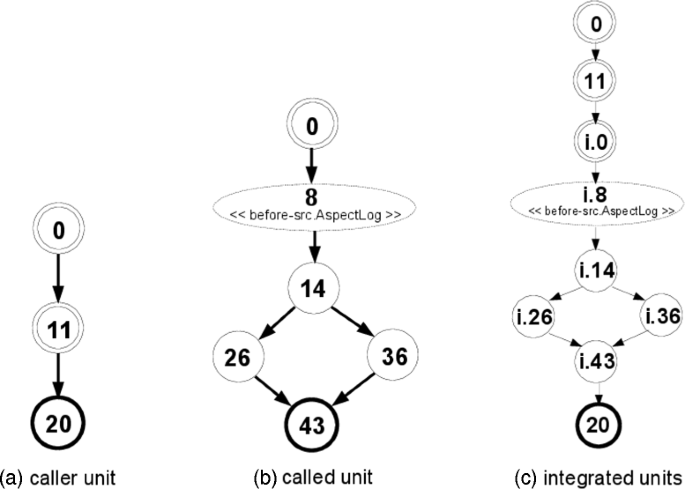
Example of an integrated CFG for the pairwise approach [14]
Full size image
Neves et al. [46] developed an approach for integration testing of OO and AO programs in which a unit is integrated with all the units that interact with it in a single level of integration depth. We presented an evolution [24] of the approaches presented by ourselves [11, 14] and by Neves et al. [46]. We augmented the integration of units considering deeper interaction chains (up to the deepest level), without making the integration testing activity too expensive, since we integrate units in a configurable level of integration depth. Such augmented integration approach also brings customised control flow and data flow criteria. We highlight that all the representation models we proposed relies on Java bytecode analysis; furthermore, they all represent crosscutting nodes using a special type of node as shown in Fig. 1.
Our most recent approach characterises the whole execution context for a given piece of advice in a model that represents the execution flow from the aspect perspective [16]. A set of control flow and data flow criteria was proposed to require the execution of paths related to base code-advice integration.
Covering and analysing test requirements
In a series of preliminary assessment studies, we emphasised the effort required to cover test requirements derived from the proposed criteria for pairwise testing [14], multi-level integration testing [24] and pointcut-based integration testing [16]. A summary of the results is depicted in Table 1.
Full size table
For each application we collected, for example, the number of test cases required to cover 100 % of all-nodes, all-edges and all-uses of each unit (#u.TCs in Table 1) and the number of additional test cases required to cover requirements derived from the testing criteria of each approach (#ad.TCs in Table 1). Note that in these studies, we targeted optimal test sets with the minimum number of test cases as possible.
Analysing Table 1, we notice that in three applications (Stacks, Subj-obs and Bean), no additional effort was necessary considering all testing approaches. The other three applications (Telecom, Music and Shape) needed less than 25 % of additional test cases from the initial unit test set to cover the testing criteria of each approach. Thus, it is possible to say that the average of additional test cases needed to cover the requirements for integration testing criteria is not high. The cost of using these criteria is not high compared to the possible benefits achieved by applying such criteria. The only exception was the number of additional test cases of the multi-level integration approach in the Shape application. In this case, due to the depth considered during the generation of the test requirements, the cyclomatic complexity of some units largely increased the number of required test cases. In this way, we can say that, despite the possible applicability of the criteria, some of them may be heavily affected by structural characteristics of the implementation.
Despite the low number of additional test cases required to cover all test requirements of the proposed approaches, the analysis of the underlying model for creating test cases is not trivial. It is essential that the model facilitates the understanding of the dynamic behaviour of a program and thus the generation of relevant test cases.
The example of Fig. 2 illustrates how an around advice that is activated at a method call can be represented to enhance the comprehension of dynamic behaviour of a program. Is is obtained by applying the aforementioned multi-level integration approach by Cafeo and Masiero [24].
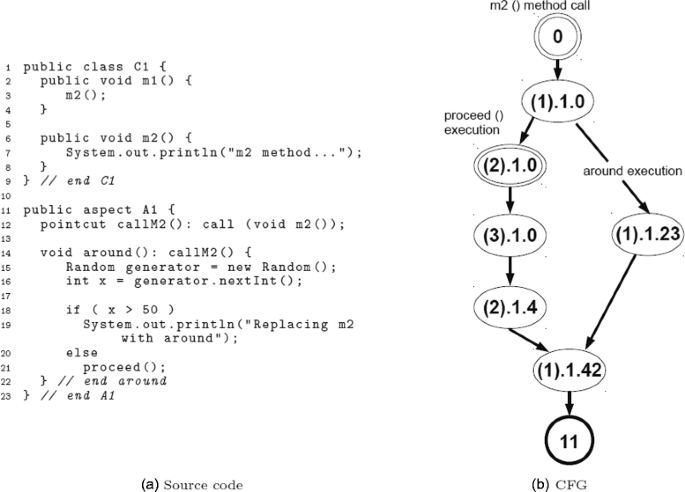
CFG of an around advice with a proceed command
Full size image
In this example, the node labelled with “0” represents the call to m2 which happens inside m1 (line 3). In this case, the CFG of the around advice is integrated in place of the m2’s CFG (this integration starts in node labelled with “(1).1.0”). Along the around execution, the proceed instruction may be invoked, depending on a predicate evaluation (line 18, which is included in the “(1).1.0” node). If the proceed is invoked, then the original join point is executed (nodes labelled with “(2).1.0”, “(3).1.0” and “(2).1.4”). Alternatively, only around instructions are executed (this is represented by the node labelled with “(1).1.23”).
In short, the CFG shown in Fig. 2 tries to represent an execution that depends on a runtime evaluation by showing the replacement of the join point by the advice and the return of the execution flow to the join point by the execution of the proceed command.
Related work on structural-based testing of AO programs
To the best of our knowledge, few approaches and testing criteria have been defined for structural testing of AO programs. Table 2 shows a list of them. Such pieces of work either propose testing approaches or explore internal implementation details of the software to support testing activity. The studies were selected based on recent literature and on a systematic review about AO software testing [50]. For each work listed in the table, the following information is presented: authors (Authors), year of publication (Year), testing level (Level), whether the approach defines testing criteria (Criteria) and whether the work implements a supporting tool (Tools). The table highlights in italics the contributions that are not from our research group in order to compare them with our work.
Full size table
Zhao [8, 51] developed a data-flow testing approach for AO programs, based on the OO approach proposed by Harrold et al. [48], addressing the testing of interfaces from the aspect perspective and from the class perspective. Differently from the contributions of our research group, Zhao considers a unit to be a class or an aspect and relies on source code analysis to enables the graph generation.
Xie and Zhao [52] presented an approach for structural- and state-based testing with support of a framework called Aspectra. In their approach, the framework generates wrapper classes. These classes are the input of a tool that generates test cases for aspectual behaviour considering structural and state-based coverage. This approach is a mixed approach (structural- and state-based) focusing on test case generation. Our contributions focus on proposing different control flow and data flow testing criteria for AO programs.
Bernardi and Lucca [45] also proposed a similar approach to our work [14, 16, 24, 46]. They defined a graph to represent the interactions between a base program and the pieces of advice interacting with it. They also defined some control flow-based criteria from such model. However, their approach does not incorporate data-flow analysis. Furthermore, to the best of our knowledge, no implementation of the approach has been presented yet.
Xu and Rountev [53] proposed an approach for regression testing of AO programs. This approach uses a control flow graph to analyse additional behaviour added by aspects as a way of generating regression testing requirements. Despite using control flow graph and proposing a tool for generating test requirements, Xu and Rountev did not propose testing criteria for AO programs.
Mahajan et al. [25] applied genetic algorithm to improve data flow-based test data generation. In this approach, the authors use the CFG to generate the data flow model of the program under test (i.e. def-use graph). Based on this information, they apply a genetic algorithm on it with many different parameters. The goal is to generate several test sets in order to reach 100 % of coverage of the all-uses criterion. Differently from the contributions of our research group, Mahajan et al. focus on generating test sets based on structural information instead of presenting an approach with an underlying model and testing criteria.
Finally, Wedyan and Gosh [15] and Wedyan et al. [29] presented an approach and tool implementation for measuring data flow coverage based on state variables defined in base classes or aspects. The goal of the approach is to prevent faults resulting from interactions (i.e. data flow) between base classes and aspects by focusing on attributes responsible for change the behaviour of both (state variables). Similarly to the work of our research group, they also define data flow criteria for AO programs. However, they only focus on the interaction between base classes and aspects established by the so-called state variables.
Mutation-based viewpoint analysis
Similarly to section ‘Structural-based viewpoint analysis’, this section revisits the contributions of our research group on fault-based testing (in particular, mutation testing) of AO programs.
Creating an underlying model
As introduced in section ‘Fault-based testing and mutation testing’, fault-based testing relies on fault models and fault taxonomies—that is, sets of prespecified faults [40]. For AO software, fault taxonomies are mostly based on the pointcut–advice–intertype declaration (ITD) model implemented in AspectJ. We proposed a preliminary fault taxonomy for AO programs that take into consideration only faults related to pointcuts [54]. Afterwards, we identified, grouped together and added to our taxonomy several fault types for AO software that have been described by other researchers [1–5]. Additionally, we included new fault types that can occur in programs written in AspectJ [7, 12].
In total, our taxonomy encompasses 26 different fault types distributed over four categories. Category F1 includes eight pointcut-related fault types that address, for instance, incorrect join point quantification, misuse of primitive pointcut designators and incorrect pointcut composition rules. Category F2 includes nine fault types that regard ITD- and declare-like expressions. Examples of fault types in this category are improper class member introduction, incorrect changes in exception-dependent control flow and incorrect aspect instantiation rules. Category F3 describes six types of faults related to advice definition and implementation. Examples of F3 fault types are improper advice type specification, incorrect advice logic and incorrect advice-pointcut binding. Finally, category F4 includes three faults types whose root causes can be assigned to the base program. For instance, code evolution that causes pointcuts to break and duplicated crosscutting code due to improper concern refactoring.
We used the taxonomy to classify 104 faults documented from three medium-sized AO systems [7]. The chart of Fig. 3 summarises the distribution. In the x-axis, fault types 1.1–1.8 are related to pointcuts, 2.1–2.9 are related to ITDs, 3.1–3.6 are related do advices and 4.1–4.3 are related to the base code. Overall, the taxonomy has shown to be complete in terms of fault categories. It also helped us to characterise recurring faulty implementation scenarios3 that should be checked during the development of AO software.
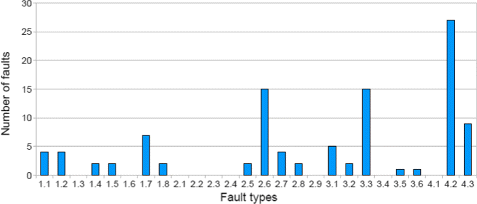
Distribution of faults through the analysed systems
Full size image
Deriving test requirements
According to section ‘Fault-based testing and mutation testing’, mutation testing [41] is a largely explored fault-based criterion. Based on a fault taxonomy, mutation operators are designed to insert faults into a program (i.e. to create the mutants). The mutants are used to evaluate the ability of the tests to reveal those artificial faults. In this context, in this section, we first summarise how mutation operators have been designed for procedural and OO paradigms. Then, we contrast this process with the designing of AO operators.
Mutation operators for procedural and OO programs
Agrawal et al. [55] designed a set of unit mutation operators—77 operators in total—for C programs, which was based on an existing set of 22 mutation operators for Fortran [56]. Although the number of C-based mutation operators is much larger than the number of Fortran-based ones, Agrawal et al. explain that their operators are either customisations or extensions of the latter, however considering the specificities of the C language.
Delamaro et al. [57] addressed the mutation testing of procedural programs at the integration level. The authors characterised a set of integration faults related to communication variables (i.e. variables that are related to the communication between units such as formal parameters, local and global variables and constants).
They then proposed the interface mutation criterion, which focuses on communication variables and encompasses a set of 33 mutation operators for C programs.
In 2004, Vincenzi [58] analysed the applicability of these two sets of C-based operators in the context of OO programs. The author focused on C++ and Java programs. With a few customisations and restrictions, Vincenzi concluded that most of the operators are straightforwardly applicable to programs written in these two languages.
The 24 inter-class mutation operators for Java programs proposed by Ma et al. [59] intend to simulate OO-specific faults. They focus on changes of variables but also address the modification of elements related to inheritance and polymorphism (e.g. deletion of an overriding method or class field or removal of references to overridden methods and fields). This is clearly an attempt to address paradigm-specific issues, even though some preliminary assessment has shown that the operators are not effective in simulating non-trivial faults [60]4.
Based on this brief analysis, we conclude that designing those operators was a “natural” evolution of operators previously devised for procedural programs, despite addressing different testing levels (i.e. unit and integration testing) and fault types. A few exceptions regard some class-level operators [59] which still require assessment through empirical studies.
Mutation operators for AO programs
Similarly to structural-based approaches for OO programs, all the mentioned sets of mutation operators can be applied to AO programs. However, they are not intended to cover AOP-specific fault types.5 To apply mutation testing to AO programs properly, one must consider the new concepts and, in particular, the AOP mechanisms together with fault types that can be introduced into the software. The design of mutation operators for AO programs must take these factors into account.
In our previous research, we designed a set of 26 mutation operators for AspectJ programs [12]. The operators address instances of several fault types (18 in total) described in the taxonomy mentioned in section ‘Creating an underlying model’. In particular, the operators simulate instances of faults within the first three categories (the groups are named G1, G2 and G3, each one simulating faults of categories F1, F2 and F3, respectively). These fault types are strictly related with the main concepts introduced by AOP.
In a preliminary assessment study, we checked the ability of the operators to simulate non-trivial faults [26]. We applied the operators to 12 small AspectJ applications and ran the non-equivalent mutants on a functional-based test set. Table 3 summarises the study results. It includes some metrics for the systems (e.g. the number of classes and aspects); the number of mutants by group of operators; the number of equivalent, anomalous and live mutants; the number of mutants killed by the original test set; and the number of test cases that have been added to kill the mutants that remained alive.
Full size table
Regarding the numbers of mutants for each group of operators (columns four to six in the table), we can observe that changes applied to pointcuts (i.e. operators from G1 group) yield the largest number of mutants for all systems except for FactorialOptimiser. In total, they represent nearly 76 % of mutants (703 out of 922). This was expected since G1 is the largest operator group, and the mutation rules encapsulated in these operators addresses varied parts of pointcuts. Nonetheless, as discussed in the next section, the analysis step for pointcut-related mutants can be partially automated, thus reducing the effort required for this task.
Covering and analysing test requirements
According to the results presented in Table 3, the operators were able to introduce non-trivial faults into the systems. In total, 39 mutants remained alive after their execution against the respective test sets in 7 out of 12 systems.
The main point with respect to covering and analysing mutation-based test requirements regarded the analysis of mutants to figure out if we needed to either classify them as equivalent or devise new test cases to kill them. The analysis of conventional mutants (i.e. derived from non-AO programs) is typically unit-centred; the task is concentrated on the mutated statement and perhaps on its surrounding statements. For AO mutants, on the other hand, detecting the equivalent ones may require a broader, in-depth analysis of the woven code.6 This is due to the quantification and obliviousness properties [44] that are realised by AOP constructs such as pointcuts, advices and declare-like expressions.
In the sequence, we present an example to illustrate scenarios in which in-depth system analyses were required in order to classify mutants as equivalent.
The code excerpts shown in Fig. 4 characterise a scenario in which an in-depth analysis was required. It consists of a pair advice–pointcut and a pointcut mutant produced by the PWIW operator (pointcut weakening by insertion of wildcards) for the MusicOnline system, which consists in an online music service presented by Bodkin and Laddad [62]. The mutation is the replacement of a naming part of the pointcut (i.e. the owed attribute that appears in line 2) with the “ ∗” wildcard. At the first view, the mutant could not be classified as equivalent, since the mutant pointcut matched four join points in the base code, while the original pointcut matched only three. This additional activation of the after returning advice represents undesired control flow. However, the extra advice execution did not produce an observable failure. In this case, the advice logic sets the account status—suspended or not—according to the current credit limit. The extra advice execution would set the suspended attribute as false twice in a roll; nevertheless, the system behaves as expected despite this undesired execution control flow. Consequently, this mutant must be classified as equivalent. For this mutant, the conclusion is that even though the mutation impacted on the quantification of join points, the behaviour of the woven application remained the same.

Example of an equivalent mutant of the MusicOnline application
Full size image
Mutations such as the one shown in Fig. 4 requires dynamic analyses of the woven code to help one identify (un)covered test requirements, since the aspect-base interactions cannot be clearly seem at the source code level. Even though current IDEs such as AJDT7 provide the developer with hints about the relationship about aspects and the base code, understanding the behaviour of the woven application to decide about equivalence regarding semantics cannot be feasible based only on static information. On the other hand, as shown in Table 3, many mutants were automatically classified as equivalent.8 In total, around 50 % of the mutants were automatically classified as equivalent (471 out or 922). They are all pointcut-related mutants, and the automatic detection of the equivalent ones is based on the analysis of join point static shadows [63]. If two pointcuts capture the same set of join points, they are considered equivalent, despite the dynamic residues left in the base code during the weaving process.
Recently, we investigated the cost reduction of mutation testing based on the identification of sufficient mutation operators [28]. We ran the sufficient procedure [64] on a group of 12 small AspectJ applications, which are the same applications tested by Ferrari et al. [26]. The procedure output is a subset of mutation operators that can keep the effectiveness of a reduced test suite in killing mutants produced by all operators. The results of our study point out a five-operator set that kept the mutation score close to 94 %, with a cost reduction of 53 % with respect to the number of mutants we had do deal with.
Related work on mutation-based testing
Apart from our contributions, some other researchers have been investigating fault based-testing for AO programs, mainly focusing on mutation testing. Their initiatives are summarised in Table 4. Such pieces of work either customise the mutation testing for AO programs, apply the criterion as a way of assessing other testing approaches, or describe a tool. Again, the studies were selected based on recent literature and on a systematic review about AO software testing [50]. For each work listed in the table, the following information is presented: authors (Authors), year of publication (Year), whether the approach customises mutation testing to be applied to AO programs and whether the work implements a supporting tool (Tools). The table highlights in italics the contributions that are not from our research group in order to compare them with our work.
Full size table
Mortensen and Alexander [9] defined three mutation operators to strengthen and weaken pointcuts and to modify the advice precedence order. However, the authors did not provide details of syntactic changes and implications of each operator. In our research [12], we precisely described the mutations performed by each operator.
Anbalagan and Xie [13] automated two pointcut-related mutation operators defined by Mortensen and Alexander [9]. Mutants are produced through the use of wildcards as well as by using naming parts of original pointcut and join points identified from the base code. Based on heuristics, the tool automatically ranks the most representative mutants, which are the ones that more closely resemble the original pointcuts. The final output is a list of the ranked mutants; no other mutation step is supported. The set of mutation operators proposed in our research [12] includes and refines the operators defined by Anbalagan and Xie.
Delamare et al. [23] proposed an approach based on test-driven development concepts and mutant analysis for testing AspectJ pointcuts. Their goal was to validate pointcuts by means of test cases that explicitly define sets of join points that should be affected by specific advices. A mutation tool named AjMutator [20] implements a subset of our pointcut-related operators [12]. The mutant pointcuts are used to validate the effectiveness of their approach.
More recently, Wedyan and Ghosh [17] proposed the use of simple object-based analysis to prevent the generation of equivalent mutants for some mutation operators for AspectJ programs. They argue that reducing the amount of equivalent mutants generated by some operators would consequently reduce the cost of mutation testing as a whole. The authors used three testing tools (namely, AjMutator [20], Proteum/AJ [21] and MuJava [60]) to assess their technique. Apart from traditional class-level mutation operators [59], Wedyan and Ghosh applied a subset of operators defined in our previous work [12] using the Proteum/AJ and AjMutator tools.
Omar and Ghosh [18] presented four approaches to generate higher order mutants for AspectJ programs. The approaches were evaluated in terms of the ability to create mutants of higher order resulting in higher efficacy and less effort when compared with first order mutants. All approaches proposed can produce higher order mutants that can be used to increase testing effectiveness and reduce testing effort and reduce the amount of equivalent mutants. Differently from Omar and Ghosh’s work, our work only considers first order mutations.
Parizi et al. [22] presented an automated approach for random test case generation and uses mutation testing as a way of assessing their approach. Basically, their automated framework analyses AspectJ object code (i.e. Java bytecodes) and exercises compiled advices (i.e. Java methods) as a way of validating the implementation of crosscutting behaviour. Mutants are generated with a modified version of the AjMutator tool [20], which implements a subset of operators defined in our previous work [12].
Reuse-centred viewpoint analysis
As discussed in section ‘Introduction’, AOP is typically applied to refactor existing systems to achieve better modularisation of crosscutting concerns [2, 33–36]. Given this scenario of AOP adoption, our recent work investigated the difficulty of testing AO and OO programs, in particular when there is a migration from one paradigm to the other. In particular, we aim to analyse the following: (i) the effort required to adapt a test suites from one paradigm to the other and vice versa, given that two equivalent programs (regarding their semantics) are available (one OO and another AO) and (ii) the structural code coverage yielded by such adapted test suites.
Results of objective (i)—effort to adapt test sets—were presented by Levin and Ferrari [27] and are summarised in section ‘Effort to adapt test sets across paradigms’. In this paper, we extend Levin and Ferrari’s work by testing a hypothesis using statistical procedures. In the sequence, section ‘Structural coverage yielded by test sets across paradigms’ brings novel results regarding objective (ii)—structural coverage of adapted test sets. We start by describing the study configuration, including target applications and applied procedures.
Study configuration
We identified 12 small applications plus one medium-sized application for which we fully created functional-based test sets in conformance with the systematic functional testing (SFT) criterion [66]. In short, SFT combines equivalence partitioning and boundary-value analysis [38] aiming at associating the benefits of functional testing (independent implementation) and greater code coverage on test [66]. The test set must include at least two test cases that cover each equivalence class and one test case to cover each boundary value. According to the SFT proponents, this minimises problems of coincidental correctness.
Table 5 brings general information for each application. Note that six applications have a “DP” suffix and consist of randomly selected examples of design patterns implemented by Hannemann and Kiczales [67]. Other columns show the number of classes (#C) and the number of aspects (#A) in each system.9
Full size table
These applications were selected because they all had OO and AO equivalent implementations developed by third-party researchers. Furthermore, their source code was either available for download or listed in the original reports (references can be found in Table 5). The specifications of these applications, which we used to define test requirements, were either documented in the original reports or were elaborated after analysing the source code. For Question Database (application #7 in Table 5), due to its size, we only tested non-functional concerns that are implemented with aspects in the AO version. Obviously, such concerns are also present in the OO implementation, though spread across or tangled with code of other concerns.
To design and perform the tests, initially we defined two groups of applications (namely, group A and group B), each one including OO and AO implementations of six programs plus two concerns10 of the Question Database system. In group A, we created SFT-adequate test sets for the OO implementation (i.e. test sets written purely in Java). Then, we adapted test cases to make them executable in the AO equivalent implementations. On the other way around, in group B, we firstly created test sets for the AO implementations, then adapted such test sets to the OO counterparts.
Table 6 illustrates the specification of functional test requirements for an operation of the ATM-log application. The table shows the input/output conditions, the valid and invalid (equivalence) classes and the boundary values. This template of specification was applied to all tested systems and guided the creation of test cases for both groups of applications (group A and group B). The last three columns of Table 8 summarise the number of test requirements and the number of test cases with respect to each target application.
Full size table
Effort to adapt test sets across paradigms
As described by Levin and Ferrari [27], in this investigation, we wanted to study the effect of different programming paradigms on the effort required to migrate (i.e. adapt) test code from OO to AO programs and vice versa. To extend the original analysis [27], we define the hypotheses listed in Table 7 (namely, H1, H2, H3 and H4). Note that the hypotheses are related to metrics described in the sequence and assume that there is no difference between the effort required to migrate test sets across OO and AO implementations (i.e. they represent null hypotheses).
Full size table
Metrics and tool: The metrics we collected to evaluate the effort required to adapt test sets across paradigms focus on code churn. Code churn is generally used to predict the defect density in software systems, and it is easily collected from a system change history [73]. Usually, this kind of metric is used to compare system versions to measure how many lines were added, changed and removed. In particular, we collected the following: Total-LOC-TC—number of non-commented LOC in the test classes; ADD—number of lines added to the new version of a test class; MOD—number of lines changed in the new version of the test class in comparison with its previous version; and REM—number of lines removed from the previous version of a test class to create a new version. Note that by ‘new version’, we mean the test class that has been adapted to the new paradigm. We used the Meld tool11 to provide visual support in the analysis of code changes between different implementations of the same application.
Results and analysis: Table 8 summarises results regarding the collected metrics. On average, for group A, adapting OO test sets to AO implementations required additions of 5.70 %, modifications in 4.46 % of test code lines, with no code removal in any application. For group B, on the other hand, more modifications and removals were needed than for group A. On average, test code was 9.57 % modified and 3.10 % removed to conform with OO implementations, while only 1.93 % lines were added to the test code.
Overall, our preliminary findings were that (i) less code is written for testing OO programs, specially because test cases for AO implementations required more specific code to expose context information to build JUnit assertions, and (ii) test code for OO programs conforms better with the open-closed principle [74], since a higher number of changes were required to make test sets of group B executable in OO implementations and (iii) test code for OO programs is more reusable, which is reflected by the MOD and REM averages that indicate recurring interventions in test sets for AO systems in order to adapt them to OO implementations.
Full size table
Figure 5 shows an example of how the test set for the Chess application was adapted from the OO implementation to the AO counterpart. Different test code lines are 15 (OO version) and 15–17 (AO version). In the first case, the srtErrorMsg attribute of the pawn object is used in the assertion. In the migrated (AO) test code, the aspectOf() AspectJ-specific method is used to allow the retrieval of the context information (i.e. the error message). In this example, the ADD metric accounts for 2 and MOD metric accounts for 1, respectively.
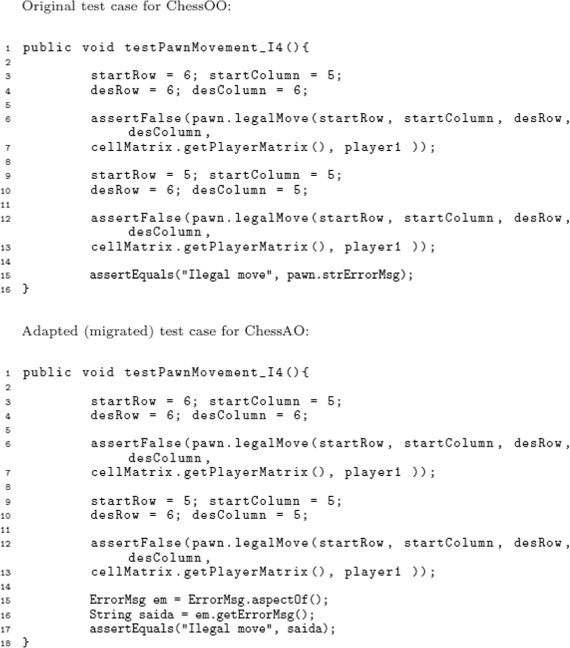
Test case example for the Chess application
Full size image
To evaluate if the preliminary findings have statistical relevance, we tested the hypotheses defined in Table 7. Initially, we checked whether the data has normal distribution. For this, we applied the Shapiro-Wilk test. Results are summarised in Table 9.
Full size table
Note that, for statistical significance, we adopted the traditional confidence of 95 %; thus, our analysis considers p values below 0.05 significant. For all statistical tests, we used the R language and environment.12
As the reader can notice, apart from TOTAL-LOC-TC AO⇔OO and MOD AO⇔OO, all other p values are below the defined threshold of 0.05. Therefore, the null hypotheses (that is, the data has normal distribution) are rejected.
We then applied the non-parametric Mann-Withney test to compare the effort to migrate test sets across the two paradigms, given that such test does not assume normal distributions [75]. Results are summarised in Table 10.
Full size table
The results reveal that, even though the preliminary findings favoured the OO paradigm regarding the analysed test sets (and their reuse), this could be not assessed with statistical rigour. Overall, the null hypotheses could not be rejected due to the low probability of perceiving difference between the two paradigms with respect to the analysed issue. One should notice that not rejecting a hypothesis does not mean the hypothesis is accepted. In fact, we cannot accept a null hypothesis, but only find evidence against it. In our case (i.e. results presented in section ‘Effort to adapt test sets across paradigms’), possible explanations for the lack of statistical significance of preliminary findings may rely on (i) the small number of analysed programs (14, in total) or (ii) the impossibility of showing differences between the two paradigms (i.e. there is no difference between them at all). Case (i) will be addressed in our future work, as stated in section ‘Final remarks, limitations and research directions’. The impossibility (and consequent conclusion) regarding case (ii) can be assessed with the enlargement of our application sets.
Structural coverage yielded by test sets across paradigms
With the aim of assessing the quality of reused test sets, we now analyse the structural coverage that can be achieved when test sets are reused across paradigms. In other words, we want to study the effect of different programming paradigms on the test coverage with respect to the structure (statements and branches) of OO and AO programs. This investigation develops in terms of the hypotheses defined in Table 11:
Full size table
Metrics and tool: To evaluate H5 and H6, we computed the code coverage yielded by SFT-adequate test sets considering the same groups of applications (i.e. group A and group B). The metrics we collected are statement coverage and branch coverage, which are similar to the all-nodes and all-edges traditional control flow-based criteria. For the Question Database system, we focused the analysis on parts of the code affected by the crosscutting behaviour that, in the AO implementation, was encapsulated within one or more aspects. For the remaining (small) applications, we considered the full code (base code and aspects, if any) for computing test requirements and coverage.
The metrics collection task was automated by EclEmma13, which is code coverage analysis tool developed as an Eclipse plugin. Note we had to manually inspect the coverage of AspectJ implementations due to the fact that EclEmma, as other Java-based coverage tools, processes ordinary bytecode (i.e. Java compiled code) to trace the traversed paths during test execution. When it comes to AspectJ, the standard ajc
14 compiler adds some structures to the compiled bytecode that are not recognised by EclEmma. These structures correspond to specific AOP constructions. For example, for each pointcut in the source code, the ajc compiler adds a method to the bytecode. Such method is often created only for retaining pointcut-related information that could be lost after compilation. However, EclEmma treats this spurious method as code that should be equally covered by the tests and hence must not be considered for coverage purposes. Such spurious requirements were spotted and discarded through a manual inspection step.
We highlight that the JaBUTi/AJ tool, developed by our group to support AO-specific structural criteria [11, 14, 16, 24, 46], is able to compute test requirements and trace the execution for particular modules of a system under testing, depending on the chosen level of integration. In other words, JaBUTi/AJ instruments and runs specific parts of a system, according to the tester’s selection. Since we intended to compute the coverage for all system modules, to speed up the process, we adopted EclEmma. Such tool is able to run full test set in a single run and compute the coverage of the full application, even though manual inspection was necessary to achieve precise results.
Results and analysis: Table 12 shows the results regarding statement and branch coverage for small applications of group A and group B. Visual representation can be found in Figs. 6 and 7. Similarly, Table 15 and Figs. 8 and 9 present results for the Question Database application, though separately from the other small applications. Note that results with respect to the Question Database application will be later discussed in this section.
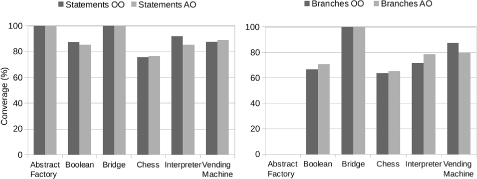
Statement and branch coverage for small applications—group A
Full size image
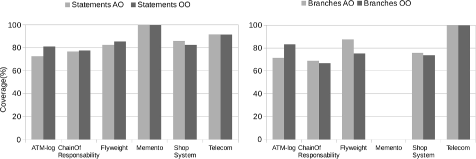
Statement and branch coverage for small applications—group B
Full size image
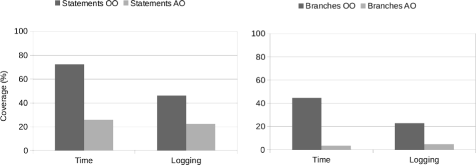
Statement and branch coverage for Question Database—group A
Full size image
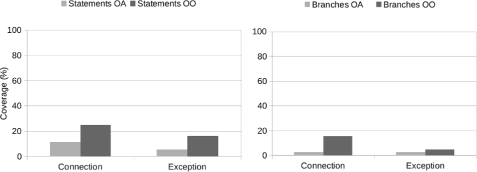
Statement and branch coverage for Question Database—group B
Full size image
Full size table
Regarding small applications, Table 12 and Figs. 6 and 7 indicate that there are only minimal differences in coverage when both criteria are considered. In group A, test sets yielded average statement coverage of 90.5 and 89.5 % for OO and AO implementations, respectively. For branch coverage in the same group, averages are 78.9 and 77.9 %. Individual differences can be checked in columns labelled with “diff %”. Despite the lower coverages obtained for applications of group B, the values for different paradigms are again very close: 86.3 % of covered statements for OO implementations and 84.9 % for AO counterparts and 66.5 % and 67.2 % of covered branches for OO and AO implementations, respectively.
To evaluate whether such minimal coverage differences have statistical relevance, we tested the hypotheses defined in Table 11, considering the differences amongst coverages (statements and branches—“dif %” columns) in both groups and paradigms. Initially, again, we checked whether the data has normal distribution. For this, we applied the Shapiro-Wilk test. Results are summarised in Table 13.
Full size table
Differently from the analysis presented in section ‘Effort to adapt test sets across paradigms’, the p values obtained for the STATEMENT
i
and BRANCH
i
metrics are all above the defined threshold of 0.05. Thus, the null hypotheses (that is, the data has normal distribution) cannot be rejected. We then applied the Student’s t test to compare the structural coverage yielded by test sets that are originally built for programs written under one paradigm (namely, OO and AO) and then migrated to the other one. Results are summarised in Table 14. Note that the null hypotheses cannot be rejected, since p values are above 0.05.
Full size table
The results confirms the preliminary findings that, for small applications, there is no difference between the two paradigms with respect to (control flow-based) structural coverage when test sets are reused across them.
Differently from results for small applications, tests executed on Question Database resulted in higher statement and branch coverage in all OO implementations (see Table 15 and Figs. 8 and 9). For example, for the Time concern in the OO implementation, statement and branch coverages were 72.2 and 44.6 %, respectively, while the same measures for the AO version were 25.8 and 3.8 %. On average, statement and branch coverage in group A were 59.2 and 33.9 % for OO implementation and 24.1 and 4.3 % for the AO implementation, respectively. Similar results (in terms of higher coverage for OO implementation) are observed for group B.
The numbers for the Question Database system have some peculiarities. Firstly, considering both paradigms, test execution resulted in low coverage rates for all concerns (the only exception is TimeOO—see Table 15). As mentioned in the beginning of this section, for this system the coverage analysis focused only on modules—aspects and classes—which are related to the selected crosscutting concerns. For them, the tool computed test requirements and their respective coverage. Despite this concern-driven analysis, we emphasise that test cases were designed to those particular concerns and hence did not exercise substantial parts of the involved modules.
Secondly, and equally important, we can notice a much higher number of test requirements in the AO implementations. Such difference relies basically on two reasons: (i) the generality of the aspect possibly to facilitate system evolution without breaking pointcuts and (ii) the strategy adopted by the developer to create aspects (and their internal parts) using AspectJ mechanisms. Both reasons are related to the conservative procedure to define pointcuts with wide scope15—i.e. they select a high number of join points—and with the advice activation logic that is resolved at runtime by the executing environment (see Fig. 10, which is described in the sequence). Besides this, the weaving process performed by the ajc compiler adds complexity to the internal logic of the base code. Examples of such added complexity are advice calls, which may or may not be nested within conditional structures inserted before, after or in place (around) the selected join points.
Full size table
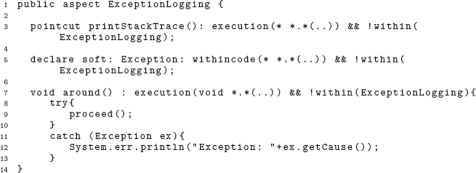
Example of conservative (weak) pointcut of the Question Database application
Full size image
Figure 10 shows an example of a highly generic pointcut named printStackTrace, which captures pointcuts of the whole system, except from the ExceptionLogging aspect itself. The weaving of the associated around advice with the base code inserts, at each join point, conditional structures to decide on join point activation. As a consequence, a high number of statements and branches are processed as test requirements by the coverage tool, even though exceptions will never be raised in part of the selected join points (i.e. unfeasible requirements).
We call the reader’s attention to the fact that, in the context of small systems (in which join point quantification is somehow restricted to a few modules) we can conclude systematically developed test sets, when properly adapted from one paradigm to the other, may result in similar code coverage levels. However, as long as the quantification of join points increases (as in the case of the Question Database system), the existing test set produces higher coverage in OO code. The cause may be the conservative approach for using AOP constructs such as pointcuts and advice. From a developer’s perspective, widely scoped pointcuts may ease the evolution of programs without causing pointcuts to break (this problem was observed in a previous study of fault-proneness of AO evolving AO programs [34]). Besides this, delegating the advice activation decision to the executing environment is also a facilitating strategy. However, from the tester’s perspective, advanced and automated program analysis techniques are required to avoid the substantial increase in the number of test requirements to be analysed.
Related work
This section summarises related work that addresses issues for testing AO programs (including some proposals for dealing with such issues) and studies that compare the testing of programs developed under different paradigms. Note that sections ‘Related work on structural-based testing of AO programs’ and ‘Related work on mutation-based testing’ have summarised more specific-related research (namely, related to structural and mutation testing of AO programs).
Ceccato et al. [3] discussed the difficulties for testing AO programs in contrast with OO programs. They argued that if aspects could be tested in isolation, AO testing should be easier than OO testing. According to them, code that implements a crosscutting concern is typically spread over several modules in OO systems, thus hardening test design and evaluation. At some extent, our findings with respect to the quality of test sets applied to OO and AO implementations go against these observations. The results indicate lower quality (in terms of code coverage) in the AO paradigm when concern scattering grows even with the execution of systematically developed test sets. Ceccato et al. also proposed a testing strategy to integrate base code and aspects incrementally. However, they did not report any kind of evaluation of their strategy as we did in the previous sections of this paper.
Zhao and Alexander [76] proposed an approach to test AspectJ AO programs as OO programs. Based on a decompilation process, AspectJ applications can be tested as ordinary Java applications using conventional approaches. Although this may ease the tests, it may impose other obstacles specially when a fault is detected in the decompiled code. In such case, identifying the fault in the original—i.e. aspectual—code may become unfeasible due to code transformations that occur during the forwards and backwards compilation/weaving processes. Differently, in this paper we summarised a set of testing approaches that are directly applied to AspectJ programs, without requiring any decompilation step.
Xie and Zhao [77] discussed existing solutions for AO testing such as test input generation, test selection and runtime checking, mostly developed by the authors. For instance, their tools support automatic test generation based on compiled AspectJ aspects (i.e. classes as bytecodes). They also discussed unit and integration testing of aspects using wrapping mechanisms, control flow- and data flow-based testing focused on early versions of AspectJ and mutation testing applied to code obtained from refactoring aspects into ordinary Java classes. Differently from our work, Xie and Zhao did not present assessment studies neither selected examples extracted from practical evaluation.
With respect to test reuse and evaluation across paradigms, Prado et al. [78] and Campanha et al. [79] compared procedural and OO programming using a set of programs from the data structures domain (e.g. queues, stacks and lists). The two pieces of research focus on structural and mutation testing, respectively. The results of Prado et al. study show that there is no evidence for the existence of differences in cost and strength between procedural and OO paradigms. This is similar to our results for small-sized OO and AO applications (details in section ‘Structural coverage yielded by test sets across paradigms’). The results of Campanha et al. study, applied to the same domain and programs, show that both cost and the strength of the mutation testing are higher in programs implemented in the procedural paradigm than in the OO paradigm. No comparison with our results is possible, given that we did not apply mutation testing to assess the quality of reused test sets.
Final remarks, limitations and research directions
A report recently published summarised the contributions of the Brazilian community to the ‘world’ of AO Software Development [80]. For testing, five key challenges are listed: (1) identifying new potential problems; (2) defining proper underlying models; (3) customising existing test selection criteria and/or defining new ones; (4) providing adequate tool support; and (5) experimenting and assessing the approaches. We can add another key challenge to this group: (6) reuse of test sets to validate AO-based software refactorings.
In spite of the challenges addressed by our research (mainly challenges 1–4 and 6), a major open issue enumerated by Kulesza et al. [80] concerns the lack of experimental studies to assess the usefulness and feasibility of AO testing approaches, as well as the generalisation of results. With respect to this, results of the preliminary studies presented in sections ‘Structural-based viewpoint analysis’, ‘Mutation-based viewpoint analysis’ and ‘Reuse-centred viewpoint analysis’ represent only initial evaluation stage. Other studies that address AO systems larger than the ones used in the preliminary evaluation, as well as larger samples, are indeed necessary, though not available for the time being. For instance, for medium-sized AO systems, we have estimated the effort to cover structural requirements derived from the pointcut-based approach based on a theoretical analysis [16]. Besides this, we have also roughly estimated the cost of mutation testing in terms of number of mutants for medium-sized AO systems [26]. However, only by creating adequate test suites for such systems one shall be able to draw stronger conclusions about the feasibility and usefulness of AO-specific test selection criteria.
We highlight that this limitation is general in regard to research on AO testing and, at some extent, to some other research on AO software development [53, 81, 82]. Overall, other research on AO testing addressed only small-sized applications [10, 13, 15, 23, 45]. Just a few studies and approaches that may be related to testing (e.g. characterisation of bug patterns for exception handling [6] and AO refactoring supported by regression testing [2]) have handled larger AO systems, though with a different focus if compared to the evaluation we presented in section ‘Reuse-centred viewpoint analysis’. In other cases, testing approaches are partially applied to larger systems; for example, as in the work of Parizi et al. [22], who applied a subset of our mutation operators [12] and limited the number of generated mutants per program.
As future work, we are planning cross-comparison studies considering test selection criteria of different techniques within the AO context. This shall enable us to empirically establish a subsume relation for the investigated criteria and to define incremental testing strategies. We also intend to target AO systems larger than the ones typically analysed in current research. The motivation is that designing a test case to exercise a large program path that includes integrated units, or analysing a mutant that has wide impact on join point quantification, is very likely to require effort and complexity that cannot be easily quantified only in terms of the number of test cases or the number of test requirements.
Other research initiatives from our group include enlarging our application sets to reproduce the studies that compare effort and quality of test suites developed for implementations in different paradigms and checking the ability of adapted test sets from one paradigm to another to reveal faults simulated by mutants. To do so, we can apply mutation operators incrementally, starting from unit mutation operators towards AOP-specific ones.
Endnotes
1
http://www.eclipse.org/aspectj/—accessed on 23/07/2015.
2
http://caesarj.org/—accessed on 23/07/2015.
3 For more details of the fault classification and examples of faulty scenarios, the reader may refer to the work of Ferrari et al. [7]
4 By non-trivial faults, we mean faults that are not easily revealed with an existing test set, be it systematically developed or not.
5 It is likely that a test case designed to cover a fault modelled by a traditional (e.g. unit-level) mutation operator may also reveal a different, perhaps AOP-specific fault. However, it has been empirically shown [61] that context-specific test sets (e.g. for unit testing) may have reduced ability to reveal faults in a different context (e.g. at the integration level).
6 The inter-class mutation operators for Java [59] pose a similar challenge: mutations of inheritance and polymorphism elements also require broad analyses of the compiled application.
7
http://www.eclipse.org/ajdt/—accessed in 23/07/2015.
8 The testing process and criterion application was supported by the Proteum/AJ tool [21]. More details can be found in a previous paper [26].
9 OO implementations have only classes, while AO counterparts have both classes and aspects.
10 In group A, concerns are time (security procedure that locks the screen after a given time without mouse movement or any pressed key) and logging. In group B, concerns are exception logging (raised exceptions are displayed to the user) and database connection control.
11
http://meldmerge.org/—accessed on 23/07/2015.
12
http://www.r-project.org/—accessed on 30/07/2015
13
http://www.eclemma.org/—accessed on 23/07/2015.
14
https://www.eclipse.org/aspectj/doc/next/devguide/ajc-ref.html—accessed on 23/07/2015.
15 Also known as weak pointcuts [9, 13].
References
-
Alexander RT, Bieman JM, Andrews AA (2004) Towards the systematic testing of aspect-oriented programs. Tech. Report CS-04-105, Dept. of Computer Science, Colorado State University, Fort Collins/Colorado — USA.
-
van Deursen A, Marin M, Moonen L (2005) A systematic aspect-oriented refactoring and testing strategy, and its application to JHotDraw. Tech.Report SEN-R0507, Stichting Centrum voor Wiskundeen Informatica, Amsterdam — The Netherlands.
-
Ceccato M, Tonella P, Ricca F (2005) Is AOP code easier or harder to test than OOP code? In: Proceedings of the 1st workshop on testing aspect oriented programs (WTAOP)—held in conjunction with AOSD, Chicago/IL — USA.
-
Bækken JS, Alexander RT (2006) A candidate fault model for aspectj pointcuts In: Proceedings of the 17th international symposium on software reliability engineering (ISSRE), 169–178.. IEEE Computer Society, Raleigh/NC — USA.
Google Scholar
-
Zhang S, Zhao J (2007) On identifying bug patterns in aspect-oriented programs In: Proceedings of the 31st annual international computer software and applications conference (COMPSAC), 431–438.. IEEE Computer Society, Beijing — China.
Google Scholar
-
Coelho R, Rashid A, Garcia A, Ferrari F, Cacho N, Kulesza U, von Staa A, Lucena C (2008) Assessing the impact of aspects on exception flows: an exploratory study In: Proceedings of the 22nd European conference on object-oriented programming (ECOOP), 207–2345142.. Springer, Paphos — Cyprus.
Google Scholar
-
Ferrari FC, Burrows R, Lemos OAL, Garcia A, Maldonado JC (2010) Characterising faults in aspect-oriented programs: Towards filling the gap between theory and practice In: Proceedings of the 24th Brazilian symposium on software engineering (SBES), 50–59.. IEEE Computer Society, Salvador/BA — Brazil.
Google Scholar
-
Zhao J (2003) Data-flow-based unit testing of aspect-oriented programs In: Proceedings of the 27th annual IEEE international computer software and applications conference (COMPSAC), 188–197.. IEEE Computer Society, Dallas/Texas — USA.
Google Scholar
-
Mortensen M, Alexander RT (2005) An approach for adequate testing of AspectJ programs In: Proceedings of the 1st workshop on testing aspect oriented programs (WTAOP)—held in conjunction with AOSD, Chicago/IL — USA.
-
Xu D, Xu W (2006) State-based incremental testing of aspect-oriented programs In: Proceedings of the 5th international conference on aspect-oriented software development (AOSD), 180–189.. ACM Press, Bonn — Germany.
Chapter
Google Scholar
-
Lemos OAL, Vincenzi AMR, Maldonado JC, Masiero PC (2007) Control and data flow structural testing criteria for aspect-oriented programs. J Syst Softw 80(6): 862–882.
Article
Google Scholar
-
Ferrari FC, Maldonado JC, Rashid A (2008) Mutation testing for aspect-oriented programs In: Proceedings of the 1st international conference on software testing, verification and validation (ICST), 52–61.. IEEE, Lillehammer — Norway.
Google Scholar
-
Anbalagan P, Xie T (2008) Automated generation of pointcut mutants for testing pointcuts in AspectJ programs In: Proceedings of the 19th international symposium on software reliability engineering (ISSRE), 239–248.. IEEE Computer Society, Seattle/WA — USA.
Google Scholar
-
Lemos OAL, Franchin IG, Masiero PC (2009) Integration testing of object-oriented and aspect-oriented programs: a structural pairwise approach for Java. Sci Comput Program 74(10): 861–878.
Article
MATH
MathSciNetGoogle Scholar
-
Wedyan F, Ghosh S (2010) A dataflow testing approach for aspect-oriented programs In: Proceedings of the 12th IEEE international high assurance systems engineering symposium (HASE), 64–73.. IEEE Computer Society, San Jose/CA — USA.
Google Scholar
-
Lemos OAL, Masiero PC (2011) A pointcut-based coverage analysis approach for aspect-oriented programs. Inf Sci 181(13): 2721–2746.
Article
Google Scholar
-
Wedyan F, Ghosh S (2012) On generating mutants for AspectJ programs. Inf Softw Technol 54(8): 900–914.
Article
Google Scholar
-
Omar E, Ghosh S (2012) An exploratory study of higher order mutation testing in aspect-oriented programming In: Proceedings of the 23rd international symposium on software reliability engineering (ISSRE), 1–10.. IEEE Computer Society, Dallas/TX — USA.
Google Scholar
-
Anbalagan P, Xie T (2006) Efficient mutant generation for mutation testing of pointcuts in aspect-oriented programs In: Proceedings of the 2nd workshop on mutation analysis (mutation)—held in conjunction with ISSRE, 51–56.. Kluwer Academic Publishers, Raleigh/NC -USA.
Google Scholar
-
Delamare R, Baudry B, Le Traon Y (2009) AjMutator: A tool for the mutation analysis of aspectj pointcut descriptors In: Proceedings of the 4th international workshop on mutation analysis (mutation), 200–204.. IEEE, Denver/CO — USA.
Google Scholar
-
Ferrari FC, Nakagawa EY, Rashid A, Maldonado JC (2010) Automating the mutation testing of aspect-oriented Java programs In: Proceedings of the 5th ICSE international workshop on automation of software test (AST), 51–58.. ACM Press, Cape Town — South Africa.
Google Scholar
-
Parizi RM, Ghani AA, Lee SP (2015) Automated test generation technique for aspectual features in AspectJ. Inf Softw Technol 57: 463–493.
Article
Google Scholar
-
Delamare R, Baudry B, Ghosh S, Le Traon Y (2009) A test-driven approach to developing pointcut descriptors in AspectJ In: Proceedings of the 2nd international conference on software testing, verification and validation (ICST), 376–385.. IEEE Computer Society, Denver/CO — USA.
Google Scholar
-
Cafeo BBP, Masiero PC (2011) Contextual integration testing of object-oriented and aspect-oriented programs: a structural approach for Java and AspectJ In: Proceedings of the 25th Brazilian symposium on software engineering (SBES), 214–223.. IEEE Computer Society, São Paulo/SP — Brazil.
Google Scholar
-
Mahajan M, Kumar S, Porwal R (2012) Applying genetic algorithm to increase the efficiency of a data flow-based test data generation approach. SIGSOFT Software Engineering Notes 37(5): 1–5.
Article
Google Scholar
-
Ferrari FC, Rashid A, Maldonado JC (2013) Towards the practical mutation testing of AspectJ programs. Sci Comput Program 78(9): 1639–1662.
Article
Google Scholar
-
Levin TG, Ferrari FC (2014) Is it difficult to test aspect-oriented software? Preliminary empirical evidence based on functional tests In: Proceedings of the 11th workshop on software modularity (WMod).. Brazilian Computer Society, Maceio/AL — Brazil.
Google Scholar
-
Lacerda JTS, Ferrari FC (2014) Towards the establishment of a sufficient set of mutation operators for AspectJ programs In: Proceedings of the 8th Brazilian workshop on systematic and automated software testing (SAST).. Brazilian Computer Society, Maceio/AL — Brazil.
Google Scholar
-
Wedyan F, Ghosh S, Vijayasarathy LR (2015) An approach and tool for measurement of state variable based data-flow test coverage for aspect-oriented programs. Inf Softw Technol 59: 233–254.
Article
Google Scholar
-
Muñoz F, Baudry B, Delamare R, Traon YL (2009) Inquiring the usage of aspect-oriented programming: an empirical study In: Proceedings of the 25th international conference on software maintenance (ICSM), 137–146.. IEEE Computer Society, Edmonton/AB — Canada.
Google Scholar
-
Rashid A, Cottenier T, Greenwood P, Chitchyan R, Meunier R, Coelho R, Südholt M, Joosen W (2010) Aspect-oriented software development in practice: tales from AOSD-Europe. IEEE Comput 43(2): 19–26.
Article
Google Scholar
-
Kiczales G, Irwin J, Lamping J, Loingtier JM, Lopes C, Maeda C, Menhdhekar A (1997) Aspect-oriented programming In: Proceedings of the 11th European conference on object-oriented programming (ECOOP), 220–2421241.. Springer, Jyväskylä — Finland.
Google Scholar
-
Mortensen M, Ghosh S, Bieman JM (2008) A test driven approach for aspectualizing legacy software using mock systems. Inf Softw Technol 50(7-8): 621–640.
Article
Google Scholar
-
Ferrari FC, Burrows R, Lemos OAL, Garcia A, Figueiredo E, Cacho N, Lopes F, Temudo N, Silva L, Soares S, Rashid A, Masiero P, Batista T, Maldonado JC (2010) An exploratory study of fault-proneness in evolving aspect-oriented programs In: Proceedings of the 32nd international conference on software engineering (ICSE), 65–74.. ACM Press, Cape Town — South Africa.
Google Scholar
-
Alves P, Santos A, Figueiredo E, Ferrari FC (2011) How do programmers learn AOP? An exploratory study of recurring mistakes In: Proceedings of the 5th Latin American workshop on aspect-oriented software development (LA-WASP), 65–74.. Brazilian Computer Society, São Paulo/SP — Brazil.
Google Scholar
-
Alves P, Figueiredo E, Ferrari FC (2014) Avoiding code pitfalls in aspect-oriented programming In: Proceedings of the 18th Brazilian symposium on programming languages (SBLP).. Springer, Maceió/AL — Brazil.
Google Scholar
-
Ferrari FC, Cafeo BBP, Lemos OAL, Maldonado JC, Masiero PC (2013) Difficulties for testing aspect-oriented programs: a report based on practical experience on structural and mutation testing In: Proceedings of the 7th Latin American workshop on aspect-oriented software development (LA-WASP), 12–17.. Brazilian Computer Society, Brasília/DF — Brazil.
Google Scholar
-
Myers GJ, Sandler C, Badgett T, Thomas TM (2004) The art of software testing. 2nd edn. John Wiley & Sons, Hoboken/NJ — USA.
Google Scholar
-
Rapps S, Weyuker EJ (1982) Data flow analysis techniques for program test data selection In: Proceedings of the 6th international conference on software engineering (ICSE), 272–278.. IEEE Computer Society, Tokio — Japan.
Google Scholar
-
Morell LJ (1990) A theory of fault-based testing. IEEE Trans Softw Eng 16(8): 844–857.
Article
Google Scholar
-
DeMillo RA, Lipton RJ, Sayward FG (1978) Hints on test data selection: help for the practicing programmer. IEEE Comput 11(4): 34–43.
Article
Google Scholar
-
Mathur AP (2007) Foundations of software testing. Addison-Wesley Professional, Toronto, Canada.
Google Scholar
-
Dijkstra EW (1976) A discipline of programming. Prentice-Hall, Englewood Cliffs/NJ — USA.
MATH
Google Scholar
-
Filman RE, Friedman D (2004) Aspect-oriented programming is quantification and obliviousness. In: Filman RE, Elrad T, Clarke S, Akşit M (eds)Aspect-oriented software development, 21–35.. Addison-Wesley, Boston. Chap. 2.
Google Scholar
-
Bernardi ML, Lucca GAD (2007) Testing aspect oriented programs: an approach based on the coverage of the interactions among advices and methods In: Proceedings of the 6th international conference on quality of information and communications technology (QUATIC), 65–76.. IEEE Computer Society, Lisbon — Portugal.
Google Scholar
-
Neves V, Lemos OAL, Masiero PC (2009) Structural integration testing at level 1 of object- and aspect-oriented programs In: Proceedings of the 3rd Latin American workshop on aspect-oriented software development (LA-WASP), 31–38.. Brazilian Computer Society, Fortaleza/CE — Brazil. (in Portuguese).
Google Scholar
-
Linnenkugel U, Müllerburg M (1990) Test data selection criteria for (software) integration testing In: First international conference on systems integration, 709–717.. IEEE Computer Society, Morristown/NJ — USA.
Chapter
Google Scholar
-
Harrold MJ, Rothermel G (1994) Performing data flow testing on classes In: Proceedings of the 2nd ACM SIGSOFT symposium on foundations of software engineering (FSE), 154–163.. ACM Press, New Orleans/LA — USA.
Chapter
Google Scholar
-
Vincenzi AMR, Delamaro ME, Maldonado JC, Wong WE (2006) Establishing structural testing criteria for java bytecode. Software: practice and experience 36(14): 1513–1541.
Google Scholar
-
Ferrari FC (2010) A contribution to the fault-based testing of aspect-oriented software. PhD thesis, Instituto de Ciências Matemáticas e de Computação, Universidade de São Paulo (ICMC/USP), São Carlos/SP — Brasil.
-
Zhao J (2002) Tool support for unit testing of aspect-oriented software In: Workshop on tools for aspect-oriented software development—held in conjunction with OOPSLA, Seattle/WA — USA.
-
Xie T, Zhao J (2006) A framework and tool supports for generating test inputs of AspectJ programs In: Proceedings of the 5th international conference on aspect-oriented software development (AOSD), 190–201.. ACM Press, Bonn — Germany.
Chapter
Google Scholar
-
Xu G, Rountev A (2007) Regression test selection for AspectJ software In: Proceedings of the 29th international conference on software engineering (ICSE), 65–74.. IEEE Computer Society, Minneapolis/MN — USA.
Chapter
Google Scholar
-
Lemos OAL, Ferrari FC, Masiero PC, Lopes CV (2006) Testing aspect-oriented programming pointcut descriptors In: Proceedings of the 2nd workshop on testing aspect oriented programs (WTAOP)—held in conjunction with ISSTA, 33–38.. ACM Press, Portland/Maine — USA.
Chapter
Google Scholar
-
Agrawal H, DeMillo RA, Hathaway R, Hsu W, Hsu W, Krauser EW, Martin RJ, Mathur AP, Spafford EH (1989) Design of mutant operators for the C programming language. Technical Report SERC-TR41-P, Software Engineering Research Center, Purdue University, West Lafayette/IN — USA.
-
Budd TA (1980) Mutation analysis of program test data. PhD thesis, Graduate School, Yale University, New Haven, CT — USA.
-
Delamaro ME, Maldonado JC, Mathur AP (2001) Interface mutation: an approach for integration testing. IEEE Trans Softw Eng 27(3): 228–247.
Article
Google Scholar
-
Vincenzi AMR (2004) Object-oriented: definition, implementation and analysis of validation and testing resources. PhD thesis, ICMC/USP, São Carlos, SP — Brazil(in Portuguese).
-
Ma YS, Kwon YR, Offutt J (2002) Inter-class mutation operators for Java In: Proceedings of the 13th international symposium on software reliability engineering (ISSRE), 352–366.. IEEE Computer Society Press, Annapolis/MD — USA.
Google Scholar
-
Ma YS, Harrold MJ, Kwon YR (2006) Evaluation of mutation testing for object-oriented programs In: Proceedings of the 28th international conference on software engineering (ICSE), 869–872.. ACM Press, Shanghai — China.
Google Scholar
-
Vincenzi AMR (1998) Resources for the establishment of testing strategies based on the mutation technique. Master’s thesis, ICMC/USP, São Carlos/SP — Brazil (in Portuguese).
-
Bodkin R, Laddad R (2005) Enterprise aspect-oriented programming In: Tutorials of EclipseCon 2005.. Online, Burlingame/CA — USA. http://www.eclipsecon.org/2005/presentations/EclipseCon2005_EnterpriseAspectJTutorial9.pdf — accessed on 23/07/2015.
Google Scholar
-
Hilsdale E, Hugunin J (2004) Advice weaving in AspectJ In: Proceedings of the 3rd international conference on aspect-oriented software development (AOSD), 26–35.. ACM Press, Lancaster — UK.
Chapter
Google Scholar
-
Barbosa EF, Maldonado JC, Vincenzi AMR (2001) Toward the determination of sufficient mutant operators for C. The Journal of Software Testing, Verification and Reliability 11(2): 113–136.
Article
Google Scholar
-
Leme FG, Ferrari FC, Maldonado JC, Rashid A (2015) Multi-level mutation testing of Java and AspectJ programs supported by the ProteumAJv2 tool In: Proceedings of the 6th Brazilian conference on software: theory and practice (CBSoft—tools session). (to appear).. Brazilian Computer Society, Belo Horizonte/MG — Brazil.
Google Scholar
-
Linkman S, Vincenzi AMR, Maldonado JC (2003) An evaluation of systematic functional testing using mutation testing In: Proceedings of the 7th international conference on empirical assessment in software engineering (EASE), 1–15.. Institution of Electrical Engineers, Keele — UK.
Google Scholar
-
Hannemann J, Kiczales G (2002) Design pattern implementation in Java and AspectJ In: Proceedings of the 17th ACM SIGPLAN conference on object-oriented programming, systems, languages, and applications (OOPSLA), 161–173.. ACM Press, Seattle/WA — USA.
Chapter
Google Scholar
-
Prechelt L, Unger B, Tichy WF, Brössler P, Votta LG (2001) A controlled experiment in maintenance comparing design patterns to simpler solutions. IEEE Trans Softw Eng 27(12): 1134–1144.
Article
Google Scholar
-
Bartsch MEmpirical assessment of aspect-oriented programming and coupling measurement in aspect-oriented systems. PhD thesis, School of Systems Engineering — University of Reading, Reading — UK.
-
Liu CH, Chang CW (2008) A state-based testing approach for aspect-oriented programming. J Inf Sci Eng 24(1): 11–31.
Google Scholar
-
Chagas JDE, Oliveira MVG (2009) Object-oriented programming versus aspect-oriented programming. A comparative case study through a bank of questions. Technical report, Federal University of Sergipe, São Cristóvão — Brazil (in Portuguese).
-
(2014) The Eclipse Foundation: AspectJ Documentation. Online. http://www.eclipse.org/aspectj/docs.php — accessed on 23/07/2015.
-
Nagappan N, Ball T (2005) Use of relative code churn measures to predict system defect density In: Proceedings of the 27th international conference on software engineering (ICSE), 284–292.. IEEE Computer Society, St. Louis/MO — USA.
Google Scholar
-
Meyer B (1988) Object-oriented software construction. Prentice-Hall, Upper Saddle River/NJ — USA.
Google Scholar
-
Shull F, Singer J, Sjøberg DIK (2007) Guide to advanced empirical software engineering. Springer, Secaucus, NJ, USA.
Google Scholar
-
Zhao C, Alexander RT (2007) Testing aspect-oriented programs as object-oriented programs In: Proceedings of the 3rd workshop on testing aspect oriented programs (WTAOP), 23–27.. ACM Press, Vancouver — Canada.
Chapter
Google Scholar
-
Xie T, Zhao J (2007) Perspectives on automated testing of aspect-oriented programs In: Proceedings of the 3rd workshop on testing aspect oriented programs (WTAOP), 7–12.. ACM Press, Vancouver/British Columbia — Canada.
Chapter
Google Scholar
-
Prado MP, Souza SRS, Maldonado JC (2010) Results of a study of characterization and evaluation of structural testing criteria between procedural and OO paradigms In: Proceedings of the 7th experimental software engineering Latin American workshop (ESELAW), 90–99, Goiânia/GO — Brasil.
-
Campanha DN, Souza SRS, Maldonado JC (2010) Mutation testing in procedural and object-oriented paradigms: an evaluation of data structure programs In: Proceedings of the 24th Brazilian symposium on software sngineering (SBES), 90–99.. IEEE Computer Society, Salvador/BA — Brazil.
Google Scholar
-
Kulesza U, Soares S, Chavez C, Castor Filho F, Borba P, Lucena C, Masiero P, Sant’Anna C, Ferrari FC, Alves V, Coelho R, Figueiredo E, Pires P, Delicato F, Piveta E, Silva C, Camargo V, Braga R, Leite J, Lemos O, Mendonça N, Batista T, Bonifácio R, Cacho N, Silva L, von Staa A, Silveira F, Valente MT, Alencar F, Castro J, et al. (2013) The crosscutting impact of the AOSD Brazilian research community. J Syst Softw 86(4): 905–933.
Article
Google Scholar
-
Rinard M, Salcianu A, Bugrara S (2004) A classification system and analysis for aspect-oriented programs In: Proceedings of the 12th ACM SIGSOFT international symposium on foundations of software engineering (FSE), 147–158.. ACM Press, Newport Beach/CA — USA.
Google Scholar
-
Burrows R, Taïani F, Garcia A, Ferrari FC (2011) Reasoning about faults in aspect-oriented programs: a metrics-based evaluation In: Proceedings of the 19th international conference on program comprehension (ICPC), 131–140.. IEEE Computer Society, Kingston/ON — Canada.
Google Scholar
Download references
Acknowledgements
We thank the financial support received from CNPq (Universal Grant 485235/2013-7) and CAPES.
Author information
Authors and Affiliations
-
Computing Department, Federal University of São Carlos, Rod. Washington Luis, km 235, São Carlos, 13565-905, SP, Brazil
Fabiano C. Ferrari, Thiago G. Levin & Jésus T. S. Lacerda
-
Informatics Department, Pontifical Catholic University of Rio de Janeiro, Rua Marquês de São Vicente, 225 RDC, Rio de Janeiro, 22451-900, RJ, Brazil
Bruno B. P. Cafeo
-
Institute of Science and Technology, Federal University of São Paulo, Rua Talim, 330, São José dos Campos, 12231-280, SP, Brazil
Otávio A. L. Lemos
-
Computer Systems Department, University of São Paulo, Avenida Trabalhador São-carlense, 400, São Carlos, 13566-590, SP, Brazil
José C. Maldonado & Paulo C. Masiero
Authors
- Fabiano C. Ferrari
You can also search for this author in
PubMed Google Scholar - Bruno B. P. Cafeo
You can also search for this author in
PubMed Google Scholar - Thiago G. Levin
You can also search for this author in
PubMed Google Scholar - Jésus T. S. Lacerda
You can also search for this author in
PubMed Google Scholar - Otávio A. L. Lemos
You can also search for this author in
PubMed Google Scholar - José C. Maldonado
You can also search for this author in
PubMed Google Scholar - Paulo C. Masiero
You can also search for this author in
PubMed Google Scholar
Corresponding author
Correspondence to
Fabiano C. Ferrari.
Additional information
Competing interests
The authors declare that they have no competing interests.
Author’s contributions
FCF developed mutation-based testing approaches and experimental evaluation. BBPC developed structural-based integration testing approaches and experimental evaluation. TGL and JTSL performed cross-paradigm test set reuse studies. OALL developed structural-based unit and integration testing approaches and experimental evaluation. JCM developed mutation-based and structural-based testing approaches. PCM developed structural-based testing approaches. All authors drafted, read and approved the final manuscript.
Rights and permissions
Open Access This article is distributed under the terms of the Creative Commons Attribution 4.0 International License(http://creativecommons.org/licenses/by/4.0/), which permits unrestricted use, distribution, and reproduction in any medium, provided you give appropriate credit to the original author(s) and the source, provide a link to the Creative Commons license, and indicate if changes were made.
Reprints and Permissions
About this article
Cite this article
Ferrari, F.C., P. Cafeo, B.B., Levin, T.G. et al. Testing of aspect-oriented programs: difficulties and lessons learned based on theoretical and practical experience.
J Braz Comput Soc 21, 20 (2015). https://doi.org/10.1186/s13173-015-0040-1
Download citation
-
Received: 01 August 2014
-
Accepted: 02 November 2015
-
Published: 20 November 2015
-
DOI: https://doi.org/10.1186/s13173-015-0040-1
Keywords
- Software testing
- Aspect-oriented programming
- Object-oriented programming
- Software refactoring
- Test reuse
- Research
- Open Access
- Published: 20 November 2015
- Bruno B. P. Cafeo2,
- Thiago G. Levin1,
- Jésus T. S. Lacerda1,
- Otávio A. L. Lemos3,
- José C. Maldonado4 &
- …
- Paulo C. Masiero4
Journal of the Brazilian Computer Society
volume 21, Article number: 20 (2015)
Cite this article
-
4364 Accesses
-
2 Citations
-
Metrics details
Abstract
Background
Since the first discussions of new challenges posed by aspect-oriented programming (AOP) to software testing, the real difficulties of testing aspect-oriented (AO) programs have not been properly analysed. Firstly, despite the customisation of traditional testing techniques to the AOP context, the literature lacks discussions on how hard it is to apply them to (even ordinary) AO programs based on practical experience. Secondly, and equally important, due to the cautious AOP adoption focused on concern refactoring, test reuse is another relevant issue that has been overlooked so far. This paper deals with these two issues. It discusses the difficulties of testing AO programs from three perspectives: (i) structural-based testing, (ii) fault-based testing and (iii) test set reuse across paradigms.
Methods
Perspectives (i) and (ii) are addressed by means of a retrospective of research done by the authors’ group. We analyse the impact of using AOP mechanisms on the testability of programs in terms of the underlying test models, the derived test requirements and the coverage of such requirements. The discussion is based on our experience on developing and applying testing approaches and tools to AspectJ programs at both unit and integration levels. Perspective (iii), on the other hand, consists of recent exploratory studies that analyse the effort to adapt test sets for refactored systems and the quality of such test sets in terms of structural coverage.
Results
Building test models for AO programs imposes higher complexity when compared to the OO paradigm. Besides this, adapting test suites for OO programs to AO equivalent programs tends to require less effort than doing the other way around, and resulting suites achieve similar quality levels for small-sized aplications.
Conclusions
The conclusion is that building test models for AO programs, as well as deriving and covering paradigm-specific test requirements, is not straightforward as it has been for procedural and object-oriented (OO) programs at some extent. Once you have test suites in conformance with programs implemented in both paradigms, the quality of such suited in termos of code coverage may vary depending on the size and characteristics of the applications under testing.
Introduction
In 2004, Alexander et al. [1] first discussed the challenges posed by aspect-oriented programming (AOP) to the software testing researchers. They enumerated potential sources of faults in aspect-oriented (AO) programs, ranging from the base code itself (i.e. not directly related to aspectual code) to emerging properties due to multiple aspect interactions. In the same report, they proposed a candidate, coarse-grained fault taxonomy for AO programs. Ever since, the software testing community has been investigating ways of dealing with the challenges described by them. In summary, research on testing of AO programs (hereafter called AO testing) has been mainly concerned with: (i) the characterisation of fault types and bug patterns [2–7], (ii) the definition of underlying test models and test selection criteria [8–18] and (iii) the provision of automated tool support [11, 14, 16, 18–22]. In particular, structural-based and mutation-based testing have been on focus by several research initiatives [8, 9, 11–29].
Despite the variety of approaches for testing AO software, too little has been reported about the difficulties of applying them based on practical experience. In other words, researchers rarely discuss the difficulty of fulfilling AO-specific test requirements and the ability of their approaches in revealing faults in AO programs. For example, questions like “how hard is for one to create a test case to traverse a specific path in an AO program graph (in structural-based testing)?” and “how hard is for one to kill an AO mutant (in mutation-based testing)?” can hardly be answered based on the analysis and discussions presented in the existing literature. Besides this, we observe that, even after almost two decades of the AOP dissemination, it is still adopted with caution by practitioners and researchers. This fact was observed in two relatively recent reports [30, 31]. From our experience and observations, when adopted, AOP is applied to refactor existing object-oriented (OO) systems to achieve better modularisation of behaviour that appears intertwined or spread across the system modules (these are the so-called crosscutting concerns [32]). Examples of AOP applied in this context can be found in the work of van Deursen et al. [2], Mortensen et al. [33], Ferrari et al. [34] and Alves et al. [35, 36], not limited to particular technologies such as Java and AspectJ.
Our previous research investigated the fault-proneness of AO programs based on faults identified during the testing of real-world AO applications [34]. This is related to the first aforementioned topic (i.e. fault characterisation). The conclusion was that, amongst the main mechanisms commonly used in AO programs, none of them stands out in terms of fault-proneness. In that exploratory study, we used test sets built upon the OO versions of the applications and then used such test sets to evaluate the AO counterparts with some test set customisations. Even though that study [34] addressed the reuse of test suites in refactoring scenarios, we did not provide any discussion with respect to the achieved code coverages, neither with respect to effort required for reusing test sets.
In this paper, we revisit our contributions on AO testing achieved by our research group along the last decade. We discuss the challenges and difficulties of testing AO programs from three perspectives: (i) structural-based testing, (ii) fault-based testing and (iii) test set reuse across programming paradigms. Regarding perspectives (i) and (ii), we analyse the impact of using AOP mechanisms on the testability of programs in terms of the definition of the underlying models, the derivation of test requirements and the coverage of the requirements. In regard to the perspective (iii), considering the OO and AO paradigms, we address the effort for adapting test suites from one paradigm to the other and analyse the quality of reused test sets in both paradigms.
We highlight upfront that this paper extends the discussions and results presented in a previous publication [37]. In order to extend our previous work, we focused on the aforementioned perspective (iii)—test set reuse across programming paradigms. We report on the results of a recently performed exploratory study that measures the effort (in terms of code changes) required to adapt test suites from one paradigm to the other and vice versa. Beyond this, we measure the structural coverage that results from the applied test sets. The reader should notice the points presented in this paper rely on our practical experience of establishing and applying approaches to test AO programs by means of theoretical definitions and exploratory assessments.
The remainder of this paper is organised as follows: section ‘Background’ describes basic background on structural and fault-based testing. It also presents basic concepts of aspect-oriented programming and the AspectJ language. Sections ‘Structural-based viewpoint analysis’ and ‘Mutation-based viewpoint analysis’ revisit the contributions of our research group on structural and mutation testing of AO programs, respectively. Section ‘Reuse-centred viewpoint analysis’ brings novel results of an exploratory study that addressed the reuse of test sets across the OO and AO paradigms. Examples and experimental results are presented along sections ‘Structural-based viewpoint analysis’, ‘Mutation-based viewpoint analysis’ and ‘Reuse-centred viewpoint analysis’. Section ‘Related work’ summarises related research. Finally, section ‘Final remarks, limitations and research directions’ points out future research directions and concludes this work.
Background
Structural testing
Structural testing—also called white-box testing—is a technique based on internal implementation details of the software. In other words, this technique establishes testing requirements based on internal structures of an application. As a consequence, the main concern of this technique is with the coverage degree of the program logic yielded by the tests [38].
In structural testing, a control flow graph (CFG) is typically used to represent the control flow of a program. A CFG is a directed graph representing the order in which the individual statements, instructions or function calls of program are executed. In a CFG, nodes represent a statement or a block of statements, and edges represent the flow of control from one statement or block of statements to another. In the context of this paper, we define a block of statement as a set of statements of a program. After the execution of the first statement of the block, the other statements within the block are sequentially executed according to the control flow. Each block corresponds to a node in the CFG and the transfer of control from one node to another is represented by directed edges between nodes.
Test selection criteria (or simply testing criteria) based on control flow use only information about the execution flow of the program such as statements and branches to determine which structures need to be tested. Typical structural-based testing criteria defined based on a CFG are all-nodes, all-edges and all-paths [38]. These criteria require test cases that exercises all nodes (i.e. all statements), all edges (i.e. all branches), and all paths (i.e. all possible combination of nodes and edges) that compose a CFG, respectively. It is important to notice that, although desirable, the coverage of all of these criteria is unfeasible in general. For instance, the coverage of the all-paths criterion may be impracticable due to the high number of paths in a CFG. This and other limitations of the control flow-based criteria motivated the introduction of data flow-based criteria.
For data flow-based testing, the def-use graph extends the CFG with information about the definitions and uses of variables [39]. Data flow-based testing uses data flow analysis as source of information to derive testing requirements. In other words, the interactions involving definition of variables and use of such definitions are explored to derive test requirements. For our purposes, the occurrence of a variable in a program is classified either as a definition or a use. We consider as a definition a value assignment to a variable. With respect to use occurrences, we consider as a predicate use (p-use), a use of a variable associated with the decision outcome of the predicate portion of a decision statement—e.g. if (x == 0)—and as a computational use (c-use), a use of a variable that directly affects a computation and it is not a p-use—e.g. y = x + 1. P-uses are associated to the def-use graph edges and c-uses are associated to the nodes. A definition clear path (def-clear path) is a path that goes from the definition place of a variable to a subsequent c-use or p-use, such that the variable is not redefined along the way. A def-use pair with respect to some variable is then a pair of definition and subsequent use locations such that there is a def-clear path with respect to that same variable from the definition to the use location [39]. If a def-use graph is used as the underlying model, typical criteria are all-defs and all-uses [39]. In short, such data flow-based criteria require test cases that traverse paths that include the definition and subsequent uses of variables of the program. For more information about the structural-testing criteria mentioned in this section, the reader may refer to seminal studies of structural testing [38, 39]).
Fault-based testing and mutation testing
The fault-based testing technique derives test requirements based on information about recurring errors made by programmers during the software development process. It focuses on types of faults which designers and programmers are likely to insert into the software and on how to deal with this issue in order to demonstrate the absence of such prespecified faults [40]. In this technique, fault models (or fault taxonomies) guide the selection or design of test cases that are able to reveal fault types characterised on such models. Fault models and taxonomies can be devised from a combination of historical data, researchers’ and practitioners’ expertise and specific programming paradigm concepts and technologies.
The most investigated and applied fault-based test selection criterion is the mutant analysis [41], also known as mutation testing. Basically, it consists in creating several versions of the program under testing, each one containing a simple fault. Such modified versions of the program are called mutants and are expected to behave differently from the original program. Each mutant is executed against the test data and is expected to produce a different output when compared to the execution of the original program.
In mutation testing, given an original program P, mutation operators encapsulate a set of modification rules applied to P in order to create a set of mutants M. Then, for each mutant m,(m∈M), the tester runs a test suite T originally designed for P. If ∃t,(t∈T) | m(t)≠P(t), this mutant is considered killed. If not, the tester should enhance T with a test case that reveals the difference between m and P. If m and P are equivalent, then P(t)=m(t) for all test cases that can be derived from P’s input domain.
Mutation testing can be applied with two goals: (i) evaluation of the program under test (i.e. P) or (ii) evaluation of the test data (i.e. T). In the first case, faults in P are uncovered when fault-revealing mutants are identified. Given that S is the specification of P, a mutant is said to be fault-revealing when it leads to the creation of a test case that shows that P(t)≠S(t),(t∈T) ([42] p. 536).
In the second case, mutation testing evaluates how sensitive the test set is in order to identify as many faults simulated by mutants as possible.
Mutation testing is usually performed in four steps [41]: (1) execution of the original program, (2) generation of mutants, (3) execution of the mutants and (4) analysis of the mutants. After each cycle of mutation testing, the current result is calculated through the mutation score, which is the ratio of the number of killed mutants to the total number of generated (non-equivalent) mutants. The mutation score is a value in the interval [0,1] that reflects the quality of the test set with respect to the produced mutants. The closer to 1 the mutant set is, the higher the quality of the test set [42].
Aspect-oriented programming
Aspect-oriented programming (AOP) [32] relies in the principle of separation of concerns (SoC) [43]. Software concerns, in general, may address both functional requirements (e.g. business rules) and non-functional properties (e.g. synchronisation or transaction management). In the context of AOP, a concern is handled as a coarse-grained feature that can be modularised within well-defined implementation units. In AOP, the so-called crosscutting concerns cannot be properly modularised within conventional units [32]. For example, in traditional programming approaches like procedural and object-oriented programming (OOP), code that implements a crosscutting concern usually appears scattered over several modules and/or tangled with other concern-specific code. Other (non-crosscutting) concern codes comprise the base code of the software.
To improve the modular implementation of crosscutting concerns, AOP introduces the notion of aspects. An aspect can be either a conceptual programming unit or a concrete, specific unit named aspect (as in widely investigated languages such as AspectJ1 and CaesarJ2). Once both aspects and base code are developed, they are combined during a weaving process [32] to produce a complete system.
In AspectJ, which is the most investigated AOP language and whose implementation model has inspired the proposition of several other languages, aspects have the ability to modify the behaviour of a program at specific points during its execution. Each of the points at which aspectual behaviour is activated is called a join point. A set of join points is identified by means of a pointcut descriptor or simply pointcut. A pointcut is represented by a language-based matching expression that identifies a set of join points that share some common characteristic (e.g. based on properties or naming conventions). This selection ability is often referred to as quantification [44].
During the program execution, once a join point is identified, a method-like construct named advice may run, depending or not of some runtime checking routine. Advices can be of different types depending on the supporting technology. For example, in AspectJ, advices can be defined to run at three different moments when a join point is reached: before, after or around (in place of) it.
AspectJ can also perform structural modifications of modules that comprise the base code. These modifications are achieved by the so-called intertype declarations (ITDs). Examples of intertype declarations are the introduction of a new attribute or method into a base module or a change in the class’ inheritance.
Structural-based viewpoint analysis
This section revisits the contributions of our research group on structural testing of AO programs. It addresses three main concerns of systematic testing: the establishment of underlying structural models (section ‘Creating an underlying model’), the identification of relevant test requirements based on that models (section ‘Deriving test requirements’) and the difficult to analyse and cover such requirements (section ‘Covering and analysing test requirements’).
Creating an underlying model
As described in Section ‘Structural testing’, the basic idea behind structural testing criteria is to ensure that specific elements (control elements and data structures) in a program are exercised by a given test set, providing evidence of the quality of the testing activity. It is supposed that the underlying model represents the dynamic behaviour of programs based on static information to generate relevant test requirements. In general, such static information is extracted from the source code. However, there may be differences between what is extracted from source code and what is the real dynamic behaviour. In techniques such as OO programming, such differences can be seen in cases of, for example, member (e.g. method or attribute) overriding and method overloading. In such cases, a special representation of these cases in the underlying model can help to reveal problems related to the dynamic behaviour.
In AOP, this situation seems to be more critical. Underlying models for AO testing are often adapted from other paradigms and programming techniques. Such models adapt existing abstractions by simply adding nodes and edges to represent the integration of some aspectual behaviour with the base program [8, 15, 45]. This is a limitation because the gap between the static information used to build the underlying model in AOP and the its dynamic behaviour is more evident. For example, AOP allows the use of different mechanisms, such as the cflow command or the around advice, which are inherently runtime-dependent.
To ameliorate the aforementioned problem, our research group applies a more sophisticated approach. We devised a series of underlying test models based on static information which are closer to the dynamic behaviour of the program. We consider specific situations that happens in OO and AO to be represented in the models and then generate relevant test requirements for testing dynamic behaviour of that program. We use the Java bytecode to generate the underlying model for programs written in Java and AspectJ [11, 14, 16, 24, 46]. We take advantage of the AspectJ weaving process to extract static information of two different programming languages from one unified representation (the Java bytecode). This reduces the gap between static information and dynamic behaviour of a program. Moreover, our approach handles some particular cases where the bytecode does not have sufficient information for building the underlying model. This is related to information that enables the generation of relevant test requirements for testing OO and AO programs such as overriding, recursion and around advice.
Deriving test requirements
Structural testing uses an internal perspective of the system to define testing criteria and derive test requirements. These test requirements aim at exercising the program’s data structures and its control flow. To better analyse the issues of deriving test requirements in AO programs, we summarise some research that has proposed structural testing criteria for procedural and OO programs. Afterwards, we describe adapted (procedural and OO) criteria to AO programs and contrast them with AO-specific to emphasise the tricks of deriving test requirements in AO programs.
Structural requirements for procedural and OO programs
Control flow- and data flow-based criteria for procedural programs (e.g. all-nodes, all-edges and all-uses) are well-established. They date from 30 years ago [39] and have been evolved to address the integration level [47]. The underlying models explicitly show the internal logic of units and the data interactions when either unit or integration testing is on focus.
For OO programs, control flow and data flow criteria are evolutions of criteria defined for procedural programs. For instance, Harrold and Rothermel [48] addressed the structural testing of OO programs by defining data flow-based criteria for four test levels: intra-method, inter-method, intra-class and inter-class. The authors addressed only explicit unit interactions; dealing with polymorphic calls and dynamic binding issues—i.e. OO specificities—was listed as future work [48].
Inspired by Harrold and Rothermel’s criteria, Vincenzi et al. [49] presented a set of testing criteria based on both control flow and data flow for unit (i.e. method) testing. Vincenzi et al. approach relies on Java bytecode analysis and is automated by the JaBUTi tool. As the reader can notice, unit interactions was again not addressed by the author.
Structural requirements for AO programs
In our research [11], we developed an approach for unit testing of AO programs considering a method or an advice as the unit under testing. We proposed a model to represent the control flow of a unit and the join points that may activate an advice. Special types of nodes, the so called crosscutting nodes, are included in the CFG to represent additional information about the type of advice that affects that point, as well as the name of the aspect the advice belongs to. Control flow and data flow testing criteria are proposed to particularly require paths that include the crosscutting nodes and their incoming and outgoing edges.
To address the integration level, we explored the pairwise integration testing of OO and AO programs [14]. In short, the approach combines two communicating units into a single graph. We also defined a set of control flow and data flow criteria based on such representation. Figure 1 exemplifies the integration of two units (caller and called). Note that one of the units is affected by a before advice, which is represented with the crosscutting node notation. Note that crosscutting nodes are represented as dashed, elliptical nodes.
Example of an integrated CFG for the pairwise approach [14]
Full size image
Neves et al. [46] developed an approach for integration testing of OO and AO programs in which a unit is integrated with all the units that interact with it in a single level of integration depth. We presented an evolution [24] of the approaches presented by ourselves [11, 14] and by Neves et al. [46]. We augmented the integration of units considering deeper interaction chains (up to the deepest level), without making the integration testing activity too expensive, since we integrate units in a configurable level of integration depth. Such augmented integration approach also brings customised control flow and data flow criteria. We highlight that all the representation models we proposed relies on Java bytecode analysis; furthermore, they all represent crosscutting nodes using a special type of node as shown in Fig. 1.
Our most recent approach characterises the whole execution context for a given piece of advice in a model that represents the execution flow from the aspect perspective [16]. A set of control flow and data flow criteria was proposed to require the execution of paths related to base code-advice integration.
Covering and analysing test requirements
In a series of preliminary assessment studies, we emphasised the effort required to cover test requirements derived from the proposed criteria for pairwise testing [14], multi-level integration testing [24] and pointcut-based integration testing [16]. A summary of the results is depicted in Table 1.
Full size table
For each application we collected, for example, the number of test cases required to cover 100 % of all-nodes, all-edges and all-uses of each unit (#u.TCs in Table 1) and the number of additional test cases required to cover requirements derived from the testing criteria of each approach (#ad.TCs in Table 1). Note that in these studies, we targeted optimal test sets with the minimum number of test cases as possible.
Analysing Table 1, we notice that in three applications (Stacks, Subj-obs and Bean), no additional effort was necessary considering all testing approaches. The other three applications (Telecom, Music and Shape) needed less than 25 % of additional test cases from the initial unit test set to cover the testing criteria of each approach. Thus, it is possible to say that the average of additional test cases needed to cover the requirements for integration testing criteria is not high. The cost of using these criteria is not high compared to the possible benefits achieved by applying such criteria. The only exception was the number of additional test cases of the multi-level integration approach in the Shape application. In this case, due to the depth considered during the generation of the test requirements, the cyclomatic complexity of some units largely increased the number of required test cases. In this way, we can say that, despite the possible applicability of the criteria, some of them may be heavily affected by structural characteristics of the implementation.
Despite the low number of additional test cases required to cover all test requirements of the proposed approaches, the analysis of the underlying model for creating test cases is not trivial. It is essential that the model facilitates the understanding of the dynamic behaviour of a program and thus the generation of relevant test cases.
The example of Fig. 2 illustrates how an around advice that is activated at a method call can be represented to enhance the comprehension of dynamic behaviour of a program. Is is obtained by applying the aforementioned multi-level integration approach by Cafeo and Masiero [24].
CFG of an around advice with a proceed command
Full size image
In this example, the node labelled with “0” represents the call to m2 which happens inside m1 (line 3). In this case, the CFG of the around advice is integrated in place of the m2’s CFG (this integration starts in node labelled with “(1).1.0”). Along the around execution, the proceed instruction may be invoked, depending on a predicate evaluation (line 18, which is included in the “(1).1.0” node). If the proceed is invoked, then the original join point is executed (nodes labelled with “(2).1.0”, “(3).1.0” and “(2).1.4”). Alternatively, only around instructions are executed (this is represented by the node labelled with “(1).1.23”).
In short, the CFG shown in Fig. 2 tries to represent an execution that depends on a runtime evaluation by showing the replacement of the join point by the advice and the return of the execution flow to the join point by the execution of the proceed command.
Related work on structural-based testing of AO programs
To the best of our knowledge, few approaches and testing criteria have been defined for structural testing of AO programs. Table 2 shows a list of them. Such pieces of work either propose testing approaches or explore internal implementation details of the software to support testing activity. The studies were selected based on recent literature and on a systematic review about AO software testing [50]. For each work listed in the table, the following information is presented: authors (Authors), year of publication (Year), testing level (Level), whether the approach defines testing criteria (Criteria) and whether the work implements a supporting tool (Tools). The table highlights in italics the contributions that are not from our research group in order to compare them with our work.
Full size table
Zhao [8, 51] developed a data-flow testing approach for AO programs, based on the OO approach proposed by Harrold et al. [48], addressing the testing of interfaces from the aspect perspective and from the class perspective. Differently from the contributions of our research group, Zhao considers a unit to be a class or an aspect and relies on source code analysis to enables the graph generation.
Xie and Zhao [52] presented an approach for structural- and state-based testing with support of a framework called Aspectra. In their approach, the framework generates wrapper classes. These classes are the input of a tool that generates test cases for aspectual behaviour considering structural and state-based coverage. This approach is a mixed approach (structural- and state-based) focusing on test case generation. Our contributions focus on proposing different control flow and data flow testing criteria for AO programs.
Bernardi and Lucca [45] also proposed a similar approach to our work [14, 16, 24, 46]. They defined a graph to represent the interactions between a base program and the pieces of advice interacting with it. They also defined some control flow-based criteria from such model. However, their approach does not incorporate data-flow analysis. Furthermore, to the best of our knowledge, no implementation of the approach has been presented yet.
Xu and Rountev [53] proposed an approach for regression testing of AO programs. This approach uses a control flow graph to analyse additional behaviour added by aspects as a way of generating regression testing requirements. Despite using control flow graph and proposing a tool for generating test requirements, Xu and Rountev did not propose testing criteria for AO programs.
Mahajan et al. [25] applied genetic algorithm to improve data flow-based test data generation. In this approach, the authors use the CFG to generate the data flow model of the program under test (i.e. def-use graph). Based on this information, they apply a genetic algorithm on it with many different parameters. The goal is to generate several test sets in order to reach 100 % of coverage of the all-uses criterion. Differently from the contributions of our research group, Mahajan et al. focus on generating test sets based on structural information instead of presenting an approach with an underlying model and testing criteria.
Finally, Wedyan and Gosh [15] and Wedyan et al. [29] presented an approach and tool implementation for measuring data flow coverage based on state variables defined in base classes or aspects. The goal of the approach is to prevent faults resulting from interactions (i.e. data flow) between base classes and aspects by focusing on attributes responsible for change the behaviour of both (state variables). Similarly to the work of our research group, they also define data flow criteria for AO programs. However, they only focus on the interaction between base classes and aspects established by the so-called state variables.
Mutation-based viewpoint analysis
Similarly to section ‘Structural-based viewpoint analysis’, this section revisits the contributions of our research group on fault-based testing (in particular, mutation testing) of AO programs.
Creating an underlying model
As introduced in section ‘Fault-based testing and mutation testing’, fault-based testing relies on fault models and fault taxonomies—that is, sets of prespecified faults [40]. For AO software, fault taxonomies are mostly based on the pointcut–advice–intertype declaration (ITD) model implemented in AspectJ. We proposed a preliminary fault taxonomy for AO programs that take into consideration only faults related to pointcuts [54]. Afterwards, we identified, grouped together and added to our taxonomy several fault types for AO software that have been described by other researchers [1–5]. Additionally, we included new fault types that can occur in programs written in AspectJ [7, 12].
In total, our taxonomy encompasses 26 different fault types distributed over four categories. Category F1 includes eight pointcut-related fault types that address, for instance, incorrect join point quantification, misuse of primitive pointcut designators and incorrect pointcut composition rules. Category F2 includes nine fault types that regard ITD- and declare-like expressions. Examples of fault types in this category are improper class member introduction, incorrect changes in exception-dependent control flow and incorrect aspect instantiation rules. Category F3 describes six types of faults related to advice definition and implementation. Examples of F3 fault types are improper advice type specification, incorrect advice logic and incorrect advice-pointcut binding. Finally, category F4 includes three faults types whose root causes can be assigned to the base program. For instance, code evolution that causes pointcuts to break and duplicated crosscutting code due to improper concern refactoring.
We used the taxonomy to classify 104 faults documented from three medium-sized AO systems [7]. The chart of Fig. 3 summarises the distribution. In the x-axis, fault types 1.1–1.8 are related to pointcuts, 2.1–2.9 are related to ITDs, 3.1–3.6 are related do advices and 4.1–4.3 are related to the base code. Overall, the taxonomy has shown to be complete in terms of fault categories. It also helped us to characterise recurring faulty implementation scenarios3 that should be checked during the development of AO software.
Distribution of faults through the analysed systems
Full size image
Deriving test requirements
According to section ‘Fault-based testing and mutation testing’, mutation testing [41] is a largely explored fault-based criterion. Based on a fault taxonomy, mutation operators are designed to insert faults into a program (i.e. to create the mutants). The mutants are used to evaluate the ability of the tests to reveal those artificial faults. In this context, in this section, we first summarise how mutation operators have been designed for procedural and OO paradigms. Then, we contrast this process with the designing of AO operators.
Mutation operators for procedural and OO programs
Agrawal et al. [55] designed a set of unit mutation operators—77 operators in total—for C programs, which was based on an existing set of 22 mutation operators for Fortran [56]. Although the number of C-based mutation operators is much larger than the number of Fortran-based ones, Agrawal et al. explain that their operators are either customisations or extensions of the latter, however considering the specificities of the C language.
Delamaro et al. [57] addressed the mutation testing of procedural programs at the integration level. The authors characterised a set of integration faults related to communication variables (i.e. variables that are related to the communication between units such as formal parameters, local and global variables and constants).
They then proposed the interface mutation criterion, which focuses on communication variables and encompasses a set of 33 mutation operators for C programs.
In 2004, Vincenzi [58] analysed the applicability of these two sets of C-based operators in the context of OO programs. The author focused on C++ and Java programs. With a few customisations and restrictions, Vincenzi concluded that most of the operators are straightforwardly applicable to programs written in these two languages.
The 24 inter-class mutation operators for Java programs proposed by Ma et al. [59] intend to simulate OO-specific faults. They focus on changes of variables but also address the modification of elements related to inheritance and polymorphism (e.g. deletion of an overriding method or class field or removal of references to overridden methods and fields). This is clearly an attempt to address paradigm-specific issues, even though some preliminary assessment has shown that the operators are not effective in simulating non-trivial faults [60]4.
Based on this brief analysis, we conclude that designing those operators was a “natural” evolution of operators previously devised for procedural programs, despite addressing different testing levels (i.e. unit and integration testing) and fault types. A few exceptions regard some class-level operators [59] which still require assessment through empirical studies.
Mutation operators for AO programs
Similarly to structural-based approaches for OO programs, all the mentioned sets of mutation operators can be applied to AO programs. However, they are not intended to cover AOP-specific fault types.5 To apply mutation testing to AO programs properly, one must consider the new concepts and, in particular, the AOP mechanisms together with fault types that can be introduced into the software. The design of mutation operators for AO programs must take these factors into account.
In our previous research, we designed a set of 26 mutation operators for AspectJ programs [12]. The operators address instances of several fault types (18 in total) described in the taxonomy mentioned in section ‘Creating an underlying model’. In particular, the operators simulate instances of faults within the first three categories (the groups are named G1, G2 and G3, each one simulating faults of categories F1, F2 and F3, respectively). These fault types are strictly related with the main concepts introduced by AOP.
In a preliminary assessment study, we checked the ability of the operators to simulate non-trivial faults [26]. We applied the operators to 12 small AspectJ applications and ran the non-equivalent mutants on a functional-based test set. Table 3 summarises the study results. It includes some metrics for the systems (e.g. the number of classes and aspects); the number of mutants by group of operators; the number of equivalent, anomalous and live mutants; the number of mutants killed by the original test set; and the number of test cases that have been added to kill the mutants that remained alive.
Full size table
Regarding the numbers of mutants for each group of operators (columns four to six in the table), we can observe that changes applied to pointcuts (i.e. operators from G1 group) yield the largest number of mutants for all systems except for FactorialOptimiser. In total, they represent nearly 76 % of mutants (703 out of 922). This was expected since G1 is the largest operator group, and the mutation rules encapsulated in these operators addresses varied parts of pointcuts. Nonetheless, as discussed in the next section, the analysis step for pointcut-related mutants can be partially automated, thus reducing the effort required for this task.
Covering and analysing test requirements
According to the results presented in Table 3, the operators were able to introduce non-trivial faults into the systems. In total, 39 mutants remained alive after their execution against the respective test sets in 7 out of 12 systems.
The main point with respect to covering and analysing mutation-based test requirements regarded the analysis of mutants to figure out if we needed to either classify them as equivalent or devise new test cases to kill them. The analysis of conventional mutants (i.e. derived from non-AO programs) is typically unit-centred; the task is concentrated on the mutated statement and perhaps on its surrounding statements. For AO mutants, on the other hand, detecting the equivalent ones may require a broader, in-depth analysis of the woven code.6 This is due to the quantification and obliviousness properties [44] that are realised by AOP constructs such as pointcuts, advices and declare-like expressions.
In the sequence, we present an example to illustrate scenarios in which in-depth system analyses were required in order to classify mutants as equivalent.
The code excerpts shown in Fig. 4 characterise a scenario in which an in-depth analysis was required. It consists of a pair advice–pointcut and a pointcut mutant produced by the PWIW operator (pointcut weakening by insertion of wildcards) for the MusicOnline system, which consists in an online music service presented by Bodkin and Laddad [62]. The mutation is the replacement of a naming part of the pointcut (i.e. the owed attribute that appears in line 2) with the “ ∗” wildcard. At the first view, the mutant could not be classified as equivalent, since the mutant pointcut matched four join points in the base code, while the original pointcut matched only three. This additional activation of the after returning advice represents undesired control flow. However, the extra advice execution did not produce an observable failure. In this case, the advice logic sets the account status—suspended or not—according to the current credit limit. The extra advice execution would set the suspended attribute as false twice in a roll; nevertheless, the system behaves as expected despite this undesired execution control flow. Consequently, this mutant must be classified as equivalent. For this mutant, the conclusion is that even though the mutation impacted on the quantification of join points, the behaviour of the woven application remained the same.
Example of an equivalent mutant of the MusicOnline application
Full size image
Mutations such as the one shown in Fig. 4 requires dynamic analyses of the woven code to help one identify (un)covered test requirements, since the aspect-base interactions cannot be clearly seem at the source code level. Even though current IDEs such as AJDT7 provide the developer with hints about the relationship about aspects and the base code, understanding the behaviour of the woven application to decide about equivalence regarding semantics cannot be feasible based only on static information. On the other hand, as shown in Table 3, many mutants were automatically classified as equivalent.8 In total, around 50 % of the mutants were automatically classified as equivalent (471 out or 922). They are all pointcut-related mutants, and the automatic detection of the equivalent ones is based on the analysis of join point static shadows [63]. If two pointcuts capture the same set of join points, they are considered equivalent, despite the dynamic residues left in the base code during the weaving process.
Recently, we investigated the cost reduction of mutation testing based on the identification of sufficient mutation operators [28]. We ran the sufficient procedure [64] on a group of 12 small AspectJ applications, which are the same applications tested by Ferrari et al. [26]. The procedure output is a subset of mutation operators that can keep the effectiveness of a reduced test suite in killing mutants produced by all operators. The results of our study point out a five-operator set that kept the mutation score close to 94 %, with a cost reduction of 53 % with respect to the number of mutants we had do deal with.
Related work on mutation-based testing
Apart from our contributions, some other researchers have been investigating fault based-testing for AO programs, mainly focusing on mutation testing. Their initiatives are summarised in Table 4. Such pieces of work either customise the mutation testing for AO programs, apply the criterion as a way of assessing other testing approaches, or describe a tool. Again, the studies were selected based on recent literature and on a systematic review about AO software testing [50]. For each work listed in the table, the following information is presented: authors (Authors), year of publication (Year), whether the approach customises mutation testing to be applied to AO programs and whether the work implements a supporting tool (Tools). The table highlights in italics the contributions that are not from our research group in order to compare them with our work.
Full size table
Mortensen and Alexander [9] defined three mutation operators to strengthen and weaken pointcuts and to modify the advice precedence order. However, the authors did not provide details of syntactic changes and implications of each operator. In our research [12], we precisely described the mutations performed by each operator.
Anbalagan and Xie [13] automated two pointcut-related mutation operators defined by Mortensen and Alexander [9]. Mutants are produced through the use of wildcards as well as by using naming parts of original pointcut and join points identified from the base code. Based on heuristics, the tool automatically ranks the most representative mutants, which are the ones that more closely resemble the original pointcuts. The final output is a list of the ranked mutants; no other mutation step is supported. The set of mutation operators proposed in our research [12] includes and refines the operators defined by Anbalagan and Xie.
Delamare et al. [23] proposed an approach based on test-driven development concepts and mutant analysis for testing AspectJ pointcuts. Their goal was to validate pointcuts by means of test cases that explicitly define sets of join points that should be affected by specific advices. A mutation tool named AjMutator [20] implements a subset of our pointcut-related operators [12]. The mutant pointcuts are used to validate the effectiveness of their approach.
More recently, Wedyan and Ghosh [17] proposed the use of simple object-based analysis to prevent the generation of equivalent mutants for some mutation operators for AspectJ programs. They argue that reducing the amount of equivalent mutants generated by some operators would consequently reduce the cost of mutation testing as a whole. The authors used three testing tools (namely, AjMutator [20], Proteum/AJ [21] and MuJava [60]) to assess their technique. Apart from traditional class-level mutation operators [59], Wedyan and Ghosh applied a subset of operators defined in our previous work [12] using the Proteum/AJ and AjMutator tools.
Omar and Ghosh [18] presented four approaches to generate higher order mutants for AspectJ programs. The approaches were evaluated in terms of the ability to create mutants of higher order resulting in higher efficacy and less effort when compared with first order mutants. All approaches proposed can produce higher order mutants that can be used to increase testing effectiveness and reduce testing effort and reduce the amount of equivalent mutants. Differently from Omar and Ghosh’s work, our work only considers first order mutations.
Parizi et al. [22] presented an automated approach for random test case generation and uses mutation testing as a way of assessing their approach. Basically, their automated framework analyses AspectJ object code (i.e. Java bytecodes) and exercises compiled advices (i.e. Java methods) as a way of validating the implementation of crosscutting behaviour. Mutants are generated with a modified version of the AjMutator tool [20], which implements a subset of operators defined in our previous work [12].
Reuse-centred viewpoint analysis
As discussed in section ‘Introduction’, AOP is typically applied to refactor existing systems to achieve better modularisation of crosscutting concerns [2, 33–36]. Given this scenario of AOP adoption, our recent work investigated the difficulty of testing AO and OO programs, in particular when there is a migration from one paradigm to the other. In particular, we aim to analyse the following: (i) the effort required to adapt a test suites from one paradigm to the other and vice versa, given that two equivalent programs (regarding their semantics) are available (one OO and another AO) and (ii) the structural code coverage yielded by such adapted test suites.
Results of objective (i)—effort to adapt test sets—were presented by Levin and Ferrari [27] and are summarised in section ‘Effort to adapt test sets across paradigms’. In this paper, we extend Levin and Ferrari’s work by testing a hypothesis using statistical procedures. In the sequence, section ‘Structural coverage yielded by test sets across paradigms’ brings novel results regarding objective (ii)—structural coverage of adapted test sets. We start by describing the study configuration, including target applications and applied procedures.
Study configuration
We identified 12 small applications plus one medium-sized application for which we fully created functional-based test sets in conformance with the systematic functional testing (SFT) criterion [66]. In short, SFT combines equivalence partitioning and boundary-value analysis [38] aiming at associating the benefits of functional testing (independent implementation) and greater code coverage on test [66]. The test set must include at least two test cases that cover each equivalence class and one test case to cover each boundary value. According to the SFT proponents, this minimises problems of coincidental correctness.
Table 5 brings general information for each application. Note that six applications have a “DP” suffix and consist of randomly selected examples of design patterns implemented by Hannemann and Kiczales [67]. Other columns show the number of classes (#C) and the number of aspects (#A) in each system.9
Full size table
These applications were selected because they all had OO and AO equivalent implementations developed by third-party researchers. Furthermore, their source code was either available for download or listed in the original reports (references can be found in Table 5). The specifications of these applications, which we used to define test requirements, were either documented in the original reports or were elaborated after analysing the source code. For Question Database (application #7 in Table 5), due to its size, we only tested non-functional concerns that are implemented with aspects in the AO version. Obviously, such concerns are also present in the OO implementation, though spread across or tangled with code of other concerns.
To design and perform the tests, initially we defined two groups of applications (namely, group A and group B), each one including OO and AO implementations of six programs plus two concerns10 of the Question Database system. In group A, we created SFT-adequate test sets for the OO implementation (i.e. test sets written purely in Java). Then, we adapted test cases to make them executable in the AO equivalent implementations. On the other way around, in group B, we firstly created test sets for the AO implementations, then adapted such test sets to the OO counterparts.
Table 6 illustrates the specification of functional test requirements for an operation of the ATM-log application. The table shows the input/output conditions, the valid and invalid (equivalence) classes and the boundary values. This template of specification was applied to all tested systems and guided the creation of test cases for both groups of applications (group A and group B). The last three columns of Table 8 summarise the number of test requirements and the number of test cases with respect to each target application.
Full size table
Effort to adapt test sets across paradigms
As described by Levin and Ferrari [27], in this investigation, we wanted to study the effect of different programming paradigms on the effort required to migrate (i.e. adapt) test code from OO to AO programs and vice versa. To extend the original analysis [27], we define the hypotheses listed in Table 7 (namely, H1, H2, H3 and H4). Note that the hypotheses are related to metrics described in the sequence and assume that there is no difference between the effort required to migrate test sets across OO and AO implementations (i.e. they represent null hypotheses).
Full size table
Metrics and tool: The metrics we collected to evaluate the effort required to adapt test sets across paradigms focus on code churn. Code churn is generally used to predict the defect density in software systems, and it is easily collected from a system change history [73]. Usually, this kind of metric is used to compare system versions to measure how many lines were added, changed and removed. In particular, we collected the following: Total-LOC-TC—number of non-commented LOC in the test classes; ADD—number of lines added to the new version of a test class; MOD—number of lines changed in the new version of the test class in comparison with its previous version; and REM—number of lines removed from the previous version of a test class to create a new version. Note that by ‘new version’, we mean the test class that has been adapted to the new paradigm. We used the Meld tool11 to provide visual support in the analysis of code changes between different implementations of the same application.
Results and analysis: Table 8 summarises results regarding the collected metrics. On average, for group A, adapting OO test sets to AO implementations required additions of 5.70 %, modifications in 4.46 % of test code lines, with no code removal in any application. For group B, on the other hand, more modifications and removals were needed than for group A. On average, test code was 9.57 % modified and 3.10 % removed to conform with OO implementations, while only 1.93 % lines were added to the test code.
Overall, our preliminary findings were that (i) less code is written for testing OO programs, specially because test cases for AO implementations required more specific code to expose context information to build JUnit assertions, and (ii) test code for OO programs conforms better with the open-closed principle [74], since a higher number of changes were required to make test sets of group B executable in OO implementations and (iii) test code for OO programs is more reusable, which is reflected by the MOD and REM averages that indicate recurring interventions in test sets for AO systems in order to adapt them to OO implementations.
Full size table
Figure 5 shows an example of how the test set for the Chess application was adapted from the OO implementation to the AO counterpart. Different test code lines are 15 (OO version) and 15–17 (AO version). In the first case, the srtErrorMsg attribute of the pawn object is used in the assertion. In the migrated (AO) test code, the aspectOf() AspectJ-specific method is used to allow the retrieval of the context information (i.e. the error message). In this example, the ADD metric accounts for 2 and MOD metric accounts for 1, respectively.
Test case example for the Chess application
Full size image
To evaluate if the preliminary findings have statistical relevance, we tested the hypotheses defined in Table 7. Initially, we checked whether the data has normal distribution. For this, we applied the Shapiro-Wilk test. Results are summarised in Table 9.
Full size table
Note that, for statistical significance, we adopted the traditional confidence of 95 %; thus, our analysis considers p values below 0.05 significant. For all statistical tests, we used the R language and environment.12
As the reader can notice, apart from TOTAL-LOC-TC AO⇔OO and MOD AO⇔OO, all other p values are below the defined threshold of 0.05. Therefore, the null hypotheses (that is, the data has normal distribution) are rejected.
We then applied the non-parametric Mann-Withney test to compare the effort to migrate test sets across the two paradigms, given that such test does not assume normal distributions [75]. Results are summarised in Table 10.
Full size table
The results reveal that, even though the preliminary findings favoured the OO paradigm regarding the analysed test sets (and their reuse), this could be not assessed with statistical rigour. Overall, the null hypotheses could not be rejected due to the low probability of perceiving difference between the two paradigms with respect to the analysed issue. One should notice that not rejecting a hypothesis does not mean the hypothesis is accepted. In fact, we cannot accept a null hypothesis, but only find evidence against it. In our case (i.e. results presented in section ‘Effort to adapt test sets across paradigms’), possible explanations for the lack of statistical significance of preliminary findings may rely on (i) the small number of analysed programs (14, in total) or (ii) the impossibility of showing differences between the two paradigms (i.e. there is no difference between them at all). Case (i) will be addressed in our future work, as stated in section ‘Final remarks, limitations and research directions’. The impossibility (and consequent conclusion) regarding case (ii) can be assessed with the enlargement of our application sets.
Structural coverage yielded by test sets across paradigms
With the aim of assessing the quality of reused test sets, we now analyse the structural coverage that can be achieved when test sets are reused across paradigms. In other words, we want to study the effect of different programming paradigms on the test coverage with respect to the structure (statements and branches) of OO and AO programs. This investigation develops in terms of the hypotheses defined in Table 11:
Full size table
Metrics and tool: To evaluate H5 and H6, we computed the code coverage yielded by SFT-adequate test sets considering the same groups of applications (i.e. group A and group B). The metrics we collected are statement coverage and branch coverage, which are similar to the all-nodes and all-edges traditional control flow-based criteria. For the Question Database system, we focused the analysis on parts of the code affected by the crosscutting behaviour that, in the AO implementation, was encapsulated within one or more aspects. For the remaining (small) applications, we considered the full code (base code and aspects, if any) for computing test requirements and coverage.
The metrics collection task was automated by EclEmma13, which is code coverage analysis tool developed as an Eclipse plugin. Note we had to manually inspect the coverage of AspectJ implementations due to the fact that EclEmma, as other Java-based coverage tools, processes ordinary bytecode (i.e. Java compiled code) to trace the traversed paths during test execution. When it comes to AspectJ, the standard ajc
14 compiler adds some structures to the compiled bytecode that are not recognised by EclEmma. These structures correspond to specific AOP constructions. For example, for each pointcut in the source code, the ajc compiler adds a method to the bytecode. Such method is often created only for retaining pointcut-related information that could be lost after compilation. However, EclEmma treats this spurious method as code that should be equally covered by the tests and hence must not be considered for coverage purposes. Such spurious requirements were spotted and discarded through a manual inspection step.
We highlight that the JaBUTi/AJ tool, developed by our group to support AO-specific structural criteria [11, 14, 16, 24, 46], is able to compute test requirements and trace the execution for particular modules of a system under testing, depending on the chosen level of integration. In other words, JaBUTi/AJ instruments and runs specific parts of a system, according to the tester’s selection. Since we intended to compute the coverage for all system modules, to speed up the process, we adopted EclEmma. Such tool is able to run full test set in a single run and compute the coverage of the full application, even though manual inspection was necessary to achieve precise results.
Results and analysis: Table 12 shows the results regarding statement and branch coverage for small applications of group A and group B. Visual representation can be found in Figs. 6 and 7. Similarly, Table 15 and Figs. 8 and 9 present results for the Question Database application, though separately from the other small applications. Note that results with respect to the Question Database application will be later discussed in this section.
Statement and branch coverage for small applications—group A
Full size image
Statement and branch coverage for small applications—group B
Full size image
Statement and branch coverage for Question Database—group A
Full size image
Statement and branch coverage for Question Database—group B
Full size image
Full size table
Regarding small applications, Table 12 and Figs. 6 and 7 indicate that there are only minimal differences in coverage when both criteria are considered. In group A, test sets yielded average statement coverage of 90.5 and 89.5 % for OO and AO implementations, respectively. For branch coverage in the same group, averages are 78.9 and 77.9 %. Individual differences can be checked in columns labelled with “diff %”. Despite the lower coverages obtained for applications of group B, the values for different paradigms are again very close: 86.3 % of covered statements for OO implementations and 84.9 % for AO counterparts and 66.5 % and 67.2 % of covered branches for OO and AO implementations, respectively.
To evaluate whether such minimal coverage differences have statistical relevance, we tested the hypotheses defined in Table 11, considering the differences amongst coverages (statements and branches—“dif %” columns) in both groups and paradigms. Initially, again, we checked whether the data has normal distribution. For this, we applied the Shapiro-Wilk test. Results are summarised in Table 13.
Full size table
Differently from the analysis presented in section ‘Effort to adapt test sets across paradigms’, the p values obtained for the STATEMENT
i
and BRANCH
i
metrics are all above the defined threshold of 0.05. Thus, the null hypotheses (that is, the data has normal distribution) cannot be rejected. We then applied the Student’s t test to compare the structural coverage yielded by test sets that are originally built for programs written under one paradigm (namely, OO and AO) and then migrated to the other one. Results are summarised in Table 14. Note that the null hypotheses cannot be rejected, since p values are above 0.05.
Full size table
The results confirms the preliminary findings that, for small applications, there is no difference between the two paradigms with respect to (control flow-based) structural coverage when test sets are reused across them.
Differently from results for small applications, tests executed on Question Database resulted in higher statement and branch coverage in all OO implementations (see Table 15 and Figs. 8 and 9). For example, for the Time concern in the OO implementation, statement and branch coverages were 72.2 and 44.6 %, respectively, while the same measures for the AO version were 25.8 and 3.8 %. On average, statement and branch coverage in group A were 59.2 and 33.9 % for OO implementation and 24.1 and 4.3 % for the AO implementation, respectively. Similar results (in terms of higher coverage for OO implementation) are observed for group B.
The numbers for the Question Database system have some peculiarities. Firstly, considering both paradigms, test execution resulted in low coverage rates for all concerns (the only exception is TimeOO—see Table 15). As mentioned in the beginning of this section, for this system the coverage analysis focused only on modules—aspects and classes—which are related to the selected crosscutting concerns. For them, the tool computed test requirements and their respective coverage. Despite this concern-driven analysis, we emphasise that test cases were designed to those particular concerns and hence did not exercise substantial parts of the involved modules.
Secondly, and equally important, we can notice a much higher number of test requirements in the AO implementations. Such difference relies basically on two reasons: (i) the generality of the aspect possibly to facilitate system evolution without breaking pointcuts and (ii) the strategy adopted by the developer to create aspects (and their internal parts) using AspectJ mechanisms. Both reasons are related to the conservative procedure to define pointcuts with wide scope15—i.e. they select a high number of join points—and with the advice activation logic that is resolved at runtime by the executing environment (see Fig. 10, which is described in the sequence). Besides this, the weaving process performed by the ajc compiler adds complexity to the internal logic of the base code. Examples of such added complexity are advice calls, which may or may not be nested within conditional structures inserted before, after or in place (around) the selected join points.
Full size table
Example of conservative (weak) pointcut of the Question Database application
Full size image
Figure 10 shows an example of a highly generic pointcut named printStackTrace, which captures pointcuts of the whole system, except from the ExceptionLogging aspect itself. The weaving of the associated around advice with the base code inserts, at each join point, conditional structures to decide on join point activation. As a consequence, a high number of statements and branches are processed as test requirements by the coverage tool, even though exceptions will never be raised in part of the selected join points (i.e. unfeasible requirements).
We call the reader’s attention to the fact that, in the context of small systems (in which join point quantification is somehow restricted to a few modules) we can conclude systematically developed test sets, when properly adapted from one paradigm to the other, may result in similar code coverage levels. However, as long as the quantification of join points increases (as in the case of the Question Database system), the existing test set produces higher coverage in OO code. The cause may be the conservative approach for using AOP constructs such as pointcuts and advice. From a developer’s perspective, widely scoped pointcuts may ease the evolution of programs without causing pointcuts to break (this problem was observed in a previous study of fault-proneness of AO evolving AO programs [34]). Besides this, delegating the advice activation decision to the executing environment is also a facilitating strategy. However, from the tester’s perspective, advanced and automated program analysis techniques are required to avoid the substantial increase in the number of test requirements to be analysed.
Related work
This section summarises related work that addresses issues for testing AO programs (including some proposals for dealing with such issues) and studies that compare the testing of programs developed under different paradigms. Note that sections ‘Related work on structural-based testing of AO programs’ and ‘Related work on mutation-based testing’ have summarised more specific-related research (namely, related to structural and mutation testing of AO programs).
Ceccato et al. [3] discussed the difficulties for testing AO programs in contrast with OO programs. They argued that if aspects could be tested in isolation, AO testing should be easier than OO testing. According to them, code that implements a crosscutting concern is typically spread over several modules in OO systems, thus hardening test design and evaluation. At some extent, our findings with respect to the quality of test sets applied to OO and AO implementations go against these observations. The results indicate lower quality (in terms of code coverage) in the AO paradigm when concern scattering grows even with the execution of systematically developed test sets. Ceccato et al. also proposed a testing strategy to integrate base code and aspects incrementally. However, they did not report any kind of evaluation of their strategy as we did in the previous sections of this paper.
Zhao and Alexander [76] proposed an approach to test AspectJ AO programs as OO programs. Based on a decompilation process, AspectJ applications can be tested as ordinary Java applications using conventional approaches. Although this may ease the tests, it may impose other obstacles specially when a fault is detected in the decompiled code. In such case, identifying the fault in the original—i.e. aspectual—code may become unfeasible due to code transformations that occur during the forwards and backwards compilation/weaving processes. Differently, in this paper we summarised a set of testing approaches that are directly applied to AspectJ programs, without requiring any decompilation step.
Xie and Zhao [77] discussed existing solutions for AO testing such as test input generation, test selection and runtime checking, mostly developed by the authors. For instance, their tools support automatic test generation based on compiled AspectJ aspects (i.e. classes as bytecodes). They also discussed unit and integration testing of aspects using wrapping mechanisms, control flow- and data flow-based testing focused on early versions of AspectJ and mutation testing applied to code obtained from refactoring aspects into ordinary Java classes. Differently from our work, Xie and Zhao did not present assessment studies neither selected examples extracted from practical evaluation.
With respect to test reuse and evaluation across paradigms, Prado et al. [78] and Campanha et al. [79] compared procedural and OO programming using a set of programs from the data structures domain (e.g. queues, stacks and lists). The two pieces of research focus on structural and mutation testing, respectively. The results of Prado et al. study show that there is no evidence for the existence of differences in cost and strength between procedural and OO paradigms. This is similar to our results for small-sized OO and AO applications (details in section ‘Structural coverage yielded by test sets across paradigms’). The results of Campanha et al. study, applied to the same domain and programs, show that both cost and the strength of the mutation testing are higher in programs implemented in the procedural paradigm than in the OO paradigm. No comparison with our results is possible, given that we did not apply mutation testing to assess the quality of reused test sets.
Final remarks, limitations and research directions
A report recently published summarised the contributions of the Brazilian community to the ‘world’ of AO Software Development [80]. For testing, five key challenges are listed: (1) identifying new potential problems; (2) defining proper underlying models; (3) customising existing test selection criteria and/or defining new ones; (4) providing adequate tool support; and (5) experimenting and assessing the approaches. We can add another key challenge to this group: (6) reuse of test sets to validate AO-based software refactorings.
In spite of the challenges addressed by our research (mainly challenges 1–4 and 6), a major open issue enumerated by Kulesza et al. [80] concerns the lack of experimental studies to assess the usefulness and feasibility of AO testing approaches, as well as the generalisation of results. With respect to this, results of the preliminary studies presented in sections ‘Structural-based viewpoint analysis’, ‘Mutation-based viewpoint analysis’ and ‘Reuse-centred viewpoint analysis’ represent only initial evaluation stage. Other studies that address AO systems larger than the ones used in the preliminary evaluation, as well as larger samples, are indeed necessary, though not available for the time being. For instance, for medium-sized AO systems, we have estimated the effort to cover structural requirements derived from the pointcut-based approach based on a theoretical analysis [16]. Besides this, we have also roughly estimated the cost of mutation testing in terms of number of mutants for medium-sized AO systems [26]. However, only by creating adequate test suites for such systems one shall be able to draw stronger conclusions about the feasibility and usefulness of AO-specific test selection criteria.
We highlight that this limitation is general in regard to research on AO testing and, at some extent, to some other research on AO software development [53, 81, 82]. Overall, other research on AO testing addressed only small-sized applications [10, 13, 15, 23, 45]. Just a few studies and approaches that may be related to testing (e.g. characterisation of bug patterns for exception handling [6] and AO refactoring supported by regression testing [2]) have handled larger AO systems, though with a different focus if compared to the evaluation we presented in section ‘Reuse-centred viewpoint analysis’. In other cases, testing approaches are partially applied to larger systems; for example, as in the work of Parizi et al. [22], who applied a subset of our mutation operators [12] and limited the number of generated mutants per program.
As future work, we are planning cross-comparison studies considering test selection criteria of different techniques within the AO context. This shall enable us to empirically establish a subsume relation for the investigated criteria and to define incremental testing strategies. We also intend to target AO systems larger than the ones typically analysed in current research. The motivation is that designing a test case to exercise a large program path that includes integrated units, or analysing a mutant that has wide impact on join point quantification, is very likely to require effort and complexity that cannot be easily quantified only in terms of the number of test cases or the number of test requirements.
Other research initiatives from our group include enlarging our application sets to reproduce the studies that compare effort and quality of test suites developed for implementations in different paradigms and checking the ability of adapted test sets from one paradigm to another to reveal faults simulated by mutants. To do so, we can apply mutation operators incrementally, starting from unit mutation operators towards AOP-specific ones.
Endnotes
1
http://www.eclipse.org/aspectj/—accessed on 23/07/2015.
2
http://caesarj.org/—accessed on 23/07/2015.
3 For more details of the fault classification and examples of faulty scenarios, the reader may refer to the work of Ferrari et al. [7]
4 By non-trivial faults, we mean faults that are not easily revealed with an existing test set, be it systematically developed or not.
5 It is likely that a test case designed to cover a fault modelled by a traditional (e.g. unit-level) mutation operator may also reveal a different, perhaps AOP-specific fault. However, it has been empirically shown [61] that context-specific test sets (e.g. for unit testing) may have reduced ability to reveal faults in a different context (e.g. at the integration level).
6 The inter-class mutation operators for Java [59] pose a similar challenge: mutations of inheritance and polymorphism elements also require broad analyses of the compiled application.
7
http://www.eclipse.org/ajdt/—accessed in 23/07/2015.
8 The testing process and criterion application was supported by the Proteum/AJ tool [21]. More details can be found in a previous paper [26].
9 OO implementations have only classes, while AO counterparts have both classes and aspects.
10 In group A, concerns are time (security procedure that locks the screen after a given time without mouse movement or any pressed key) and logging. In group B, concerns are exception logging (raised exceptions are displayed to the user) and database connection control.
11
http://meldmerge.org/—accessed on 23/07/2015.
12
http://www.r-project.org/—accessed on 30/07/2015
13
http://www.eclemma.org/—accessed on 23/07/2015.
14
https://www.eclipse.org/aspectj/doc/next/devguide/ajc-ref.html—accessed on 23/07/2015.
15 Also known as weak pointcuts [9, 13].
References
-
Alexander RT, Bieman JM, Andrews AA (2004) Towards the systematic testing of aspect-oriented programs. Tech. Report CS-04-105, Dept. of Computer Science, Colorado State University, Fort Collins/Colorado — USA.
-
van Deursen A, Marin M, Moonen L (2005) A systematic aspect-oriented refactoring and testing strategy, and its application to JHotDraw. Tech.Report SEN-R0507, Stichting Centrum voor Wiskundeen Informatica, Amsterdam — The Netherlands.
-
Ceccato M, Tonella P, Ricca F (2005) Is AOP code easier or harder to test than OOP code? In: Proceedings of the 1st workshop on testing aspect oriented programs (WTAOP)—held in conjunction with AOSD, Chicago/IL — USA.
-
Bækken JS, Alexander RT (2006) A candidate fault model for aspectj pointcuts In: Proceedings of the 17th international symposium on software reliability engineering (ISSRE), 169–178.. IEEE Computer Society, Raleigh/NC — USA.
Google Scholar
-
Zhang S, Zhao J (2007) On identifying bug patterns in aspect-oriented programs In: Proceedings of the 31st annual international computer software and applications conference (COMPSAC), 431–438.. IEEE Computer Society, Beijing — China.
Google Scholar
-
Coelho R, Rashid A, Garcia A, Ferrari F, Cacho N, Kulesza U, von Staa A, Lucena C (2008) Assessing the impact of aspects on exception flows: an exploratory study In: Proceedings of the 22nd European conference on object-oriented programming (ECOOP), 207–2345142.. Springer, Paphos — Cyprus.
Google Scholar
-
Ferrari FC, Burrows R, Lemos OAL, Garcia A, Maldonado JC (2010) Characterising faults in aspect-oriented programs: Towards filling the gap between theory and practice In: Proceedings of the 24th Brazilian symposium on software engineering (SBES), 50–59.. IEEE Computer Society, Salvador/BA — Brazil.
Google Scholar
-
Zhao J (2003) Data-flow-based unit testing of aspect-oriented programs In: Proceedings of the 27th annual IEEE international computer software and applications conference (COMPSAC), 188–197.. IEEE Computer Society, Dallas/Texas — USA.
Google Scholar
-
Mortensen M, Alexander RT (2005) An approach for adequate testing of AspectJ programs In: Proceedings of the 1st workshop on testing aspect oriented programs (WTAOP)—held in conjunction with AOSD, Chicago/IL — USA.
-
Xu D, Xu W (2006) State-based incremental testing of aspect-oriented programs In: Proceedings of the 5th international conference on aspect-oriented software development (AOSD), 180–189.. ACM Press, Bonn — Germany.
Chapter
Google Scholar
-
Lemos OAL, Vincenzi AMR, Maldonado JC, Masiero PC (2007) Control and data flow structural testing criteria for aspect-oriented programs. J Syst Softw 80(6): 862–882.
Article
Google Scholar
-
Ferrari FC, Maldonado JC, Rashid A (2008) Mutation testing for aspect-oriented programs In: Proceedings of the 1st international conference on software testing, verification and validation (ICST), 52–61.. IEEE, Lillehammer — Norway.
Google Scholar
-
Anbalagan P, Xie T (2008) Automated generation of pointcut mutants for testing pointcuts in AspectJ programs In: Proceedings of the 19th international symposium on software reliability engineering (ISSRE), 239–248.. IEEE Computer Society, Seattle/WA — USA.
Google Scholar
-
Lemos OAL, Franchin IG, Masiero PC (2009) Integration testing of object-oriented and aspect-oriented programs: a structural pairwise approach for Java. Sci Comput Program 74(10): 861–878.
Article
MATH
MathSciNetGoogle Scholar
-
Wedyan F, Ghosh S (2010) A dataflow testing approach for aspect-oriented programs In: Proceedings of the 12th IEEE international high assurance systems engineering symposium (HASE), 64–73.. IEEE Computer Society, San Jose/CA — USA.
Google Scholar
-
Lemos OAL, Masiero PC (2011) A pointcut-based coverage analysis approach for aspect-oriented programs. Inf Sci 181(13): 2721–2746.
Article
Google Scholar
-
Wedyan F, Ghosh S (2012) On generating mutants for AspectJ programs. Inf Softw Technol 54(8): 900–914.
Article
Google Scholar
-
Omar E, Ghosh S (2012) An exploratory study of higher order mutation testing in aspect-oriented programming In: Proceedings of the 23rd international symposium on software reliability engineering (ISSRE), 1–10.. IEEE Computer Society, Dallas/TX — USA.
Google Scholar
-
Anbalagan P, Xie T (2006) Efficient mutant generation for mutation testing of pointcuts in aspect-oriented programs In: Proceedings of the 2nd workshop on mutation analysis (mutation)—held in conjunction with ISSRE, 51–56.. Kluwer Academic Publishers, Raleigh/NC -USA.
Google Scholar
-
Delamare R, Baudry B, Le Traon Y (2009) AjMutator: A tool for the mutation analysis of aspectj pointcut descriptors In: Proceedings of the 4th international workshop on mutation analysis (mutation), 200–204.. IEEE, Denver/CO — USA.
Google Scholar
-
Ferrari FC, Nakagawa EY, Rashid A, Maldonado JC (2010) Automating the mutation testing of aspect-oriented Java programs In: Proceedings of the 5th ICSE international workshop on automation of software test (AST), 51–58.. ACM Press, Cape Town — South Africa.
Google Scholar
-
Parizi RM, Ghani AA, Lee SP (2015) Automated test generation technique for aspectual features in AspectJ. Inf Softw Technol 57: 463–493.
Article
Google Scholar
-
Delamare R, Baudry B, Ghosh S, Le Traon Y (2009) A test-driven approach to developing pointcut descriptors in AspectJ In: Proceedings of the 2nd international conference on software testing, verification and validation (ICST), 376–385.. IEEE Computer Society, Denver/CO — USA.
Google Scholar
-
Cafeo BBP, Masiero PC (2011) Contextual integration testing of object-oriented and aspect-oriented programs: a structural approach for Java and AspectJ In: Proceedings of the 25th Brazilian symposium on software engineering (SBES), 214–223.. IEEE Computer Society, São Paulo/SP — Brazil.
Google Scholar
-
Mahajan M, Kumar S, Porwal R (2012) Applying genetic algorithm to increase the efficiency of a data flow-based test data generation approach. SIGSOFT Software Engineering Notes 37(5): 1–5.
Article
Google Scholar
-
Ferrari FC, Rashid A, Maldonado JC (2013) Towards the practical mutation testing of AspectJ programs. Sci Comput Program 78(9): 1639–1662.
Article
Google Scholar
-
Levin TG, Ferrari FC (2014) Is it difficult to test aspect-oriented software? Preliminary empirical evidence based on functional tests In: Proceedings of the 11th workshop on software modularity (WMod).. Brazilian Computer Society, Maceio/AL — Brazil.
Google Scholar
-
Lacerda JTS, Ferrari FC (2014) Towards the establishment of a sufficient set of mutation operators for AspectJ programs In: Proceedings of the 8th Brazilian workshop on systematic and automated software testing (SAST).. Brazilian Computer Society, Maceio/AL — Brazil.
Google Scholar
-
Wedyan F, Ghosh S, Vijayasarathy LR (2015) An approach and tool for measurement of state variable based data-flow test coverage for aspect-oriented programs. Inf Softw Technol 59: 233–254.
Article
Google Scholar
-
Muñoz F, Baudry B, Delamare R, Traon YL (2009) Inquiring the usage of aspect-oriented programming: an empirical study In: Proceedings of the 25th international conference on software maintenance (ICSM), 137–146.. IEEE Computer Society, Edmonton/AB — Canada.
Google Scholar
-
Rashid A, Cottenier T, Greenwood P, Chitchyan R, Meunier R, Coelho R, Südholt M, Joosen W (2010) Aspect-oriented software development in practice: tales from AOSD-Europe. IEEE Comput 43(2): 19–26.
Article
Google Scholar
-
Kiczales G, Irwin J, Lamping J, Loingtier JM, Lopes C, Maeda C, Menhdhekar A (1997) Aspect-oriented programming In: Proceedings of the 11th European conference on object-oriented programming (ECOOP), 220–2421241.. Springer, Jyväskylä — Finland.
Google Scholar
-
Mortensen M, Ghosh S, Bieman JM (2008) A test driven approach for aspectualizing legacy software using mock systems. Inf Softw Technol 50(7-8): 621–640.
Article
Google Scholar
-
Ferrari FC, Burrows R, Lemos OAL, Garcia A, Figueiredo E, Cacho N, Lopes F, Temudo N, Silva L, Soares S, Rashid A, Masiero P, Batista T, Maldonado JC (2010) An exploratory study of fault-proneness in evolving aspect-oriented programs In: Proceedings of the 32nd international conference on software engineering (ICSE), 65–74.. ACM Press, Cape Town — South Africa.
Google Scholar
-
Alves P, Santos A, Figueiredo E, Ferrari FC (2011) How do programmers learn AOP? An exploratory study of recurring mistakes In: Proceedings of the 5th Latin American workshop on aspect-oriented software development (LA-WASP), 65–74.. Brazilian Computer Society, São Paulo/SP — Brazil.
Google Scholar
-
Alves P, Figueiredo E, Ferrari FC (2014) Avoiding code pitfalls in aspect-oriented programming In: Proceedings of the 18th Brazilian symposium on programming languages (SBLP).. Springer, Maceió/AL — Brazil.
Google Scholar
-
Ferrari FC, Cafeo BBP, Lemos OAL, Maldonado JC, Masiero PC (2013) Difficulties for testing aspect-oriented programs: a report based on practical experience on structural and mutation testing In: Proceedings of the 7th Latin American workshop on aspect-oriented software development (LA-WASP), 12–17.. Brazilian Computer Society, Brasília/DF — Brazil.
Google Scholar
-
Myers GJ, Sandler C, Badgett T, Thomas TM (2004) The art of software testing. 2nd edn. John Wiley & Sons, Hoboken/NJ — USA.
Google Scholar
-
Rapps S, Weyuker EJ (1982) Data flow analysis techniques for program test data selection In: Proceedings of the 6th international conference on software engineering (ICSE), 272–278.. IEEE Computer Society, Tokio — Japan.
Google Scholar
-
Morell LJ (1990) A theory of fault-based testing. IEEE Trans Softw Eng 16(8): 844–857.
Article
Google Scholar
-
DeMillo RA, Lipton RJ, Sayward FG (1978) Hints on test data selection: help for the practicing programmer. IEEE Comput 11(4): 34–43.
Article
Google Scholar
-
Mathur AP (2007) Foundations of software testing. Addison-Wesley Professional, Toronto, Canada.
Google Scholar
-
Dijkstra EW (1976) A discipline of programming. Prentice-Hall, Englewood Cliffs/NJ — USA.
MATH
Google Scholar
-
Filman RE, Friedman D (2004) Aspect-oriented programming is quantification and obliviousness. In: Filman RE, Elrad T, Clarke S, Akşit M (eds)Aspect-oriented software development, 21–35.. Addison-Wesley, Boston. Chap. 2.
Google Scholar
-
Bernardi ML, Lucca GAD (2007) Testing aspect oriented programs: an approach based on the coverage of the interactions among advices and methods In: Proceedings of the 6th international conference on quality of information and communications technology (QUATIC), 65–76.. IEEE Computer Society, Lisbon — Portugal.
Google Scholar
-
Neves V, Lemos OAL, Masiero PC (2009) Structural integration testing at level 1 of object- and aspect-oriented programs In: Proceedings of the 3rd Latin American workshop on aspect-oriented software development (LA-WASP), 31–38.. Brazilian Computer Society, Fortaleza/CE — Brazil. (in Portuguese).
Google Scholar
-
Linnenkugel U, Müllerburg M (1990) Test data selection criteria for (software) integration testing In: First international conference on systems integration, 709–717.. IEEE Computer Society, Morristown/NJ — USA.
Chapter
Google Scholar
-
Harrold MJ, Rothermel G (1994) Performing data flow testing on classes In: Proceedings of the 2nd ACM SIGSOFT symposium on foundations of software engineering (FSE), 154–163.. ACM Press, New Orleans/LA — USA.
Chapter
Google Scholar
-
Vincenzi AMR, Delamaro ME, Maldonado JC, Wong WE (2006) Establishing structural testing criteria for java bytecode. Software: practice and experience 36(14): 1513–1541.
Google Scholar
-
Ferrari FC (2010) A contribution to the fault-based testing of aspect-oriented software. PhD thesis, Instituto de Ciências Matemáticas e de Computação, Universidade de São Paulo (ICMC/USP), São Carlos/SP — Brasil.
-
Zhao J (2002) Tool support for unit testing of aspect-oriented software In: Workshop on tools for aspect-oriented software development—held in conjunction with OOPSLA, Seattle/WA — USA.
-
Xie T, Zhao J (2006) A framework and tool supports for generating test inputs of AspectJ programs In: Proceedings of the 5th international conference on aspect-oriented software development (AOSD), 190–201.. ACM Press, Bonn — Germany.
Chapter
Google Scholar
-
Xu G, Rountev A (2007) Regression test selection for AspectJ software In: Proceedings of the 29th international conference on software engineering (ICSE), 65–74.. IEEE Computer Society, Minneapolis/MN — USA.
Chapter
Google Scholar
-
Lemos OAL, Ferrari FC, Masiero PC, Lopes CV (2006) Testing aspect-oriented programming pointcut descriptors In: Proceedings of the 2nd workshop on testing aspect oriented programs (WTAOP)—held in conjunction with ISSTA, 33–38.. ACM Press, Portland/Maine — USA.
Chapter
Google Scholar
-
Agrawal H, DeMillo RA, Hathaway R, Hsu W, Hsu W, Krauser EW, Martin RJ, Mathur AP, Spafford EH (1989) Design of mutant operators for the C programming language. Technical Report SERC-TR41-P, Software Engineering Research Center, Purdue University, West Lafayette/IN — USA.
-
Budd TA (1980) Mutation analysis of program test data. PhD thesis, Graduate School, Yale University, New Haven, CT — USA.
-
Delamaro ME, Maldonado JC, Mathur AP (2001) Interface mutation: an approach for integration testing. IEEE Trans Softw Eng 27(3): 228–247.
Article
Google Scholar
-
Vincenzi AMR (2004) Object-oriented: definition, implementation and analysis of validation and testing resources. PhD thesis, ICMC/USP, São Carlos, SP — Brazil(in Portuguese).
-
Ma YS, Kwon YR, Offutt J (2002) Inter-class mutation operators for Java In: Proceedings of the 13th international symposium on software reliability engineering (ISSRE), 352–366.. IEEE Computer Society Press, Annapolis/MD — USA.
Google Scholar
-
Ma YS, Harrold MJ, Kwon YR (2006) Evaluation of mutation testing for object-oriented programs In: Proceedings of the 28th international conference on software engineering (ICSE), 869–872.. ACM Press, Shanghai — China.
Google Scholar
-
Vincenzi AMR (1998) Resources for the establishment of testing strategies based on the mutation technique. Master’s thesis, ICMC/USP, São Carlos/SP — Brazil (in Portuguese).
-
Bodkin R, Laddad R (2005) Enterprise aspect-oriented programming In: Tutorials of EclipseCon 2005.. Online, Burlingame/CA — USA. http://www.eclipsecon.org/2005/presentations/EclipseCon2005_EnterpriseAspectJTutorial9.pdf — accessed on 23/07/2015.
Google Scholar
-
Hilsdale E, Hugunin J (2004) Advice weaving in AspectJ In: Proceedings of the 3rd international conference on aspect-oriented software development (AOSD), 26–35.. ACM Press, Lancaster — UK.
Chapter
Google Scholar
-
Barbosa EF, Maldonado JC, Vincenzi AMR (2001) Toward the determination of sufficient mutant operators for C. The Journal of Software Testing, Verification and Reliability 11(2): 113–136.
Article
Google Scholar
-
Leme FG, Ferrari FC, Maldonado JC, Rashid A (2015) Multi-level mutation testing of Java and AspectJ programs supported by the ProteumAJv2 tool In: Proceedings of the 6th Brazilian conference on software: theory and practice (CBSoft—tools session). (to appear).. Brazilian Computer Society, Belo Horizonte/MG — Brazil.
Google Scholar
-
Linkman S, Vincenzi AMR, Maldonado JC (2003) An evaluation of systematic functional testing using mutation testing In: Proceedings of the 7th international conference on empirical assessment in software engineering (EASE), 1–15.. Institution of Electrical Engineers, Keele — UK.
Google Scholar
-
Hannemann J, Kiczales G (2002) Design pattern implementation in Java and AspectJ In: Proceedings of the 17th ACM SIGPLAN conference on object-oriented programming, systems, languages, and applications (OOPSLA), 161–173.. ACM Press, Seattle/WA — USA.
Chapter
Google Scholar
-
Prechelt L, Unger B, Tichy WF, Brössler P, Votta LG (2001) A controlled experiment in maintenance comparing design patterns to simpler solutions. IEEE Trans Softw Eng 27(12): 1134–1144.
Article
Google Scholar
-
Bartsch MEmpirical assessment of aspect-oriented programming and coupling measurement in aspect-oriented systems. PhD thesis, School of Systems Engineering — University of Reading, Reading — UK.
-
Liu CH, Chang CW (2008) A state-based testing approach for aspect-oriented programming. J Inf Sci Eng 24(1): 11–31.
Google Scholar
-
Chagas JDE, Oliveira MVG (2009) Object-oriented programming versus aspect-oriented programming. A comparative case study through a bank of questions. Technical report, Federal University of Sergipe, São Cristóvão — Brazil (in Portuguese).
-
(2014) The Eclipse Foundation: AspectJ Documentation. Online. http://www.eclipse.org/aspectj/docs.php — accessed on 23/07/2015.
-
Nagappan N, Ball T (2005) Use of relative code churn measures to predict system defect density In: Proceedings of the 27th international conference on software engineering (ICSE), 284–292.. IEEE Computer Society, St. Louis/MO — USA.
Google Scholar
-
Meyer B (1988) Object-oriented software construction. Prentice-Hall, Upper Saddle River/NJ — USA.
Google Scholar
-
Shull F, Singer J, Sjøberg DIK (2007) Guide to advanced empirical software engineering. Springer, Secaucus, NJ, USA.
Google Scholar
-
Zhao C, Alexander RT (2007) Testing aspect-oriented programs as object-oriented programs In: Proceedings of the 3rd workshop on testing aspect oriented programs (WTAOP), 23–27.. ACM Press, Vancouver — Canada.
Chapter
Google Scholar
-
Xie T, Zhao J (2007) Perspectives on automated testing of aspect-oriented programs In: Proceedings of the 3rd workshop on testing aspect oriented programs (WTAOP), 7–12.. ACM Press, Vancouver/British Columbia — Canada.
Chapter
Google Scholar
-
Prado MP, Souza SRS, Maldonado JC (2010) Results of a study of characterization and evaluation of structural testing criteria between procedural and OO paradigms In: Proceedings of the 7th experimental software engineering Latin American workshop (ESELAW), 90–99, Goiânia/GO — Brasil.
-
Campanha DN, Souza SRS, Maldonado JC (2010) Mutation testing in procedural and object-oriented paradigms: an evaluation of data structure programs In: Proceedings of the 24th Brazilian symposium on software sngineering (SBES), 90–99.. IEEE Computer Society, Salvador/BA — Brazil.
Google Scholar
-
Kulesza U, Soares S, Chavez C, Castor Filho F, Borba P, Lucena C, Masiero P, Sant’Anna C, Ferrari FC, Alves V, Coelho R, Figueiredo E, Pires P, Delicato F, Piveta E, Silva C, Camargo V, Braga R, Leite J, Lemos O, Mendonça N, Batista T, Bonifácio R, Cacho N, Silva L, von Staa A, Silveira F, Valente MT, Alencar F, Castro J, et al. (2013) The crosscutting impact of the AOSD Brazilian research community. J Syst Softw 86(4): 905–933.
Article
Google Scholar
-
Rinard M, Salcianu A, Bugrara S (2004) A classification system and analysis for aspect-oriented programs In: Proceedings of the 12th ACM SIGSOFT international symposium on foundations of software engineering (FSE), 147–158.. ACM Press, Newport Beach/CA — USA.
Google Scholar
-
Burrows R, Taïani F, Garcia A, Ferrari FC (2011) Reasoning about faults in aspect-oriented programs: a metrics-based evaluation In: Proceedings of the 19th international conference on program comprehension (ICPC), 131–140.. IEEE Computer Society, Kingston/ON — Canada.
Google Scholar
Download references
Acknowledgements
We thank the financial support received from CNPq (Universal Grant 485235/2013-7) and CAPES.
Author information
Authors and Affiliations
-
Computing Department, Federal University of São Carlos, Rod. Washington Luis, km 235, São Carlos, 13565-905, SP, Brazil
Fabiano C. Ferrari, Thiago G. Levin & Jésus T. S. Lacerda
-
Informatics Department, Pontifical Catholic University of Rio de Janeiro, Rua Marquês de São Vicente, 225 RDC, Rio de Janeiro, 22451-900, RJ, Brazil
Bruno B. P. Cafeo
-
Institute of Science and Technology, Federal University of São Paulo, Rua Talim, 330, São José dos Campos, 12231-280, SP, Brazil
Otávio A. L. Lemos
-
Computer Systems Department, University of São Paulo, Avenida Trabalhador São-carlense, 400, São Carlos, 13566-590, SP, Brazil
José C. Maldonado & Paulo C. Masiero
Authors
- Fabiano C. Ferrari
You can also search for this author in
PubMed Google Scholar - Bruno B. P. Cafeo
You can also search for this author in
PubMed Google Scholar - Thiago G. Levin
You can also search for this author in
PubMed Google Scholar - Jésus T. S. Lacerda
You can also search for this author in
PubMed Google Scholar - Otávio A. L. Lemos
You can also search for this author in
PubMed Google Scholar - José C. Maldonado
You can also search for this author in
PubMed Google Scholar - Paulo C. Masiero
You can also search for this author in
PubMed Google Scholar
Corresponding author
Correspondence to
Fabiano C. Ferrari.
Additional information
Competing interests
The authors declare that they have no competing interests.
Author’s contributions
FCF developed mutation-based testing approaches and experimental evaluation. BBPC developed structural-based integration testing approaches and experimental evaluation. TGL and JTSL performed cross-paradigm test set reuse studies. OALL developed structural-based unit and integration testing approaches and experimental evaluation. JCM developed mutation-based and structural-based testing approaches. PCM developed structural-based testing approaches. All authors drafted, read and approved the final manuscript.
Rights and permissions
Open Access This article is distributed under the terms of the Creative Commons Attribution 4.0 International License(http://creativecommons.org/licenses/by/4.0/), which permits unrestricted use, distribution, and reproduction in any medium, provided you give appropriate credit to the original author(s) and the source, provide a link to the Creative Commons license, and indicate if changes were made.
Reprints and Permissions
About this article
Cite this article
Ferrari, F.C., P. Cafeo, B.B., Levin, T.G. et al. Testing of aspect-oriented programs: difficulties and lessons learned based on theoretical and practical experience.
J Braz Comput Soc 21, 20 (2015). https://doi.org/10.1186/s13173-015-0040-1
Download citation
-
Received: 01 August 2014
-
Accepted: 02 November 2015
-
Published: 20 November 2015
-
DOI: https://doi.org/10.1186/s13173-015-0040-1
Keywords
- Software testing
- Aspect-oriented programming
- Object-oriented programming
- Software refactoring
- Test reuse
Особенности тестирования объектно-ориентированных программных систем
Тестирование представляет собой процесс поиска ошибок путем серии контрольных запусков программы с заранее подготовленным набором входных данных и сравнения результатов выполнения со спецификациями на программу. Тестирования как известно не гарантирует правильность программы, но позволяет получить хотя бы какую-то оценку этой правильности. Разработаны различные методы тестирования, и некоторые из них, например, метод тестирования всех ветвей, обеспечивают высокую надежность при обнаружении ошибок.
Методы тестирования структурных программ достаточно давно и хорошо проработаны (тем не менее даже для структурных программ тестирование не является полностью закрытой темой).
Объектно-ориентированные программы неизбежно добавляют специфические проблемы к технологии тестирования. Эти проблемы определяются двумя основными аспектами:
- граф управления программы уже не является полностью определяющим элементом этой программы, в связи с тем, что классы должны составляться с учетом свойств предметной области и возможностей решения других задач.
- элементом тестирования является не подпрограмма, структура которой хорошо представляется и по интерфейсу и по графу управления, а класс, имеющий набор атрибутов и методов поведения, которые не связанны друг с другом жестко.
Объектно-ориентированный подход не гарантирует создания правильных программ. Следовательно тестирования так же необходимо для объектно-ориентированных программ как и для структурных. Преимущества этого подхода, выражающиеся в возможности повторного использования, приводят к необходимости более тщательного тестирования. Классы обычно создаются заранее с возможностью использования в различных задачах, а следовательно одна задача не может полностью обеспечить тестирования взаимодействия методов поведения классов.
Основные свойства объектов ( инкапсуляция, наследование, полиморфизм ) добавляют новые аспекты тестирования.
Инкапсуляция создает проблему видимости данных, так как они доступны только через операции. В процессе тестирования это может создать определенные проблемы с выводом значений.
Наследование ставит вопросы о повторении тестирования наследуемых операций. Допустим операция А принадлежит базовому классу, и она протестирована. Операция В принадлежит производному классу и вызывает операцию А. Должна ли операция А тестироваться повторно?
Полиморфизм приводит к неоднозначности с вызовом операций, которая может быть разрешена только на этапе выполнения. Следовательно заранее построить и спланировать набор тестов становится просто невозможным.
Объектно-ориентированная технология привносит свои особенности в процесс тестирования систем. Формулируется несколько вопросов, которые необходимо разрешить для успешного проведения тестирования:
- Какая часть унаследованных свойств должна заново тестироваться.
- Когда и как можно проверять информациию о состоянии класса.
- Как можно проверить поведение системы, зависящее от состояния, когда отсутствует единый механизм управление состояниями в программе.
- Как следует тестировать интеграцию классов и какие стратегии тестирования применять.
Решение подобных вопросов выполняется путем разработки новых подходов и модернизации старых, специально для тестирования объектно-ориентированных систем
Методы тестирования объектно-ориентированных систем Выбор базового компонента для тестирования
Основной единицей тестирования должен являться класс (объект). Отдельные методы класса бесполезно рассматривать в отрыве от самого класса, а прочие компоненты являются обычно агрегацией классов. Предназначение класса в системе (например, абстрактный класс) определяет особенности его тестирования. Класс представляет собой набор атрибутов и методов ( обычно часть из них скрыта ) и, следовательно, граф управления не применим. Отметим основные черты нового модуля тестирования:
- нет глобальных данных ( или они сведены к минимуму в виде констант ),
- класс не является тестируемым элементом, тестироваться могут только объекты, т.е. экземпляры класса,
- нельзя тестировать методы поведения класса изолированно друг от друга, поскольку они используют общие атрибуты, значения которых могут меняться в зависимости от набора и последовательности вызываемых методов.
Тестирование экземпляра класса (объекта) может проводится изолированно, однако класс можно считать полностью протестированным, только после того как его экземпляр будет создан и проверен в рамках системы.
Тестирование наследования. Наследуемые методы должны быть протестированы заново при переопределении или дополнении базового метода. Это связано с тем, что новый контекст атрибутов, новые аспекты поведения могут добавить новые ошибки. Таким образом если класс А является базовым для класса В. То сначала тестируются все методы класса А, затем все методы класса В причем так, что все методы класса А, вызываемые из В тестируются заново.
Инкапсуляция, сама по себе, не является источником ошибок, однако представляет препятствие для проведения тестирования, так как при тестировании требуется получение полной информации о состоянии класса, в том числе и всех его атрибутов, многие из которых могут быть объявлены как «невидимые» извне. Решение этой проблемы может быть найдено в определении специальных отладочных методов, возвращающих информацию о состоянии класса или в использовании низкоуровневых отладчиков программного кода.
Тестирование полиморфизма. Каждый возможный вариант полиморфного вызова метода должен быть протестирован. Примером такого случая является класс А, содержащий метод МА, вызывающий в свою очередь полиморфный метод МАV. Тогда для любого производного класса В, переопределяющего метод MAV, должен быть выполнен тест по вызову метода МА.
Тестирование с учетом внутренней структуры. Такой метод обычно именуют «white-box testing» (метод «прозрачного ящика»). Тестирование выполняется путем рассмотрения структуры и определения возможных тестовых последовательностей. Существует два варианта подобного тестирования: тестирование, основанное на интерфейсе класса и тестирование, основанное на методах класса. В первом случае набор тестов составляется так, чтобы проверить функционирование интерфейсных свойств объекта, таких как сообщения и исключения. Основными методами составления тестов является анализ графа передачи управления в рамках методов объекта, и анализ потока данных.
Тестирование без учета внутренней структуры. Так называемое тестирование методом «черного ящика» («Black-box testing»). Набор тестов составляется опираясь на спецификацию и требования к классу. Структура класса при этом не анализируется. Надо учитывать, что любая спецификация не отражает (и не должна отражать) всех деталей реализации, поэтому анализ программного кода все же потребуется. Поэтому, различия между «white-box» и «black-box» тестированием уменьшаются.
Тестирование, основанное на состояниях объекта. При тестировании на основе состояний, набор тестов определяется на основе моделирования класса как конечного автомата. Результаты выполнения методов касса рассматриваются как переходы между состояниями класса. Автоматная модель класса определяет последовательность смены состояний, которую и следует проверить в ходе тестирования. Основой для составления автоматной модели класса могут служить диаграммы использования, также допустимо определение допустимых состояний методом «white box» (т.е. на основе анализа программного кода). Подобное тестирование не лишено сложностей. Класс может быть ориентирован на любую последовательность вызова методов и в этом случае тестирование состояний будет неэффективно. Управление сменой состояний объекта может быть рассредоточено по всему приложению. Такое «совместное» управление делает изолированное тестирование классов очень сложным. Выходом может является составление глобальной автоматной модели приложения, с целью определения в ней взаимодействия классов.
Проблемы адекватности и охвата при тестировании. Тестирование каждого класса, с учетом дерева иерархии, может выполнятся многократно. Это обеспечивает общее соответствие требованиям по тестированию, однако не гарантирует охвата всех возможных причин появления ошибок. Кроме тестирования всех классов, следует выполнять проверки операций, реализуемых в системе, так как их выполнение может быть связанно с многократным вызовом методов самых разных классов. Рекомендуется проводить тестирование, основанное на возможных ошибках. Источниками информации в этом случае могут являться спецификации программного средства ( проект, пользовательская документация и т.п. ) или исходный текст программы.
Интеграция классов для создания прикладной системы тесно переплетается с общим подходом к разработке. Существуют две стратегии интеграции: базирующаяся на задаче и базирующаяся на использовании. Первая определяет всю цепочку классов, начиная с главного (управляющего) класса и заканчивая классами «исполнителями». Если каждый класс проверен, то вся задача считается протестированной. Интеграция, основанная на использовании, применяется когда существует несколько или вообще не существует управляющих классов. Отдельные классы используют другие группы классов для выполнения своих задач. Тестирование такого вида интеграции осуществляется путем выделения отдельных групп классов, и тестирование каждого класса, использующего данную группу. Объектно-ориентированный подход отличается тем, что с переходом на более высокий уровень иерархии классов, объемы работ по созданию класса и, соответственно, возможности тестирования уменьшаются. Проблемой в этом случае является определения того, когда следует тестировать унаследованные свойства класса, интеграцию классов. В каждом конкретном случае следует составлять план тестирования.
Программный проект, написанный в соответствии с объектно-ориентированным подходом, будет иметь ГМП, существенно отличающийся от ГМП традиционной «процедурной» программы. Сама разработка проекта строится по другому принципу – от определения классов, используемых в программе, построения дерева классов к реализации кода проекта. При правильном использовании классов, точно отражающих прикладную область приложения, этот метод дает более короткие, понятные и легко контролируемые программы.
Объектно-ориентированное программное обеспечение является событийно управляемым. Передача управления внутри программы осуществляется не только путем явного указания последовательности обращений одних функций программы к другим, но и путем генерации сообщений различным объектам, разбора сообщений соответствующим обработчиком и передача их объектам, для которых данные сообщения предназначены. Рассмотренная ГМП в данном случае становится неприменимой. Эта модель, как минимум, требует адаптации к требованиям, вводимым объектно-ориентированным подходом к написанию программного обеспечения. При этом происходит переход от модели, описывающей структуру программы, к модели, описывающей поведение программы, что для тестирования можно классифицировать как положительное свойство данного перехода. Отрицательным аспектом совершаемого перехода для применения рассмотренных ранее моделей является потеря заданных в явном виде связей между модулями программы.
Перед тем как приступить к описанию графовой модели объектно-ориентированной программы, остановимся отдельно на одном существенном аспекте разработки программного обеспечения на языке объектно-ориентированного программирования (ООП), например, C++ или С#. Разработка программного обеспечения высокого качества для MS Windows или любой другой операционной системы, использующей стандарт «look and feel», с применением только вновь созданных классов практически невозможна. Программист должен будет затратить массу времени на решение стандартных задач по созданию пользовательского интерфейса. Чтобы избежать работы над давно решенными вопросами, во всех современных компиляторах предусмотрены специальные библиотеки классов. Такие библиотеки включают в себя практически весь программный интерфейс операционной системы и позволяют задействовать при программировании средства более высокого уровня, чем просто вызовы функций. Базовые конструкции и классы могут быть переиспользованы при разработке нового программного проекта. За счет этого значительно сокращается время разработки приложений. В качестве примера подобной системы можно привести библиотеку Microsoft Foundation Class для компилятора MS Visual C++ «.
Работа по тестированию приложения не должна включать в себя проверку работоспособности элементов библиотек, ставших фактически промышленным стандартом для разработки программного обеспечения, а только проверку кода, написанного непосредственно разработчиком программного проекта. Тестирование объектно-ориентированной программы должно включать те же уровни, что и тестирование процедурной программы — модульное, интеграционное и системное. Внутри класса отдельно взятые методы имеют императивный характер исполнения. Все языки ООП возвращают контроль вызывающему объекту, когда сообщение обработано. Поэтому каждый метод (функция – член класса) должен пройти традиционное модульное тестирование по выбранному критерию C (как правило,С1). В соответствии с введенными выше обозначениями, назовем метод Modi, а сложность тестирования – V(Modi,C). Все результаты, полученные в лекции 5 для тестирования модулей, безусловно, подходят для тестирования методов классов. Каждый класс должен быть рассмотрен и как субъект интеграционного тестирования. Интеграция для всех методов класса проводится с использованием инкрементальной стратегии снизу вверх. При этом мы можем переиспользовать тесты для классов-родителей тестируемого класса, что следует из принципа наследования – от базовых классов, не имеющих родителей, к самым верхним уровням классов.
В объектно-ориентированном программировании — часто используется Mock-объект (от англ. mock object, буквально: «объект-пародия», «объект-имитация», а также «подставка») — тип объектов, реализующих заданные аспекты моделируемого программного окружения. например эммуляцию интернет соединения или работу с базами данных.
Mock-объект представляет собой фиктивную реализацию реального класса, предназначенную исключительно для тестирования.
Использование
Mock-объекты активно используются в разработке через тестирование.
Обычно Mock-и создаются для симулирования работы с:
- хранилищами данных (СУБД)
- внешними API
- другими классами приложения, реализующими бизнес-логику, но не тестируемыми в данном конкретном тесте.
Источник:
Продолжаем говорить о техниках тест-дизайна. Сегодня речь пойдет о технике предугадывания ошибок. Она подойдет в том случае, когда мы уже знакомы с продуктом и имеем определенный опыт в тестировании подобного функционала.
Суть техники в том, что чтобы найти все способы, которые могут сломать тестируемый продукт.
По традиции начну с определения. Немного информации из ISTQB:
Предположение об ошибках – это способ предотвращения ошибок, дефектов и отказов, основанный на знаниях тестировщика, включающих:
— Историю работы приложения в прошлом.
— Наиболее вероятные типы дефектов, допускаемых при разработке.
— Типы дефектов, которые были обнаружены в схожих приложениях.
Структурированный подход к предположению об ошибках предполагает создание списка всех возможных ошибок, дефектов и отказов с последующей разработкой тестов, направленных на поиск дефектов из этого списка. Списки отказов и дефектов могут быть построены на основе опыта, исторических данных об отказах и ошибках, а также на общих знаниях о причинах отказа программ.
Получается, что предугадывание ошибки — это когда тест аналитик использует свои знания системы и способность к интерпретации спецификации на предмет того, чтобы «предугадать» при каких входных условиях система может выдать ошибку.
Например, в программе я вижу: «для подтверждения заказа введите свой номер телефона в формате +7(…)… ….» И я, как тестировщик, начинаю думать: «А если не вводить телефон?», «А если ввести в формате не +7, а просто 8? «, и так далее. Это и есть предугадывание ошибки.
Давайте посмотрим на конкретных примерах, как можно использовать этот метод.
Уже знакомая нам игра с молокозаводом
Возьмем объекты, которые нам необходимо построить. Например, каким образом можно сломать курятник на этапе покупки?
- Можно попробовать поставить его на другой объект

2. Или за границу доступного поля

3. За границей поля тоже не получается.. А давайте попробуем поставить на воду? Вдруг разработчики не учли этот момент?

Тоже никак, все работает как надо… Ладно поставим пока курятник на место. Теперь попробуем проверить, все ли нормально с его работой.
4. В курятник можно покупать и сажать кур. А что если попробовать вместо кур поместить коров?

5. Или попробовать кур поместить на территорию вне курятника

6. Или попробовать зайти в магазин, пока покупаем кур

«Ладно, видимо не в этот раз» — говорим мы себе и закрываем игру…
Таким образом, путем предугадывания ошибок, мы с вами нашли 6 случаев, при которых возможны проблемы в работе приложения.
А теперь посмотрим на примере сайта
Возьмем один из элементов сайта — форму регистрации. Посмотрим на нее внимательно и подумаем, как мы можем ее «сломать».

Мне на ум приходят вот какие варианты:
- Указать e-mail c несуществующим доменом на конце.
- Указать e-mail без знака «@».
- Заполнить поле «Пароль» без использования обязательных символов. Например, если программа требует, чтобы в пароле были заглавные и строчные буквы, то пробуем ввести пароль без использования заглавных букв.
- В поле «Пароль еще раз» ввести символы отличные от символов в поле «Пароль».
- Снять галочку «Я принимаю условия Пользовательского соглашения».
- Ввести неверные символы с картинки.
- Оставить одно поле незаполненным.
________________________________
Таким образом, суть данного метода заключается в том, чтобы найти как можно больше ошибок, попытаться сломать работающий функционал. Название техники уже говорит само за себя.
________________________________
В предугадывании ошибок нет четкой и логической схемы, которая позволила бы нам составить тест-кейсы. Т.е. нельзя сказать, что сделав сначала Шаг №1, затем Шаг №2 и т.д. мы на выходе получим готовые проверки с максимально полным покрытием.
Наоборот, эта техника основывается на опыте тестировщика и на его умении думать креативно и деструктивно.