
-
-
Предмет:
Английский язык
-
Автор:
biancabranch409
-
Создано:
3 года назад
Знаешь ответ? Добавь его сюда!
-
-
Математика1 минута назад
Ребяятт, сколько будет 8*13? ПОМОГИТЕЕЕЕЕЕ ПОЖАЛУЙСТАААААА
-
Геометрия1 минута назад
Контрольная по геометрии
-
История1 минута назад
Помогите решить задачу по истории СРОЧНО!!!
-
Геометрия1 минута назад
Вычислить arccos (-1)
-
Русский язык2 минуты назад
Семейная прогулка Воскресным днём как обычно мы всей семьёй пошли гулять в зимнем парке несмотря на погоду. Конечно каждый раз мама волнуется что мы простынем. А бабушка её переубеждает так как знает что прогулки полезны. Но едва подует ветерок мы идём домой. С братом мы любим кататься на ледяных горках а если выходят ребята с соседних дворов нам становится веселее оттого что мы вместе можем поиграть и слепить снеговика. И каждый раз мы возвращались с прогулки домой очень счастливыми хотя мама нас часто ругает за промокшую одежду. Лишь отец посмеялся и сказал чтобы мы проводили время с друзьями пока маленькие. РАССТАВИТЬ ЗАПЯТЫЕ!!!!!! помогите пожалуйста, срочно
Информация
Посетители, находящиеся в группе Гости, не могут оставлять комментарии к данной публикации.

How much to ban the user?
1 hour
1 day
Единственное и множественное число (особые случаи)
A
Иногда мы используем множественное число существительных для одной вещи, которая состоит из двух частей. Например:

trousers (two legs)
также jeans/tights/shorts/pants

pyjamas
(top and bottom)

glasses

binoculars

scissors
Эти слова во множественном числе, поэтому и глагол с ними идет тоже во множественном числе:
- My trousers are too long. (not
my trousers is)
Мои штаны/брюки – слишком длинные.
Вы также можете использовать a pair of (пара) + те слова:
- Those are nice jeans. или That’s a nice pair of jeans. (not
a nice jeans) - I need some new glasses. или I need a new pair of glasses.
B
Некоторые существительные оканчиваются на -ics, но они обычно не во множественном числе. Например:
athletics economics electronics gymnastics maths (= mathematics) physics politics
- Gymnastics is my favourite sport. (not
Gymnastics are)
News – не во множественном числе (см. урок 70B):
- What time is the news on television? (not
are the news)
Некоторые слова, заканчивающиеся на -s, могут быть в единственном или множественном числе. Например:
means
a means of transport
many means of transport
series
a television series
two television series
species
a species of bird
200 species of bird
C
Некоторые существительные в единственном числе часто используются с глаголом во множественном числе. Например:
audience committee company family firm government staff team
Все эти существительные относятся к группам людей. Мы часто (не всегда) думаем о них, как о некотором количестве людей (= they), а не как одно целое (= it). Поэтому, мы часто используем и глагол во множественном числе:
- The government (= they) want to increase taxes.
Правительство намерено увеличить налоги. - The staff at the school (= they) are not happy with their new working conditions.
Сотрудники школы недовольны своими новыми рабочими условиями.
Таким же образом, мы часто используем глагол во множественном числе после названия спортивной команды или компании:
- Italy are playing Brazil next week (in a football match).
- Shell have increased the price of petrol.
Глагол в единственном числе (The government wants … / Shell has … и др.) – также возможен.
Мы используем глагол во множественном числе с police:
- The police are investigating the murder, but haven’t arrested anyone yet. (not
The police is … hasn’t)
Заметьте, что мы говорим a police officer / a policeman / a policewoman (not a police).
D
Множественным числом слова person будет people, а не persons (обычно):
- He’s a nice person. but They are nice people. (not
nice persons) - Many people don’t have enough to eat. (not
Many people doesn’t)
E
Мы думаем о a sum of money, a period of time, a distance и др. как о едином целом. Поэтому мы используем глагол в единственном числе:
- Twenty thousand pounds (= it) was stolen in the robbery. (not
were stolen) - Three years (= it) is a long time to be without a job. (not
Three years are) - Six miles is a long way to walk every day.
Упражнения
1. Закончите каждое предложение, используя слово из разделов A или B. Иногда вам нужно добавить неопределенный артикль a или some.
- My eyesight isn’t very good. I need .
- is a group of animals or plants that have the same characteristics.
- Footballers don’t wear trousers when they play. They wear .
- The bicycle is of transport.
- The bicycle and the car are of transport.
- I want to cut this piece of material. I need .
- A friend of mine is writing of articles for the local newspaper.
- There are a lot of American TV shown on British television.
- While we were out walking, we saw many different of bird.

2. В каждом примере слова слева связаны с какой-либо деятельностью (например, спорт или учебный предмет). Напишите название этой деятельности. Начало слова дано..
calculate algebra equation
government election minister
exercises somersault parallel bars
computer silicon chip video games
3. Отметьте галочкой правильную форму глагола: в единственном числе или во множественном. В одном предложении возможны оба варианта.
- Gymnastics is / are my favourite sport. (is – правильный вариант)
- The trousers you bought for me doesn’t / don’t fit me.
- The police want / wants to interview two men about the robbery last week.
- Physics was / were my best subject at school.
- Can I borrow your scissors? Mine isn’t / aren’t sharp enough.
- Fortunately the news wasn’t / weren’t as bad as we expected.
- Where does / do your family live?
- Three days isn’t / aren’t long enough for a good holiday.
- I can’t find my binoculars. Do you know where it is / they are?
- It’s a nice place to visit. The people is / are very friendly.
- Does / Do the police know how the accident happened?
- I don’t like very hot weather. Thirty degrees is / are too hot for me.
4. Большинство этих предложений неправильны. Исправьте их, если необходимо.
Three years are long time to be without a job.
The government want to increase taxes.
Susan was wearing a black jeans.
Brazil are playing Italy in a football match next week.
I like Martin and Jane. They’re very nice persons.
I need more than ten pounds. Ten pounds aren’t enough.
I’m going to buy a new pyjama.
The committee haven’t made a decision yet.
There was a police directing traffic in the street.
What is the police going to do?
This scissors isn’t very sharp.
Sometimes we use a plural noun for one thing that has two parts. For example:
trousers (two legs) also jeans/tights/shorts/pants
pyjamas (top and bottom)
glasses (or spectacles)
binoculars
scissors
These words are plural, so they take a plural verb:
* My trousers are too long. (not ‘is too long’)
You can also use a pair of + these words:
* Those are nice jeans. or That’s a nice pair of jeans. (not ‘a nice jeans’)
* I need some new glasses. or I need a new pair of glasses.
Some nouns end in -ics but are not usually plural. For example: athletics gymnastics mathematics (or maths) physics electronics economics politics
* Gymnastics is my favourite sport. News is not plural:
* What time is the news on television? (not ‘are the news’)
Some words ending in -s can be singular or plural. For example:
means a means of transport many means of transport
series a television series two television series
species a species of bird 200 species of bird
Some singular nouns are often used with a plural verb. For example:
government staff team family audience committee company firm
These nouns are all groups of people. We often think of them as a number of people (= ‘they’), not as one thing (= ‘it’). So we often use a plural verb:
* The government (= they) want to increase taxes.
* The staff at the school (= they) are not happy with their new working conditions.
In the same way, we often use a plural verb after the name of a sports team or a company:
* Scotland are playing France next week (in a football match).
* Shell have increased the price of petrol.
A singular verb (The government wants…/Shell has… etc.) is also possible.
We always use a plural verb with police:
* The police have arrested a friend of mine. (not ‘The police has’)
* Do you think the police are well-paid?
Note that a person in the police is ‘a policeman/a policewoman/a police officer’ (not ‘a police’).
We do not often use the plural of person (‘persons’). We normally use people (a plural word):
* He’s a nice person. but They are nice people.
* Many people don’t have enough to eat. (not ‘doesn’t have’)
We think of a sum of money, a period of time, a distance etc. as one thing. So we use a singular verb:
* Twenty thousand pounds (= it) was stolen in the robbery. (not ‘were stolen’)
* Three years (= it) is a long time to be without a job. (not ‘Three years are …’)
* Six miles is a long way to walk every day.
EXERCISES
78.1 Complete the sentences using a word from Sections A or B. Sometimes you need a or some.
1. My eyes aren’t very good. I need _glasses._
2. This plant is _a_ very rare _species._
3. Footballers don’t wear trousers when they play. They wear —.
4. The bicycle is — of transport.
5. The bicycle and the car are — of transport.
6. I want to cut this piece of material. I need —.
7. Ann is going to write — of articles for her local newspaper.
8. There are a lot of American TV — shown on British television.
9. While we were out walking, we saw 25 different — of bird.
78.2 In each example the words on the left are connected with an activity (for example, a sport or an academic subject). Write the name of the activity. Each time the beginning of the word is given.
1. calculate algebra equation: mathematics.
2. government election minister: p—
3. finance trade industry: e—
4. running lumping throwing: a—
5. light heat gravity: ph—
6. exercises somersault parallel bars: gy—
7. computer silicon chip video games: el—
78.3 Choose the correct form of the verb, singular or plural. In one sentence either the singular or plural verb is possible.
1. Gymnastics _is/are_ my favourite sport. (‘is’ is correct)
2. The trousers you bought for me _doesn’t/don’t_ fit me.
3. The police _want/wants_ to interview two men about the robbery last week.
4. Physics _was/were_ my best subject at school.
5. Can I borrow your scissors? Mine _isn’t/aren’t_ sharp enough.
6. Fortunately the news _wasn’t/weren’t_ as bad as we expected.
7. Where _does/do_ your family live?
8. Three days _isn’t/aren’t_ long enough for a good holiday.
9. I can’t find my binoculars. Do you know where _it is/they are?_
10. Do you think the people _is/are_ happy with the government?
11. _Does/Do_ the police know how the accident happened?
12. I don’t like very hot weather. Thirty degrees _is/are_ too warm for me.
78.4 Most of these sentences are wrong. Correct them where necessary; Put ‘RIGHT’ if the sentence is already correct.
1. The government want to increase taxes. _RIGHT (wants’ is also correct)_
2. Susan was wearing a black jeans.
3. Brazil are playing Italy in a football match next Wednesday.
4. I like Martin and Jill. They’re very nice persons.
5. I need more money than that. Ten pounds are not enough.
6. I’m going to buy a new pyjama.
7. The committee haven’t made a decision yet.
8. Many people has given up smoking.
9. There was a police standing at the corner of the street.
10. Has the police arrived yet?
11. This scissors is not very sharp.
78.1
3 shorts
4 a means
5 means
6 some scissors or a pair of scissors
7 a series
8 series
9 species
78.2
2 politics 3 economics
4 athletics 5 physics
6 gymnastics 7 electronics
78.3
2 don’t 3 want
4 was 5 aren’t
6 wasn’t 7 does or do
8 isn’t 9 they are
10 are 11 Do 12 is
78.4
2. wearing black jeans
3 right (is playing is also correct)
4 nice people
5 Ten pounds is not enough.
6 some new pyjamas or a new pair of pyjamas
7 right (hasn’t is also correct)
8 Many people have
9 a policeman/a policewoman/a polce officer
10 Have the police
11 These scissors aren’t
Вставьте слова series, glasses, means, species, scissors, shorts в нужной форме.
1. His eyesight is very poor. He needs … .
2. … is a group of animals or plants.
3. Football players don’t wear trousers when they play. They wear … .
4. The bicycle is … of transport.
5. The car and the bicycle are … of transport.
6. When you want to cut a piece of fabric you need ….
7. This author is writing … of articles for the local newspaper.
8. There are a lot of TV … shown on our television.
9. We saw many different… of birds in the forest.
Выберите правильную форму глагола:
1. Where does / do vour family live?
2. The trousers you bought for me doesn’t / don’t fit me.
3. The police want / wants to catch two criminals.
4. Physics was / were mv favourite subject at school.
5. May I take your scissors? Mine isn’t / aren’t sharp enough.
6. The news wasn’t / weren’t as bad as we expected.
7. Gymnastics is /are mv favourite sport.
8. Five days isn’t / aren’t lone enough for a good holiday.
9. I can’t find my glasses. Maybe you know where it is / they are?
10. The people in that city is / are very friendly.
11. Does / Do the police know how the road accident happened?
12. I don’t like very cold weather. Minus 10 degrees is / are too cold for me.
Исправьте ошибки (если они есть).
1. The government want to increase taxes.
2. Jenny is wearing a black jeans today.
3. Russia are playing England in a football match next week.
4. i like Joe and Nora. They’re very nice persons.
About Myself 73
5 .i need more than ten pounds. Ten pounds aren’t enough.
6. I’m going to buy a new pajamas.
7. The committee haven’t made a decision yet.
8. There was a police directing traffic in the street.
9. What is the police going to do?
10. This scissors isn’t very sharp
-
аноним -
почти 4 года назад -
1
Unit 79- Part A
 Sometimes we use a plural noun for one thing that has two parts. For example: Sometimes we use a plural noun for one thing that has two parts. For example: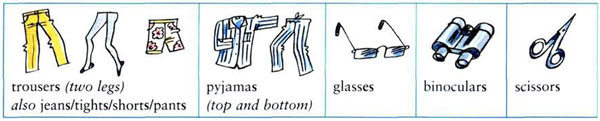
|
| These words are plural, so they take a plural verb: • My trousers are too long. (not my trousers is) You can also use a pair of + these words: • Those are nice jeans. or That’s a nice pair of jeans. (not a nice jeans) • I need some new glasses. or I need a new pair of glasses. |
Unit 79- Part B
Some nouns end in -ics, but are not usually plural. For example:
athletics economics electronics gymnastics maths (= mathematics) physics politics
• Gymnastics is my favourite sport. (not Gymnastics are)
News is not plural (see Unit 70B):
• What time is the news on television? (not are the news)
Some words ending in -s can be singular or plural. For example:
means a means of transport many means of transport
series a television series two television series
species a species of bird 200 species of bird
Unit 79- Part C
Some singular nouns are often used with a plural verb. For example:
audience committee company family firm government staff team
These nouns are all groups of people. We often think of them as a number of people (= they), not as one thing (= it). So we often use a plural verb:
• The government (= they) want to increase taxes.
• The staff at the school (= they) are not happy with their new working conditions.
In the same way, we often use a plural verb after the name of a sports team or a company:
• Italy are playing Brazil next week (in a football match).
• Shell have increased the price of petrol.
A singular verb (The government wants … / Shell has … etc.) is also possible.
We use a plural verb with police:
• The police are investigating the murder, but haven’t arrested anyone yet. (not The police is … hasn’t)
Note that we say a police officer / a policeman / a policewoman (not a police).
Unit 79- Part D
We do not often use the plural of person (‘persons’). We normally use people (a plural word):
• He’s a nice person. but They are nice people. (not nice persons)
• Many people don’t have enough to eat. (not Many people doesn’t)
Unit 79- Part E
We think of a sum of money, a period of time, a distance etc. as one thing. So we use a singular verb:
• Twenty thousand pounds (= it) was stolen in the robbery. (not were stolen)
• Three years (= it) is a long time to be without a job. (not Three years are)
• Six miles is a long way to walk every day.
Exercises
{slide=1 Complete each sentence using a word from Sections A or B.} Complete each sentence using a word from Sections A or B. Sometimes you need a or some.
{tooltip}Key.{end-link}3 shorts
4 a means
5 means
6 some scissors or a pair of scissors
7 a series
8 series
9 species{end-tooltip}
1 My eyesight isn’t very good. I need glasses.
2 A cpecies is a group of animals or plants that have the same characteristics.
3 Footballers don’t wear trousers when they play. They wear _______________.
4 The bicycle is _______________ of transport.
5 The bicycle and the car are _______________ of transport.
6 I want to cut this piece of material. I need _______________.
7 A friend of mine is writing _______________ of articles for the local newspaper.
8 There are a lot of American TV _______________ shown on British television.
9 While we were out walking, we saw many different _______________ of bird. {/slide} {slide=2 Write the name of the activity.}In each example the words on the left are connected with an activity (for example, a sport or an academic subject). Write the name of the activity. The beginning of the word is given.
{tooltip}Key.{end-link}2 politics
3 economics
4 athletics
5 physics
6 gymnastics
7 electronics{end-tooltip}
| 1 calculate algebra equation 2 government election minister 3 finance trade employment 4 running jumping throwing 5 light heat gravity 6 exercises somersault parallel bars 7 computer silicon chip video games |
mathematics p________________ e________________ a________________ ph_______________ gy_______________ el________________ |
{/slide} {slide=3 Choose the correct form of the verb, singular or plural.}Choose the correct form of the verb, singular or plural. In one sentence either the singular or plural verb is possible.
{tooltip}Key.{end-link}2 don’t
3 want
4 was
5 aren’t
6 wasn’t
7 does or do
8 isn’t
9 they are
10 are
11 Do
12 is{end-tooltip}
1 Gymnastics is / are my favourite sport. (is is correct)
2 The trousers you bought tor me doesn’t / don’t fit me.
3 The police want / wants to interview two men about the robbery last week.
4 Physics was / were my best subject at school.
5 Can I borrow your scissors? Mine isn’t / aren’t sharp enough.
6 Fortunately the news wasn’t / weren’t as bad as we expected.
7 Where does / do your family live?
8 Three days isn’t / aren’t long enough for a good holiday.
9 I can’t find my binoculars. Do you know where it is / they are?
10 It’s a nice place to visit. The people is / are very friendly.
11 Does / Do the police know how the accident happened?
12 I don’t like very hot weather. Thirty degrees is / are too hot for me. {/slide} {slide=4 Most of these sentences are wrong. Correct them where necessary.}Most of these sentences are wrong. Correct them where necessary.
{tooltip}Key.{end-link}3 … wearing black jeans.
4 OK (Brazil is playing is also correct)
5 … very nice people.
6 Ten pounds isn’t
7 … buy some new pyjamas. or … buy a new pair of pyjamas.
8 OK (The committee hasn’t is also correct)
9 There was a police officer / a policeman / a policewoman …
10 What are the police …
11 These scissors aren’t …{end-tooltip}
| 1 Three years are a long time to be without a job. 2 The govermnent want to increase taxes. 3 Susan was wearing a black jeans. 4 Brazil are playing Italy in a football match next week. 5 I like Martin and Jane. They’re very nice persons. 6 I need more than ten pounds. Ten pounds aren’t enough. 7 I’m going to buy a new pyjama. 8 The committee haven’t made a decision yet. 9 There was a police directing traffic in the street. 10 What is the police going to do? 11 This scissors isn’t very sharp. |
Three years is a long time. OK (wants is also corrrect) _________________________ _________________________ _________________________ _________________________ _________________________ _________________________ _________________________ _________________________ _________________________ |
{/slide}
www.sambookia.com – онлайн-система бронирования, позволяющая Вам ежедневно узнавать авиабилеты стоимость, бронировать авиабилеты, железнодорожные билеты, отели, автомобилии. Путешествуй по миру без посредников!
ENGLISH GRAMMAR IN USE FOR INTERMEDIATE
33. SHOULD 1
|
A |
You should do something= it is a good thing to do or the right · · · We often use should with I think · · · You shouldn’t do something= it isn’t a good thing to do: · Should is not as strong · · |
|
B |
You can use should when something is not right or what you expect:
· · We also use should to say that we expect something to happen: · Helen has been studying · (= I don’t expect |
|
C |
You should have done something= you didn’t do it, but it would · · You shouldn’t have done something= you did it, but it was the · · Compare should (do) and should · · |
|
D |
Ought You can use ought to instead of should · · · · |
EXERCISES
|
33.1 |
For each situation, write a sentence go away for a few days put some pictures on the walls go to bed so late take a photo Look for another job use her car so much
|
||||||||||||||||||
|
33.2 |
Read the situations and write sentences
|
||||||||||||||||||
|
33.3 |
Complete the sentences with should (have)+ the verb in brackets.
|
||||||||||||||||||
|
33.4 |
Read the
|
ANSWER
KEY
33.1
2 You should look for another job.
3 He shouldn’t go to bed so late.
4 You should take a photo.
5 She shouldn’t use her car so much.
6 He should put some pictures on the walls.
33.2
2 I don’t think you should go out . /I
think you should stay at home.
3 I think you should apply for it. /_for
the j ob.
4 I don’t think the government should increase
taxes.
33.3
3 should come
4 should do
5 should have done
6 should have won
7 should win
8 should be
9 should have turned
33.4
3 We should have reserved a table.
4 The shop should be open (now). /The
shop should have opened by now. Or It
should …
5 She shouldn’t be doing SO. /She shouldn’t
be driving so fast. /She should be driving more slowly.
6 I should have written down her address.
/I should have written her address down. Or
I should have written it down.
7 The driver in front shouldn’t have
stopped without warning. /… shouldn’t have stopped so suddenly.
8 I should have been looking where 1 was
going. /I shouldn’t have been looking behind me.