-
#1
Let’s suppose that a word in English slips my mind. For example “table”. So, I’m pointing to the table and asking my friend who is Englishman: “What do you call it in English?” Or should it be “How do you call…”?
I’ve searched in the forum for “how do you call” and “what do you call” and have found plenty of both variants in similar contexts. Are they both correct or not? I’m asking because I’ve failed to find a single thread where a native corrected “what” to “how” of vice versa. I myself would opt for “what”.
So, what do you think?
-
#2
I think that How do you call it in English? is better than «What…» .
-
#3
I would always say «What do you call that?» or «What is that called?»
«How do you call that?» does not sound like good English to me, though it would be understood.
-
#4
I would always say «What do you call that?» or «What is that called?»
«How do you call that?» does not sound like good English to me, though it would be understood.
Really? I didn’t know it..
-
#5
Just to add to that, I would say, for example:
«How do you say XXX in Italian»
but
«What do you call a/an XXX in Italian»
-
#6
Now I understand, thanks
I said that the best form was «How do you call it..?» ‘<… non-English …>
Last edited by a moderator: Apr 3, 2009
-
#7
In English it is best to use ‘what’ in the place of ‘how’
In many European languages you say how.
<<…>>
How is that called?
A lot of the European’s I speak to say, ‘how do you call it’. It’s not correct but it does, as already stated, get your point across.
It depends on what you are asking.
Asking about a sound or a method of speech
How do you say/pronounce ‘Extraordinary’?
Asking about a word (normally in written language)
What does that mean?
Asking about an object or person
What do you call him, her, it?
Hopefully I helped
Last edited by a moderator: Apr 3, 2009
-
#8
Yes, yes, you helped me and I hope that you helped dec sev too
-
#9
I think that How do you call it in English? is better than «What…» .
I don’t know a single word of Italian, but I suppose, it’s like in Spanish <<…>>. So, you Italians use «how» in this situatioin, as well as we Russians do, that’s why many Russins tend to say «how do you call..» I mean when they speak English. Surprisingly, but nobody makes mistake saying «What is your name». May be because it’s the first phrase you learn when you study English
Last edited by a moderator: Apr 3, 2009
-
#10
Yes, yes, you helped me and I hope that you helped dec sev too

Undoubtfully Thanks a lot!
-
#11
It seems to me that you understand now dec-sev
You are correct in saying the Spanish use how.
English do not in this case.

-
#12
Now I understand, thanks
I said that the best form was «How do you call it..?» because I know that «How» means Come and «What» Cosa…
It is not natural English to say «How do you call it?» to mean «What is the English word for that?», or «What is that called in English?» It is instead the sort of error that would immediately indicate that someone was not a native speaker. The only situation I could imagine in which «how do you call it?» is correct is if you are asking for information about the correct manner of summoning (or «calling») something.
Farmer John: When I want my horse to come to me, I call it with my special horse-summoning call, and when I want my cow, I use my cow-summoning call.
City Sue: And what about your pig? When you want your pig to come to you, how do you call it?
-
#13
It is not natural English to say «How do you call it?» to mean «What is the English word for that?», or «What is that called in English?» It is instead the sort of error that would immediately indicate that someone was not a native speaker. The only situation I could imagine in which «how do you call it?» is correct is if you are asking for information about the correct manner of summoning (or «calling») something.
Farmer John: When I want my horse to come to me, I call it with my special horse-summoning call, and when I want my cow, I use my cow-summoning call.
City Sue: And what about your pig? When you want your pig to come to you, how do you call it?
Very good point. I actually thought about how I could have worded after I made my post
-
#14
better use »how do you call..»it sounds better

-
#15
better use »how do you call..»it sounds better
Hello LilMama — welcome to WordReference
If you are talking about the original context of this thread, meaning «What is the English word for that,» the native speakers above have given a very clear answer. Asking «How do you call it?» very clearly marks you as a non-native.
GWB has explained that in some particular contexts the sentence «How do you call it?» is correct, but those contexts have nothing to do with asking for the English word for something.
<<Moderator note.
This is the English Only forum. Please keep discussion to English. If you wish to discuss other languages, there are other forums.
panjandrum >>
-
#16
Let’s suppose that a word in English slips my mind. For example “table”. So, I’m pointing to the table and asking my friend who is Englishman: “What do you call it in English?” Or should it be “How do you call…”?
I’ve searched in the forum for “how do you call” and “what do you call” and have found plenty of both variants in similar contexts. Are they both correct or not? I’m asking because I’ve failed to find a single thread where a native corrected “what” to “how” of vice versa. I myself would opt for “what”.
So, whatdo you think?
As mentioned by panjandrum,
Asking «How do you call it?» very clearly marks you as a non-native.
But that also implies that native speakers are likely to understand your question.
As an non-native speaker, I am in favor of «What» over «How». Not just because it sounds better or natural, but they are slightly different.
When you asked a «How» question, you are effectively asking for a method or some procedures. Referring to your example, If I am presented with that question, I would assume that you do not know and you also could not pronounce the word «table». You would like me to teach you how to emulate the sound of «table» one syllable at a time. This is akin to asking «How to shutdown a computer?». The answers come in steps.
On the contrary, a «What» question is relatively straight forward. You are expecting something precise and to the point.
I am not suggesting that you should stick to «xxx do you call?», since better choice has already been offered. I am just stating those minor differences between «What» and «How» based on the given context.
-
#17
As mentioned by panjandrum,
But that also implies that native speakers are likely to understand your question.As an non-native speaker, I am in favor of «What» over «How». Not just because it sounds better or natural, but they are slightly different.
When you asked a «How» question, you are effectively asking for a method or some procedures. Referring to your example, If I am presented with that question, I would assume that you do not know and you also could not pronounce the word «table». You would like me to teach you how to emulate the sound of «table» one syllable at a time. This is akin to asking «How to shutdown a computer?». The answers come in steps.
On the contrary, a «What» question is relatively straight forward. You are expecting something precise and to the point.
I am not suggesting that you should stick to «xxx do you call?», since better choice has already been offered. I am just stating those minor differences between «What» and «How» based on the given context.
That’s exactly what I was getting at earlier. How implies you want to know the method rather than the word.
Also, when asking ‘What do you call it?’, in most cases it’s better, but not necessary, to say ‘What do you call that?’
The reason is that it sounds a lot more directed, native English and also more specific which can be a problem for non-native speakers. If the object is close enough and it’s obvious about what you are asking about, use that rather than it.
-
#18
I don’t have any problem with using ‘how’ with ‘call’ (when it means to apply a name.) Some quotes:
How do you call this word in German? (Mark Twain; direct quote)
How do you call this lady who is going to sing? (Bernard Shaw; in fiction)
How do you call this place again? (Joseph Conrad; in fiction)
Q: How do you call a man that dives into a swimming pool and that doesn’t get his hair wet?
A: A bald man! (Anonymous)
-
#19
I don’t have any problem with using ‘how’ with ‘call’ (when it means to apply a name.) Some quotes:
How do you call this word in German? (Mark Twain; direct quote)
How do you call this lady who is going to sing? (Bernard Shaw; in fiction)
How do you call this place again? (Joseph Conrad; in fiction)
Q: How do you call a man that dives into a swimming pool and that doesn’t get his hair wet?
A: A bald man! (Anonymous)
Hmmm.
The first is a translation to English from a report in German (presumably) of what Mark Twain said in English.
The next two were spoken by characters whose origins are not immediately clear (one is probably Polish).
The fourth was written by Eduardo Marqes of Espinho.
… All of which supports the view that this usage is an indication of non-native English.

-
#20
I agree with panjandrum. «How do you call X» is not correct English for me. It is a mistake common among non-native speakers because of the prevalence of this structure in their own language. I think most Romance, Germanic and Slavic languages use this structure, at the very least.
Nonetheless, I would correct this to «What do you call X», because «How do you call X in German» sounds absolutely horrible to me. For me, «how» is analagous to «In what way», and so we come back to GreenWhiteBlue’s pig.
My advice to non-native speakers : use «What do you call X». It is correct, it is natural, and it is the structure used by anglophones in 99% of cases. I do not believe that «How do you call X» is correct. Clearly certain other people do, but in my opinion they are in the minority, and if you are aiming to speak correct English, go with «what».
-
#21
Hmmm.
The first is a translation to English from a report in German (presumably) of what Mark Twain said in English.
Exactly! And Sköll should have been more cautious saying that was a direct quote from Twain. Thank you for your post, panjandrum!!!
-
#22
I think how do you call it is better than what do you call it.

-
#23
I think how do you call it is better than what do you call it.
Why do you think that? «How do you call it?» is not English but a direct translation from various other languages.
-
#24
Exactly! And Sköll should have been more cautious saying that was a direct quote from Twain.
Here is the full text:
«He [Twain] had entitled his speech, ‘Die Schrecken der Deutschen Sprache’ (the terrors of the German language). At times he would interrupt himself in English and ask, with a stuttering smile, ‘How do you call this word in German’ or ‘I only know that in mother-tongue.’ » (Albert Bigelow Paine,
Mark Twain: A Biography)
Clearly certain other people do, but in my opinion they are in the minority,…
That could very well be true.
Last edited: Jul 16, 2009
-
#25
Here is the full text:
«He [Twain] had entitled his speech, ‘Die Schrecken der Deutschen Sprache’ (the terrors of the German language). At times he would interrupt himself in English and ask, with a stuttering smile, ‘How do you call this word in German’ or ‘I only know that in mother-tongue.» (Albert Bigelow Paine,
Mark Twain: A Biography)
…
Think about this.
How far removed is the above quotation from what Mark Twain said?
In a speech in German, he lapsed into English and said XXXXX
It was reported, in German, in a Viennese newspaper.
In German?
Yes, because that would be natural and to reinforce the point the writer tells us that he spoke these sentences in English. That would not be necessary if the actual newspaper report gave the sentences in English.
That article was then translated to English to appear in Paine’s biography.
According to Paine, Twain uttered these sentences:
How do you call this word in German.
I only know that in mother-tongue.
Would anyone seriously attribute these two sentences to Mark Twain?
-
#26
It seems Paine made a mistake in reporting the second quote correctly, dropping the word «my» in «my mother tongue». The quote attributed to Mark Twain appears in English in the original German article as reported here.
Cagey
post mod (English Only / Latin)
-
#27
Americans usually don’t refer to their «mothertongue». I don’t think that was different in Twain’s day. It seems likely that in both this phrase and in «How do you call…» he was adapting his English to what he thought his German listeners would most easily understand.
I can imagine doing the same.
Last edited: Jul 17, 2009
-
#28
I agree with panjandrum. «How do you call X» is not correct English for me. It is a mistake common among non-native speakers because of the prevalence of this structure in their own language. I think most Romance, Germanic and Slavic languages use this structure, at the very least.
Nonetheless, I would correct this to «What do you call X», because «How do you call X in German» sounds absolutely horrible to me. For me, «how» is analagous to «In what way», and so we come back to GreenWhiteBlue’s pig.
I agree. In American English, the question «what» is typically looking to be answered with a noun, and the question «how» is looking to be answered with a verb (which is why it is appropriate to say, «How do you say [X]?» because you are looking to be answered with an explanation of how to do something).
In any case, I would defer to the Hershey’s company and their fine chocolate/peanut/caramel confection, the Whatchamacallit.

Howzamacallit just doesn’t sound as tasty!
Last edited: Jul 17, 2009
-
#29
Hi,
Can we shorten «How do you say (a,an) X in English?» to «How to say (a,an) X in English?«
And would it be acceptable to change say/call to be and say
What will (the word/a,an/-) X be in English?
What would X be in English?
What is (it/that) in English?
How will X be in English?
How would X be in English?
How is (it/that) in English?

-
#30
Can we shorten «How do you say (a,an) X in English?» to «How to say (a,an) X in English?»
No. «How to say X in English?» is not a sentence as it has neither a subject nor a verb. It could however be used as a title. My essay is «How to Say X in English». However, the essay would be about
how
to pronounce X not
what
the translation of X is.
What will (the word/a,an/-) X be in English? A prediction about the future?
What would X be in English? Supposing that there isn’t a word for X in English?
What is (the word for) (it/that) in English?
How will X be in English? X will be very nice in English when it gets there in the future.
How would X be in English? Another unreal conditional? How would carrots be in this soup (if we were to add them)?
How is (it/that) in English? It is very nice in English now.
Last edited: Jun 14, 2012
-
#31
Great! Myridon, thank you!
-
#32
If you want to know how a word is pronounced one would say «How do you say thorough in English». If you want a translation one might say «What do you call a klotz in English» (random word taken from German dictionary). The usual usage of what do you call it is such as «The what do you call it fell on top of him» «You mean the lathe» «That’s it». It is used when one has either forgotten or never knew or temporarily cannot be bothered to think of a word. «Thingummy» is often used in the same way.
-
#33
If you want to know how a word is pronounced one would say «How do you say thorough in English»
Then what do «How do you say thorough in French?» and «How do you say klotz in English?» mean?
-
#34
«How do you say thorough in English» might be asked by someone who speaks English but has not met the word before. This is not unusual. Through, though, tough, plough etcetera. It is the sort of thing that is not inherently obvious, children need a lot of teaching before they know the difference and there are some names, Clough for instance that are similar. If I ask «How do you say thorough in French?» I want a translation of the word into French; if I ask «How do you say klotz in English?» I want a translation into English.
-
#35
How do you say klotz in English? Another, less ambiguous, version would be «What is the English word for klotz?»
How do you call klotz in English?
-
#36
I agree with the other native speakers. Use «What do you call this» and don’t use «how do you call this.»

-
#37
In Vietnam, we will use «how do you call it» for that structure as well because of the language’s difference? but it’s better to use the native English structures.
-
#38
No. «How to say X in English?» is not a sentence as it has neither a subject nor a verb. It could however be used as a title. My essay is «How to Say X in English». However, the essay would be about
how
to pronounce X not
what
the translation of X is.
I’m just interested, can one be thinking this way to himself?
How to say X in English?
along with, for example
How can I say X in English?
-
#39
What about addressing someone?
Do we say, «how may I address you?» or «what may I address you?»
-
#40
What about addressing someone?
Do we say, «how may I address you?» or «what may I address you?»
It is a little old fashioned to say ‘may’ although not strictly incorrect: most people in the UK would say ‘should’ instead.
«How should I address you?»
«What should I address you.»
«What should I address you as?»
I can’t say I’ve ever had to ask someone else how to address them mind you, it is generally obvious unless you are meeting a member of the nobility.
If you want to know whether to use their first or second name, the general rule is to use their title followed by their second name (Ms Wilson, Mr Smith, Dr Jones, Professor McDonald) until told otherwise, with anyone who is older or more senior in rank than yourself.
-
#42
You would say «How may I address you?» Note that you are asking for someone to describe a method of doing something, and that the answer uses the word «as»:
Servant: How may I address you?
Nobleman: You may address me as «Lord Vertblancbleu.»
If you were asking for a name using «call», you need to use «what», and there is no «as»:
Nobleman: What do they call you, my good fellow?
Servant: They call me Humble Tom, my lord.

-
#43
How may I … = In which manner may I …
What may I … = Of many options. which may I …
Which may I … = Of limited options, which may I …
Правильно говорят: другой язык — другой образ мыслей. Порой удивляешься, почему у них, англоговорящих, именно так, а не иначе. Например, почему в английском языке слово “advice” (совет) может быть только в единственном числе? Или, допустим, почему “funny” означает и “смешной/забавный”, и “подозрительный”?
При этом мы, носители русского языка, часто забываем об этой разнице и переводим свои мысли, калькируя (повторяя) родной язык. Существует даже выражение “рунглийский язык”. Этот неологизм обозначает некий “диалект” английского, созданный русскими. Вот типичные ошибки в английском языке:
- русские ошибки в английском произношении (подробнее в статьях “Как мне говорить по-английски, если мой язык — русский”, “Разбираем сложные звуки английского языка: æ, ʌ, a:”),
- неверное использование времен английских глаголов (читай статью “Как выразить русские мысли в системе английских времен”).
- куча других ошибок, о которых и пойдет речь ниже.

Я чувствую подмену: о неверном использовании ряда английских слов
Зачастую, мы переводим некоторые фразы неверно, поскольку думаем, что в английском языке они звучат так же, как и в русском, что приводит к лексическим ошибкам в английском языке.
Распространяется это явление на многие слова. Начнем с местоимений:
Когда мы хотим уточнить название чего-либо, то используем вопросительное местоимение “как”.
Пример: “Как это называется в английском языке?” — говорит русскоговорящий и показывает на некий предмет.
Затем мы переводим это предложение по образу и подобию, допуская очень распространенную ошибку:
Неправильно: How do you call this in English? или How is it named on English?
Правильно: What is it called in English? (или What is the English for this?)
Еще один сложный случай:
Неправильно: I have a sister which studies at school
Правильно: I have a sister who studies at school (У меня есть сестра, которая учится в школе)
Такие же “неловкости” могут поджидать нас в вежливых формах обращения:
Человеку, давно изучающему английский, известно, что на “Thank you” нужно ответить либо “You are welcome”, либо “My pleasure”. Но нередки случаи калькирования русского “пожалуйста”, что приводит иностранцев в замешательство 🙂 Приведу еще несколько примеров странной для иностранцев вежливости:
Неправильно: переспрашивать что-то неуслышанное словом “what?” (Что?)
Правильно: Excuse me? (или Sorry?)
Неправильно: Give me a cup. (для иностранца, особенно незнакомого, эта фраза прозвучит довольно грубо, поскольку представляет собой указание, почти приказ)
Правильно: Could you give me a cup, please?
Предлоги — еще одна головная боль:
Лично для меня, кстати, наиболее сильная. Стыдно признаться, но я пока ни разу не смогла пройти грамматическую тренировку по предлогам на все 10 баллов 🙁
Пример: “Я злюсь на него!” — говорим мы по-русски, а затем так же переводим на английский язык.
Неправильно: To be angry on somebody
Правильно: To be angry with somebody
Еще ряд сложных для нашего понимания примеров:
Неправильно: In this moment
Правильно: At the moment (в данный момент)
Неправильно: It depends from him (или Depend of him)
Правильно: It depends on him (это зависит от него)
Неправильно: Divide on groups
Правильно: Divide into groups
Неправильно: To wait somebody
Правильно: To wait for somebody (ждать кого-то)
Неправильно: To graduate school
Правильно: To graduate from school (окончить школу)
Неправильно: To listen somebody/music
Правильно: To listen to music (слушать музыку)
Неправильно: To be afraid somebody/something
Правильно: To be afraid of something (бояться чего-то)
Помни, что в русском языке существительные имеют формы косвенных падежей, а в английском — падежи образуются при помощи предлогов (отсюда и “растут ноги” таких несоответствий). Подробнее читай в статье “Взвешиваем языки: словоизменение в русском и английском”.
Ты говоришь лишнее: о добавлении ненужных слов
Приведу пример, уже ставший классикой:
“Я хорошо себя чувствую” — говорим мы в ответ на вопрос сопереживающих.
Как перевести это предложение на английский? Просто вспомни песню Джеймса Брауна 🙂
Неправильно: I feel myself good
Правильно: I feel good
Идем дальше. Приведу еще примеры с лишними словами:
Неправильно: I am agree with you
Правильно: I agree with you (глагол-связка не требуется, т.к. agree — это глагол)
Неправильно: <…> and etc.
Правильно: <…> etc. (и т.д.)
Ты явно что-то не договариваешь: об игнорировании нужных слов
В первую очередь это, конечно, касается артиклей. Объяснить эту ошибку очень просто: в русском языке их нет. Повторять правила использования артикля не стану — найти эту информацию можно во многих источниках (например, в грамматической тренировке на Lingualeo). Скажу лишь, что русские люди зачастую могут говорить ВООБЩЕ не используя артиклей при том, что употреблять их необходимо!

Не доверяй “ложным друзьям переводчика”
— It’s from another magazine, — сказал как-то мой знакомый продавщице, которая просила заплатить за бутылку воды, купленную им в другом магазине.
— May be it’s from another shop? — лукаво переспросила она 🙂
Таких межъязыковых омонимов очень много:
- “abuse” — значит “злоупотребление, оскорбление” (а не обуза);
- “accord” — согласие (а не аккорд);
- “Antarctica” — Антарктида (а не Антарктика);
- “baton” — жезл, дирижерская палочка (а не батон);
- “cabinet” — шкаф с выдвижными ящиками (а не кабинет);
- “compositor” — наборщик, а не композитор;
- “data” — данные, факты, сведения (а не дата);
- “examine” — рассматривать, осматривать (а не экзамен) и др.
Чтобы не попасть в неловкую ситуацию, такие слова нужно запомнить. Кстати, на Lingualeo есть целый набор этих слов. Добавь их в свой словарь и прогоняй по разным тренировкам 🙂 Или хотя бы зайди и посмейся!
Список “опасных” мест
Назову еще ряд “ловушек”, подстерегающих нас, носителей русского языка:
1. Несоответствие русских и английских исчисляемых/не исчисляемых слов.
Об одном таком слове я уже упомянула в начале статьи — advice.
Неправильно: My mother gave me good advices
Правильно: My mother gave me good advice (даже если имеем в виду несколько советов).
Еще одно слово, которое может ввести нас в замешательство — news. Загвоздка с этим словом состоит в том, что оно имеет форму только единственного числа.
Неправильно: What are the news?
Правильно: What is the news?
2. К тому же существуют устойчивые выражения, в которых мы используем множественное число, а они — единственное:
Неправильно: No problems
Правильно: No problem (Нет проблем, или Не проблема)
Неправильно: no comments
Правильно: no comment (без комментариев).
3. В русском языке есть многозначные слова, для перевода которых в английском языке используются уже слова разные.
Например, слово “палец” — это конечная часть и руки, и ноги в русском языке. Тогда как в английском — в первом случае нужно использовать “finger” (палец руки), а во втором — “toe” (палец ноги).

Примеры таких слов
Итак, предлагаю на этом закончить обзор и предаться изучению английского, дабы ни одна ошибка не прокралась в твою безупречную речь 🙂 Успехов!
Очень полезная статья: Львята учатся читать, или Подборка книг на английском для новичков
and welcome to ELU. The answer to your question is as simple as it is complicated.
There are many standard ways of saying things in one language of which there is no suitable word for word translation into English. Romance languages are an example, such as French.
What is your name?
The French do not say:-
Quel est votre nom? (although a Frenchman would know what you are trying to say).
A Frenchman would say this:-
Comment vous appelez-vous ?
And an Italian or a Spaniard would express the question is a similar fashion, as, in fact, would a Greek: Πως ονομάζεσθε («how are you called?»)
So how can be ruled out straight away. Both your other two might do, depending on the thing/idea/circumstance under discussion was. So «I am not sure what it is called (or what you call it) in English are equally possible. There is a third possibility:
I am not sure of the right word for it in English.
But that is no better than the other two. Choice between these is a matter of personal choice.

В статье вы узнаете, какие есть популярные ошибки на английском языке.
1. I feel myself («Я чувствую себя»)
Неправильно: I feel myself fine today.
Правильно: I feel fine today.
В английском языке после глагола feel («чувствовать») не ставится возвратное местоимение myself («себя») — носители английского и так поймут, что вы говорите о своем самочувствии. Они говорят просто: I feel well / I feel sick / I feel happy.
Можно говорить просто feeling myself today. Раньше это считалось неприличным выражением («трогать себя»), но сейчас американская молодёжь так выражает хорошее настроение.
2. Enough («Достаточно»)
Неправильно: She spoke English enough well to get the job.
Правильно: She spoke English well enough to get the job.
В английском языке правильный порядок слов важнее, чем в русском. Место слова enough в предложении зависит от того, к какой части речи оно относится: наречию, прилагательному или существительному.
Если enough относится к наречию или прилагательному, то стоит после смыслового глагола:
— Do you think he’s old enough to watch that movie?
— We’ve done enough today.
Old («взрослый») — прилагательное, today («сегодня») — наречие.
Если enough относится к существительному, то стоит перед глаголом:
— We had enough money to buy a ticket.
3. Normal («Нормально»)
Неправильно: How are you? — I’m normal, thanks.
Правильно: How are you? — I’m fine, thanks.
В английском языке мы обычно не употребляем слово normal («нормально»), чтобы рассказать о своем настроении или прошедшем дне. Носители английского говорят fine или ok. А слово normal они воспринимают, скорее, в значении «средний, обычный» или же именно «нормальный».
Представьте, что у вас спрашивают: «Как дела, как ты?» А вы отвечаете: «Я нормальный». Согласитесь, звучит нелепо: вы будто пытаетесь убедить собеседника, что вы нормальный человек, а не странный или даже сумасшедший. Возможно, как раз самое время заявить о своей нормальности миру, но вы-то наверняка говорили совсем не об этом.
4. Scientist, scholar («Ученый»)
Неправильно: Scientists study history so that humanity can learn from the past.
Правильно: Scholars study history so that humanity can learn from the past.
Оба слова: и scientist, и scholar — переводятся с английского языка как «ученый», но значение у них разное.
Scientist — это эксперт в точных (химия, физика, математика, биология) или социальных (психология, социология, политология) науках.
Scholar — это эксперт в определенной области знаний. Он отлично разбирается в предмете, потому что изучает его. Scholar — специалист в областях вроде истории, искусства или языках. Так же называют умненького студента, который получает стипендию — scholarship.
Разница еще и в том, что a scientist для изучения предмета пользуется научными методами — строит гипотезы, проводит эксперименты, делает заключения. А scholar обычно обходится без этого.

5. Предлоги
Неправильно: I was waiting David on the theater.
Правильно: I was waiting for David at the theater.
При изучении английского языка русскоговорящие часто путаются в предлогах или вовсе опускают их. Нам кажется, что предлоги в английских фразах должны быть такими же, какими были бы в русских. Но это не так. Чтобы не путаться, надо просто выучить самые распространенные выражения, где предлог тесно связан с глаголом.
Depends on — «зависит от».
Tired of — «устал от».
To divide into — «разделить на».
Часто в английском предложении предлог необходим, а в русском не нужен, или наоборот:
To wait for someone — «ждать кого-то».
To graduate from school — «окончить школу».
To listen to someone/music — «слушать кого-то/музыку».
To be afraid of someone/something — «бояться кого-то/чего-то».
To explain to someone — «объяснять кому-то».
To answer a question — «ответить на вопрос» (обратите внимание: без предлога, но с артиклем).
Предлоги можно разделить на несколько категорий. Так вы быстрее поймете, когда и какой предлог употребить:
Покрытия (настольные, настенные, напольные, плиты, крыша, полки): on.
— Например: on the roof, on the table.
Технологии (компьютер, телевизор, радио, экран, DVD, жесткий диск, CD): on.
— On this DVD.
Общественный транспорт (поезд, автобус, трамвай, самолет, корабль, паром): on.
— On the bus, on the ship.
Внутри физического объекта/структуры (книга, карман, ящик, номер): in.
— In his pocket, in a box.
Места (офис, стадион, магазин, супермаркет, станция, театр, парк): at/in.
— In the street, at the station.
6. How and What («Как» и «Что»)
Неправильно: How do you call this in English?
Правильно: What do you call this in English?
Носители русского языка часто путают вопросительные слова how и what, спрашивая на английском: «Как это называется?» Они пытаются начать фразу с привычного «как» — how. Но в английском употребляют именно what. Это нужно запомнить.
7. City
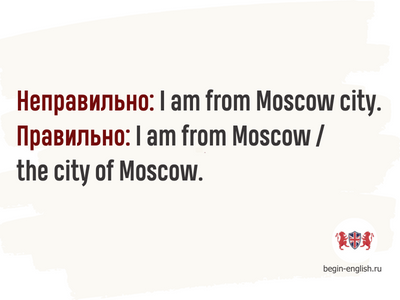
Часто говорят только название (Москва, Нью-Йорк, Лондон) и не добавляют слово «город». Если же важно уточнить, что это именно город и ничто иное, то используйте конструкцию the city of.
Например: the city of London, the city of Boston, the city of Moscow.
В редких случаях слово «город» входит в название: New York City, Salt Lake City, Mexico City. Иногда так дают понять, что это конкретный город, а не иная географическая зона с таким же названием:
I grew up in a small town in the state of New York, but now I live in New York City.
Although I have lived in Moscow for several years, my parents still live in a small town outside of the city but still in Moscow Oblast.
I visited Salt Lake City this summer.
8. Plural and Singular
(Единственное и множественное число)
Неправильно: The professor gave us several useful advices for our researches.
Правильно: The professor gave us several useful words of advice for our research projects.
И в русском, и в английском языках есть исчисляемые существительные, которые легко можно сосчитать (кресло, яблоко, стакан), и неисчисляемые, которые нельзя посчитать без дополнительных единиц (вода в литрах, время в минутах, рис в граммах). Но часто исчисляемые существительные в английском становятся неисчислимыми.
Пример неисчисляемых существительных:
— Advice, research, knowledge, accommodation, baggage, equipment, furniture, garbage, information, luggage, money, news, pasta, progress, travel, work.
Если вы хотите употребить неисчисляемые существительные во множественном числе, используйте дополнительные слова: piece, glass, chunk.
Например:
We just bought several new pieces of equipment for our lab.
I’ll have three glasses of lemonade, please.
She cut off a large chuck of meat and fed it to her dog.
Есть несколько устойчивых выражений, которые в английском языке всегда употребляются в единственном числе:
— Правильно: Thank God, we have each other.
— Неправильно: Thanks Gods
— Правильно: No problem!
— Неправильно: No problems!
— Правильно: We have no comment about the case.
— Неправильно: No comments.
9. Possibility and Opportunity
Неправильно: I will have the possibility to go to the conference next year.
Правильно: I will have the opportunity to go to the conference next year.
Носители русского языка часто говорят possibility, когда рассказывают о своей возможности сделать что-либо. Но в английском языке есть и слово opportunity, также означающее «возможность». Какое слово использовать, зависит от контекста.
Possibility — это нечто гипотетическое, что может произойти или оказаться правдой.
Opportunity — это благоприятные обстоятельства, которые позволяют нам сделать что-либо или дают шанс действовать.
There is a possibility that it will rain tomorrow, so you will have an opportunity to use your new umbrella.
There is a possibility that we will have enough funding for another research assistant position. If so, you will have an opportunity to apply for this position.

10. Say and Tell
Неправильно: Can you say me how to tell this in English?
Правильно: Can you tell me how to say this in English?
Say говорят, когда хотят пересказать слова другого человека. Tell употребляют, когда хотят о чем-то попросить, спросить или информируют кого-то о чем-либо. Глагол tell сопровождается прямым дополнением: tell us/him/her/the audience.
At lunch John told his coworkers about his business trip to China.
John said that the business trip to China went very well.
Запомните эти словосочетания:
Say yes or no, a few words, something.
Tell a story, a lie, a secret, a joke, the truth.
11. Learn and Teach

Неправильно: Can you learn me to speak English better?
Правильно: Can you teach me to speak English better?
Learn и teach часто путают, потому что оба слова означают «учить». Но в английском языке их значения совершенно разные.
Learn — это учиться самостоятельно. Студент учит домашнее задание, девочка учится играть на гитаре, и так далее.
Teach — это обучать кого-то. Преподаватель обучает студентов тонкостям языка.
«I remind myself every morning: Nothing I say this day will teach me anything. So if I’m going to learn, I must do it by listening» — Larry King.
12. Free
Неправильно: I want to speak English freely.
Правильно: I want to speak English fluently.
Если человек хочет сказать, что свободно говорит на иностранном языке, то использует слово fluent, а не free.
Да, free означает «свободно», но другое его значение — «бесплатно». А если free стоит после существительного (smoke-free, car-free, alcohol-free), это означает, что действие запрещено.
This is the smoke-free bar. If you want to smoke, you must go outside.
13. Do and Make
Неправильно: I think I did a mistake.
Правильно: I think I made a mistake.
На русский язык оба глагола — do и make — переводятся как «делать». Но значение у них разное.
Do — для повседневной деятельности или работы, результатом которой станет нечто нематериальное, то, что нельзя потрогать:
Do homework, do the dishes, do the laundry, do a job, do the shopping.
Do используют, когда обобщают, а не конкретизируют. Часто рядом стоят слова something, nothing, anything, everything:
He has done nothing all day.
She would do anything for her Mom.
Is there something I can do for you?
Make употребляют, когда говорят о создании материальной, ощутимой вещи:
Make food, make a cup of tea, make clothes, make a mess.
Но есть много словосочетаний-исключений с глаголами make и do, которые просто нужно запомнить:
Make money, do someone a favor, do business, make a decision, do good, make a plan.
14. Expensive и dear («Дорогой»)
Неправильно: That computer is too dear for me to buy.
Правильно: That computer is too expensive for me to buy.
Русское слово «дорогой» переводится на английский как expensive или dear, опять-таки в зависимости от контекста. Оба слова означают нечто ценное для человека, но смысл у них разный.
Dear — это нечто ценное в эмоциональном или личностном смысле:
This necklace isn’t very expensive, but, since it belonged to my grandmother, it is very dear to me.
Expensive — это нечто ценное в финансовом смысле, например, дорогостоящая покупка:
I wish I hadn’t dropped my new iPhone in the toilet. It was really expensive!
15. Gender («Род»)
Неправильно: It’s time I bought a new computer, since he is very old.
Правильно: It’s time I bought a new computer, since it is very old.
Носители русского языка часто по привычке говорят he или she в случаях, когда надо использовать it.
В английском языке личные местоимения he или she применимы по отношению к людям. Уместно говорить he или she про собак, кошек или других животных, чей пол известен. Часто мы называем так домашних животных, которых любим или которые нам нравятся, они для нас не безликое it, а именно he или she — «он» или «она».
I have fond memories of my dog, Spot. He was a great dog.
Можно говорить так о неодушевленных предметах, к которым мы привязаны — автомобилях, кораблях и даже странах:
Look at that sports car! Isn’t she a beauty?
«God bless America,
Land that I love,
Stand beside her, and guide her
Through the night with a light from above».
Irving Berlin
В английском языке есть слова, у которых уже есть род — они учитывают фактический пол человека или животного:
Женский: women, girl, mother, daughter, aunt, niece, nun, goddess, empress, queen, princess, heroine, actress, waitress, lioness, cow.
Мужской: man, boy, father, son, uncle, nephew, monk, god, emperor, king, prince, hero, actor, waiter, lion, bull.
В современном английском языке слова вроде waiter («официант»), actor («актер»), hero («герой») используются как для мужского, так и для женского рода. Если необходимо точно обозначить пол, можно добавить слова «мужчина» или «женщина»:
In Shakespeare’s time women couldn’t be actor and play on stage, so all female roles were played by actor men.
В английском языке слово hero («герой») означает не только героя книги. Герой — это человек, реальный или вымышленный, проявляющий большую смелость или идущий на жертву ради общего блага.
Чтобы учить английский дальше, переходите на эту статью с лексикой английского языка о развлечениях.
Оставить комментарий
Для комментирования необходимо войти через  Вконтакте
mmelik-adamyan
больше года назад
И еще 17 самая ужасная ошибка:
Неправильно: I want that she do/ will do/ does/ did.
Правильно: I want her to do.
Многие забывают, что после want нельзя ставить ни that, ни she. В английском такое русское сложноподчиненное предложение переводится простым предложением, с одним подлежащим. Пожалуйста, говорите They want me to come, а на русский переводите Они хотят, чтобы я пришла.
4
There’s a difference in language between being understood and sounding natural to a native speaker.
The words that make up «how do you call it» make sense and anyone who speaks English will understand you, but it’s a dead giveaway for someone who is learning (American) English non-natively.
The only reason languages change and evolve is because people start using one phrase or word and stop using others. For whatever reason, be it a popular shared piece of media like Shakespeare or Johnny Carson, or cultural attitudes or even large historical events, a group will stop using a word or phrase and it’ll fall out of fashion. It’ll still make sense, sure, because the words line up meaning-wise, but it’ll sound awkward and foreign.
I don’t know the particular etymology behind this phrase. I don’t know that anyone would (I’d like to know, if someone does). I don’t know that «how do you call it» was ever a used English phrase. Most certainly no authority sat down and decided to go with «how do you say», or «what do you call», instead of «how do you call it». It’s more that it, like all of language, just sort of… happened.
Без всяких сомнений английский является глобальным языком в наши дни, ведь миллионы людей по всему миру используют его для общения, путешествия, бизнеса, для различных технологий, туризма и даже образования, или же просто для разговора с родственниками, друзьями, коллегами. Согласитесь, ведь многие дети и подростки обладают большим запасом лексики благодаря играм, где используется английский язык, большинство электронных девайсов использует английских язык. Более того, английский один из самых легко изучаемых языков в мире. Но почему же когда мы изучаем английский, мы делаем очень много разных, но довольно типичных ошибок. Сегодня мы разберем 8 самых типичных ошибок, которые делают русскоговорящие люди при изучении английского языка.
1. Первая, и, на мой взгляд, самая огромная ошибка в речи русскоговорящих людей, это когда они используют фразу «Я хорошо говорю на английском». Естественно, все знают английское слово «good» и это прекрасно, но запомните, НИКОГДА не говорите «I speak English good». Если хотите выглядеть как настоящий англоговорящий человек, то нужно говорить правильно «I speak English well». Или же если очень хочется употребить слово «good», то правильно будет сказать «I speak good English». Почему так? Нужно помнить, что в английском, как и в русском языке, есть прилагательные, которые описывают качество предмета и отвечают на вопрос Какой?, и наречия, описывающие качества действия Как?. То есть, запоминаем:
I speak English well или I speak good English
2. Вторая типичная ошибка – это когда мы хотим задать вопрос «Как это называется?» или когда хотим узнать эквивалент русскому слову в английском языке. Без сомнений, вы сразу подумали о «How do you call it/this?»…и снова сделали ошибку. Да, на русском языке мы говорим «как» и на английском, естественно, это будет «how» НО, правильно будет сказать «What do you call it/this?». То есть:
What do you call this animal? – It is a dog (Как называется это животное? – Это собака).
Когда мы употребляем «How do you call it?» — это вопрос к обстоятельству образа действия, то есть КАК вы называете это? В смысле – громко, тихо, ласково и т.д.
3. Третья и не менее важная ошибка, когда употребляете фразы на подобии «I am agree to go to the movie» или «I am like apples», НИКОГДА, запомните, НИКОГДА не ставьте глагол «to be» и другой глагол рядом в одном предложении. Глагол to be ставим только перед существительными или прилагательными, например:
I am a girl или же She is a beautiful girl.
Никаких «I am agree, you are agree, we are agree, she is agree etc». Правильно будет «I agree to go to the movie, I like apples».
4. Ошибка номер 4.
«I very like cooking» — Я очень люблю готовить
Да, по-русски мы говорим «Я очень люблю петь/танцевать» или «Я очень люблю готовить», но по-английски нужно говорить «I like cooking very much», так как фразы «very well, very much ect» мы всегда ставим в конец предложения.
Например:
My mum cooks very well – Моя мама готовит хорошо
I drive car very fast – Я вожу машину быстро
5. Идем далее, ошибка под номером 5 не очень очевидна и более того, мы могли о ней не слышать, но она так часто встречается в речи, что не разобрать ее не можем. Итак, когда хотим сказать следующую фразу: «Мы с моими родителями или мы с моей женой пошли в кино». На русском все довольно легко и предельно ясно, но на английском ни в коем случае нельзя переводить эту фразу следующим образом:
«We and my girlfriend went to the movies» — «Мы с моей девушкой пошли в кино» – эта фраза будет обозначать, что не только вы и ваша девушка пошли в кино, но и кто-то третий. Если же вы все-таки пошли вдвоём, то правильнее будет сказать:
«My girlfriend and I went to the movies» – Я пошел в кино со своей девушкой.
«My dog and I like meat» – Моя собака и я оба любим мясо.
6. Следующая и очень часто употребляемая ошибка в нашей речи, когда вы говорите «My mood depends from the weather» – Мое настроение зависит от погоды, но правильно говорить «depend on». Например:
« The clothes I wear depend on the weather» – Одежка, которую я ношу, зависит от погоды.
7. Следующая часто встречаемая ошибка в речи русскоговорящих это когда желаем выразить свои чувства, то есть употребить фразу «Мне скучно!», «Мне интересно» и т.д. Зачастую многие говорят: «I am so boring» или «I am interesting» …это не совсем правильно. Нужно говорить: «I am so bored», «I am interested». «Почему?» – Спросите вы. Прилагательные, которые имеют окончания -ed, описывают чувства человека, в то время как прилагательные с окончанием -ing, описывают те вещи, которые заставляют нас чувствовать.
Например:
I`m not very interested in history – Я не очень интересуюсь историей.
TV programs about history are very boring – Телевизионные программы об истории очень скучные.
8. Последняя и самая распространённая ошибка, когда говорим «I fell myself». Конечно, в русском язык говорим: «Я чувствую себя плохо/хорошо» и дословно переводим на английский. Но это неверно. Когда употребляем фразу «I fell myself», имеем ввиду, что мы себя щупаем в прямом смысле и иногда выглядим глупо. То есть таким образом мы не передаем наше душевное или физическое состояние. Правильнее будет сказать «I feel bad or good, happy or sad».
А теперь давайте проверим себя. Предлагаю просмотреть все правила еще раз и исправить ошибки в следующих предложениях:
1. She speaks English very good.
2. How do you call this food? – It is an apple.
3. She is agrees to marry me.
4. He very much likes speak French.
5. We and my parents decided to buy new car.
6. All my life and mood depend from you.
7. This grammar lesson is bored.
I am boring reading all about these grammar rules.
8. I feel myself happy because of new presents.
Конечно же вы правы!!
В следующих предложениях правильными ответами будут:
1. She speaks English well!
2. What do you call this food? – It is an apple.
3. She agrees to marry me!
4. He likes speak French very much.
5. My parents and I decided to buy new car.
6. All my life and mood depend on you.
7. This grammar lesson is boring.
I am bored reading all about these grammar rules.
8. I feel happy because of new presents.