I have upgraded my Inteliij IDEA 2019.2 recently and I am getting below error, if I try to pull from my IDE
Git Pull Failed: unable to access ‘https://github.xxx.com/app-Hello-USD/DGS.git/’: SSL certificate problem: self signed certificate in certificate chain.
Could some one help me what option I have to enable.
Thanks

CrazyCoder
382k168 gold badges964 silver badges881 bronze badges
asked Aug 2, 2019 at 13:35
1
git config --global http.sslVerify false
answered Aug 2, 2019 at 21:42
CrazyCoderCrazyCoder
382k168 gold badges964 silver badges881 bronze badges
7
To expand on the answer of @CrazyCoder.
This usually happens because your Git repository server is hosted inside a private network and uses a locally generated (self signed) TLS certificate. Because this certificate is not from a «trusted» source, most software will complain that the connection is not secure.
So you need to disable SSL verification on Git to clone the repository and immediately enable it again, otherwise Git will not verify certificate signatures for any other repository.
- Disable SSL verification on Git globally:
git config --global http.sslVerify false - Clone your repository:
git clone <your repo> - Enable SSL verification on Git globally:
git config --global http.sslVerify true - Change directory into your repo:
cd <your repo> - Disable SSL verification only on your repository:
git config --local http.sslVerify false
In the first step, when turning off SSL verification, if you’re getting this error:
warning: http.sslverify has multiple values
error: cannot overwrite multiple values with a single value
       Use a regexp, --add or --replace-all to change http.sslVerify.
Open your .gitconfig file and remove duplicate http.sslverify lines.
answered Feb 23, 2022 at 11:29

Boško BezikBoško Bezik
1,4002 gold badges17 silver badges33 bronze badges
We can use window certificate storage mechanism.
Please try this
git config —global http.sslbackend schannel
answered Sep 15, 2022 at 14:25

Kyu LeeKyu Lee
911 silver badge2 bronze badges
2
If you want to add the self-signed cert, export the cert you want as a Base-64 encoded .CER file. Locate your Git cert.pem file (for me it is in C:Program FilesGitusrsslcert.pem). Open up your .CER file in a text-editor, and copy/paste the contents at the end of your cert.pem file. Save the file. Then open up your console and type
git config --global http.sslCAInfo "C:Program FilesGitusrsslcert.pem"
answered Mar 16, 2022 at 16:29

codeMonkeycodeMonkey
3,8222 gold badges34 silver badges49 bronze badges
1
If you are connected to a VPN, please try without the VPN. I go this error because of this issue.
answered Jun 30, 2022 at 11:38

From my chief of IT: this can be fixed by disabling SSL checking in the git config for the affected repositories. This should not require elevated privileges to complete.
git config http.sslVerify "false"
This command did not require use of the —global argument.
answered May 11, 2022 at 13:48

brethvoicebrethvoice
3141 gold badge4 silver badges14 bronze badges
1
For github.com you may change protocol from HTTPS to SSH:
-
open .git/config
-
fix url in [remote «origin»] block
old: url = https://github.com/myname/proj1
new: url = git@github.com:myname/proj1.git
answered Dec 22, 2022 at 5:03

VladimirVladimir
5,7612 gold badges29 silver badges35 bronze badges
openssl s_client  -connect www.github.com:443
CONNECTED(000001E4)
depth=1 O = AO Kaspersky Lab, CN = Kaspersky Anti-Virus Personal Root Certificate
verify error:num=19:self signed certificate in certificate chain
---
Certificate chain
 0 s:/businessCategory=Private Organization/jurisdictionC=US/jurisdictionST=Delaware/serialNumber=5157550/C=US/ST=California/L=San Francisco/O=GitHub, Inc./CN=github.com
   i:/O=AO Kaspersky Lab/CN=Kaspersky Anti-Virus Personal Root Certificate
 1 s:/O=AO Kaspersky Lab/CN=Kaspersky Anti-Virus Personal Root Certificate
   i:/O=AO Kaspersky Lab/CN=Kaspersky Anti-Virus Personal Root Certificate
---
Server certificate
-----BEGIN CERTIFICATE-----
….
-----END CERTIFICATE-----
subject=/businessCategory=Private Organization/jurisdictionC=US/jurisdictionST=Delaware/serialNumber=5157550/C=US/ST=California/L=San Francisco/O=GitHub, Inc./CN=github.com
issuer=/O=AO Kaspersky Lab/CN=Kaspersky Anti-Virus Personal Root Certificate
---
No client certificate CA names sent
Peer signing digest: SHA512
Server Temp Key: ECDH, P-256, 256 bits
---
SSL handshake has read 2418 bytes and written 434 bytes
---
New, TLSv1/SSLv3, Cipher is ECDHE-RSA-AES256-GCM-SHA384
Server public key is 2048 bit
Secure Renegotiation IS supported
Compression: NONE
Expansion: NONE
No ALPN negotiated
SSL-Session:
    Protocol  : TLSv1.2
    Cipher    : ECDHE-RSA-AES256-GCM-SHA384
    Session-ID: A1BCEE841D4DBF172402BAF63BC9A80D560ED0FBC8F66B89E692206D3613FD7E
    Session-ID-ctx:
    Master-Key: ************************************************************************
    Key-Arg   : None
    PSK identity: None
    PSK identity hint: None
    SRP username: None
    Start Time: 1527649383
    Timeout   : 300 (sec)
    Verify return code: 19 (self signed certificate in certificate chain)
---
closed`
If you’re using a self-signed certificate on your Bitbucket server, you may receive SSL certificate errors when you try to perform certain actions. This page will help you resolve these errors.
Problem
When trying to perform a clone using instructions stated in Debug logging for Git operations on the client the following error is reported:
$ export GIT_CURL_VERBOSE=1

$ git clone https://username@git.example.com/scm/repository.git
Cloning into 'repository'...
* Couldn't find host git.example.com in the _netrc file; using defaults

* Adding handle: conn: 0x22a7568
* Adding handle: send: 0
* Adding handle: recv: 0
* Curl_addHandleToPipeline: length: 1
* - Conn 0 (0x22a7568) send_pipe: 1, recv_pipe: 0
* About to connect() to git.example.com port 443 (#0)
*   Trying 10.253.136.142...
* Connected to git.example.com (10.253.136.142) port 443 (#0)
* successfully set certificate verify locations:
*   CAfile: C:Program Files (x86)Git/bin/curl-ca-bundle.crt
  CApath: c:/Users/username/Downloads
* SSL certificate problem: self signed certificate in certificate chain
* Closing connection 0
fatal: unable to access 'https://username@git.example.com/scm/repository.git': SSL certificate problem: self signed certificate in certificate chain
Cause
This is caused by git not trusting the certificate provided by your server.
Workaround
One possible workaround is to temporary disable SSL check for your git command in case you only need to perform a one time clone:
GIT_SSL_NO_VERIFY=true git clone https://username@git.example.com/scm/repository.git

or

git remote add origin <gitrepo>
git config --global http.sslVerify false
The workaround is intended to be used for one-time only operations and not to be used frequently. Removing the SSL verification disproves the whole concept of having SSL implemented.
Resolution
Step1: Get a self-signed certificate of the remote server
There is multiple ways of exporting the certificate, Either from the Browser or using the OpenSSL command
Get Certificate using OpenSSL
Get Certificate using OpenSSL
$ echo | openssl s_client -servername NAME -connect HOST:PORT |
  sed -ne '/-BEGIN CERTIFICATE-/,/-END CERTIFICATE-/p' > certificate.pem
Get Certificate using the Web browser
Export Certificate in MAC
Trust Certificate in your browser
To trust a self-signed certificate, you need to add it to your Keychain.
The easiest way to do that is to open the site in question in Safari, upon which you should get this dialog box:
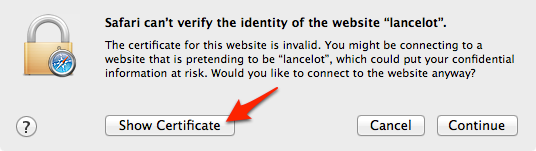
Click ‘Show Certificate’ to reveal the full details:
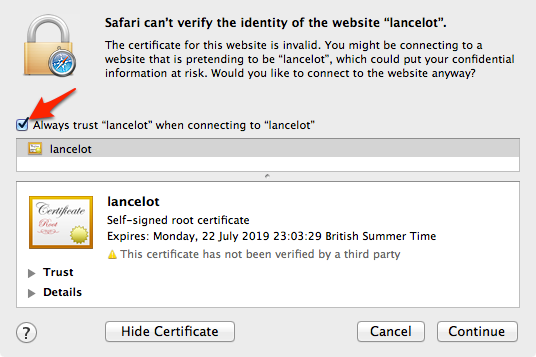
Export Certificate in .pem format
Git doesn’t use the Mac OS X keychain to resolve this, so you need to trust the certificate explicitly.
- If you haven’t done so already, follow the steps in ‘Trust certificate in your browser, above
- Open Applications > Keychain Access and select ‘Certificates’ in the lower-left pane
- Type the website into the Search field in the top-right
- Select the certificate entry for the website, then in the menu click File > Export Items
- In the Save dialog, change ‘File Format’ to ‘Privacy Enhanced Mail (.pem)’ and save the file somewhere on your drive
Export Certificate From Firefox
- Access the URL of the remote server
- Click the Open padlock in the address bar.

- Click the arrow beside OpenConnection Secure.

- Click More Information. The OpenPage Info dialog box opens.

- Click View Certificate.
- The Certificate page opens.
- Scroll down to the Miscellaneous section.
- In the Download row, click the PEM (cert) link.
- In the dialog box that opens, click OK to save the certificate file to a known location.
- Navigate to the location for saving the file, and then click Save.
Step 2: Configure Git to trust the Certificate
For MAC/Linux:
Once the certificate is saved on the client you can instruct your git client to use it to trust the remote repository by updating the local git config:
# Initial clone
GIT_SSL_CAINFO=/path/to/certificate.pem
git clone https://username@git.example.com/scm/repository.git

# Ensure all future interactions with origin remote also work
cd repository
git config http.sslCAInfo /path/to/certificate.pem
For Windows Client:
Step 1: Import the certificate into the window trust store
Import a signed certificate into the local machine certificate store
- Enter Start | Run | MMC.
- Click File | Add/Remove Snap-in.

- In the Add or Remove Snap-ins window, select Certificates and click Add.

- Select the Computer account radio button when prompted and click Next

- Select Local computer (selected by default) and click Finish.

- Back in the Add or Remove Snap-ins window, click OK.

- In the MMC main console, click on the plus (+) symbol to expand the Certificate snap-in.
- To import the CA certificate, navigate to Trusted Root Certification Authorities | Certificates pane.

- Right-click within the Certificates panel and click All Tasks | Import to start the Certificate Import wizard.


- On successfully importing the CA certificate the wizard will bring you back to the MMC main console.

- Close the MMC console.
Step 2: Configure git to use the certificate in the windows Trust store
When using Windows, the problem resides that git by default uses the «Linux» crypto backend. Starting with Git for Windows 2.14, you can configure Git to use SChannel, the built-in Windows networking layer as the crypto backend. To do that, just run the following command in the GIT client:
git config --global http.sslbackend schannelThis means that it will use the Windows certificate storage mechanism and you don’t need to explicitly configure the curl CA storage (http.sslCAInfo) mechanism. Once you have updated the git config, Git will use the Certificate in the Windows certificate store and should not require http.sslCAInfo setting.
Behind a firewall, using chrome, I am able to access a github repository like so:
https://github.com/Squirrel/Squirrel.Windows
Chrome uses our certificate for this access. If I try to access the same url using GitExtensions, I get this error:
SSL certificate problem: self signed certificate in certificate chain
Can I cause GitExtensions to use our certificate to allow access?
EDIT: more info:
On my machine, I don’t see mysysGit, but I do see mingw/curl, so I assume Git is using these. These apparently do not use Windows trust certificates when building the certificate chain. The error that I get, SSL certificate problem: self signed certificate in certificate chain, indicates that the root certificate used by Git/Github is not present in the built-in certificate authority (CA) root bundle. As @Akber Choudhry has pointed out, the CA certificate that is the root of the chain of the certs served by Github SSL server is DigiCert High Assurance EV Root CA and I do see that CA in C:Program Files (x86)Gitbincurl-ca-bundle.crt.
To verify that the problem is with Git, not GitExtensions, I did this on the command line:
>>git clone https://github.com/Squirrel/Squirrel.Windows.git
And received the same SSL certificate problem error.
It gives the appearance that Git is not using this certificate, thus I tried configuring Git like so:
>>git config --system http.sslcainfo "C:Program Files (x86)Gitbincurl-ca-bundle.crt"
but this had no effect..