I spent long time looking for a solution, I’ve tried every shared answer on the internet and nothing could solve the issue. It is an issue I was ignoring for years and I never could fix.
Ok, I’ve Plesk installed and I’m not sure if it has some effect on IIS FTP to do the following behavior …
Using Process Monitor tool, and making ftp login request and watching the tool and doing your investigation using this tool, you can get a hint about the REAL reason of the problem.
For me, I found out that IIS FTP was trying to access the ftp folder from a path DIFFERENT than the actual ftp path I’ve set, I do not know why, but maybe Plesk has some effect on this.
The actual ftp path is
C:inetpubvhostszidapp
The path that IIS FTP was trying to access DURING the login process is
C:inetpubvhostsServers7localuserzid_app_ftp_user
I fixed the issue by creating a folder link from ‘actual’ folder path to the path IIS was trying to access — using the tool mklink tool
CMD command
mklink /d C:inetpubvhostsServers7localuserzid_app_ftp_user "C:inetpubvhostszidapp"
I’ve fixed the issue that way, so wen FTP is trying to access the folder from the wrong path, it is now goes to the correct one.
Please note doing folder shortcut wont work for this, you need a link like linux, not a shortcut …
I hope it will help you 🙂
При подключении к ftp-сайту (IIS) ошибка «530 user cannot login in, home directory inaccessible»
Сделал, но при подключении получил ошибку «530 user cannot login in, home directory inaccessible».

Сначала на сервере проверил наличие пользователя ftp_user_00 в оснастке «Управление компьютером/Локальные пользователи». Пользователь присутствует.

Потом стал проверять права доступа на каталоги, — всё нормально, пользователь ftp_user_00 с соответствующими правами в свойствах каталогов есть, а доступа по-прежнему нет.
Добавил в каталог пользователя «Все», — ничего не изменилось.
Залез в групповые политики. Всё, вроде, нормально.
Потом в диспетчере IIS на начальной странице ftp-сайта стал просматривать встроенные возможности начиная с «Проверки подлинности FTP» и далее, пока не открыл «Правила авторизации FTP», а его там нет (пользователя ftp_user_00).

Добавил разрешающее правило для ftp_user_00 на чтение и запись.

Соединение пошло. Вот надо было сразу лезть в «Правила авторизации FTP», а не ковыряться по каталогам. Видимо, когда менял логин (а по сути, — это новый локальный пользователь), то добавил его в оснастке «Управление компьютером/Локальные пользователи», но при этом забыл добавить в «Правила авторизации FTP» на ftp-сайте.
Вывод. Одна из причин (если не первая) ошибки «530 user cannot login in, home directory inaccessible» при подключении к ftp-сайту (IIS), — отсутствие пользователя, под которым идет подключение, в «Правилах авторизации FTP» в Диспетчере служб IIS.
Users can upload and download files by using FTP (File Transfer Protocol) clients such as FileZilla or WinSCP. These clients connect to an FTP server hosted by IIS (Internet Information Server) or other web server technologies. In most cases, it is easy to set up and maintain an FTP server. However, you may run into issues like “530 User cannot log in, home directory inaccessible” error while trying to connect your FTP server. In this post, I will explain how to solve this issue in IIS.
No matter if you are using anonymous access or basic authentication, you may come across this error message. Here is the full connection log from FileZilla:
Connecting to 192.168.83.82:21…
Connection established, waiting for welcome message…
Insecure server, it does not support FTP over TLS.
USER anonymous
331 Anonymous access allowed, send identity (e-mail name) as password.
PASS *
530 User cannot log in, home directory inaccessible.
Critical error: Could not connect to server
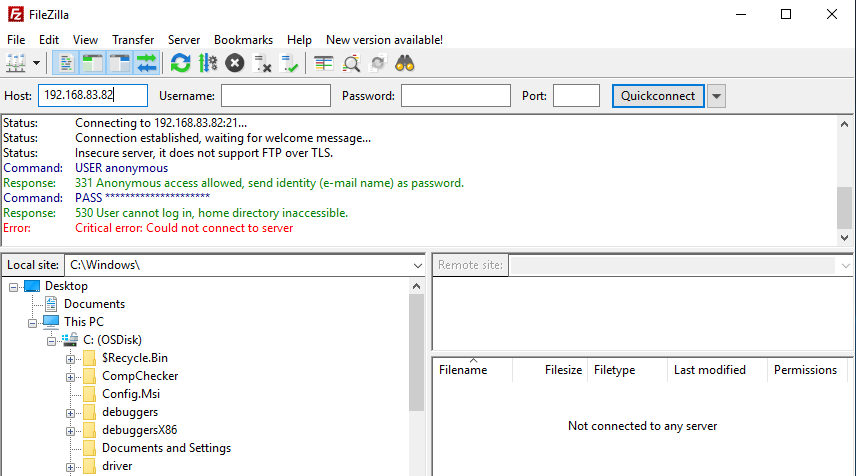
This issue may appear as “Failed to retrieve directory listing” or “Home directory inaccessible” error as well.
Depending on the FTP client, you may not see the detailed error message right away. For instance, when I tried to connect to the same site with the same configuration by using WinSCP, I received “Access Denied” error. If your FTP client doesn’t show the entire connection history, look for the log folder to get more information about the root cause.
It is not always easy to choose an FTP client that fits your requirements. Check my related post for a comparison of FTP clients: Which FTP client is better: FileZilla, CuteFTP or TotalCommander?
Root causes and solutions for “530 User cannot log in, home directory inaccessible” error
There might be a few reasons for running into this error. Here are the most common root causes and their solutions:
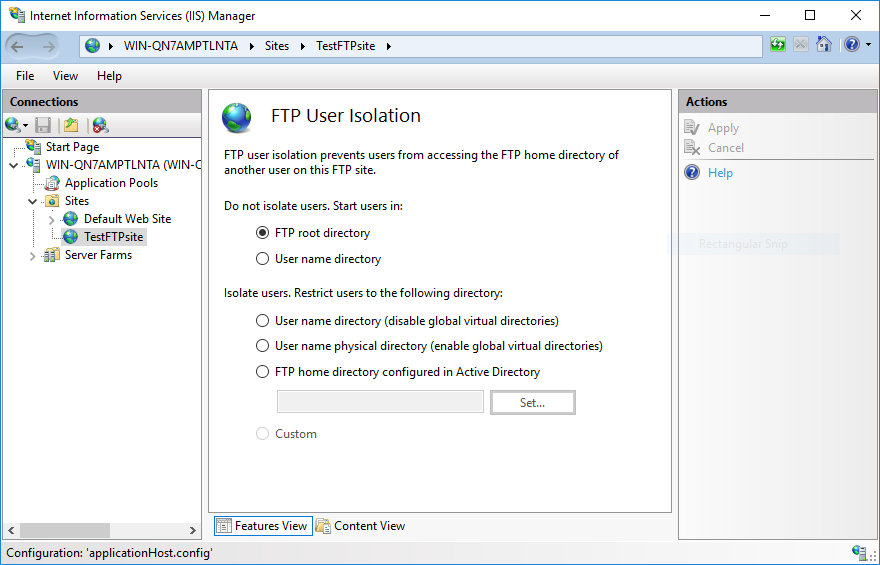
- The user is not able to access to the home directory. This is by far the most common root casue of “home directory inaccessible” error. Go to “IIS > FTP site > FTP User Isolation”. Make sure to select the directory that your users can access to. If you are not sure about what to select, select “FTP root directory”. More information: User Isolation Settings.
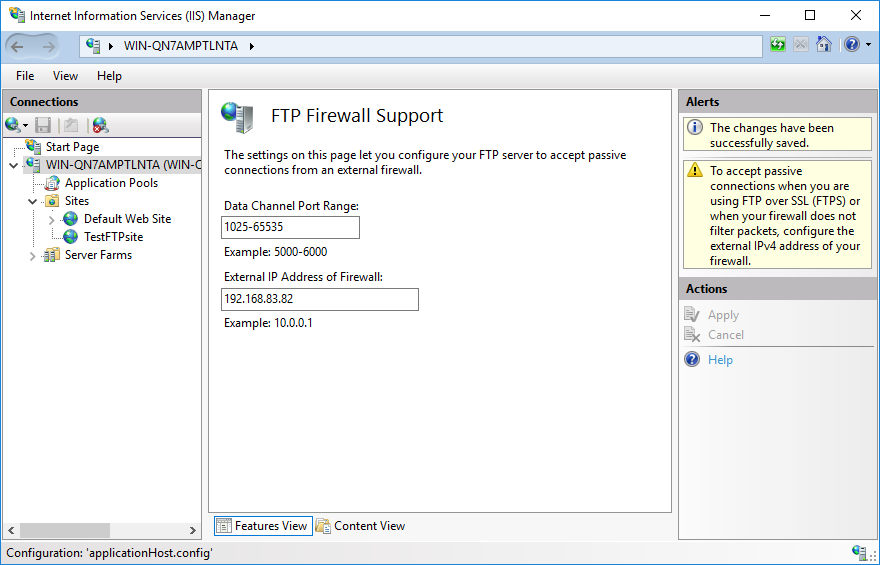
- IIS is not supporting passive mode FTP. There are two types of FTP connections: Active mode and passive mode. In active mode, the client opens a port. The server connects to this port for transferring data. In passive mode, the server opens a port. The client connects to this port to transfer data (More information: Active and Passive FTP). In order to configure IIS for supporting passive mode, enter a port range and external IP address in “IIS > Server name > FTP Firewall Support” page (More information: Using a single port for IIS FTP in passive mode).
- NTFS permissions. The issue might be simply caused by a missing NTFS permission on the FTP folder in Windows. Make sure the account you are using to connect to FTP server has permission on the folder that has FTP files.
Note: If you don’t want to turn on passive mode in IIS, you can force your FTP client to use only the active mode. In order to do this, go to “Edit > Settings > FTP” and choose “Active” in FileZilla.
Less common reasons for 530 error and how to fix them
The items below may cause “530 User cannot log in, home directory inaccessible” as well.
- Authorization rules. Make sure to have an Authorization rule that allows the user or anonymous access. Check “IIS > FTP site > FTP Authorization Rules” page to allow or deny access for certain or all users.
- NTFS permissions. The FTP users (local or domain users) should have permissions on the physical folder. Right click the folder and go to Properties. In the Security tab, make sure the user has required permissions. You can ignore Shared tab. It is not used for FTP access. A related post: Combining AD permissions with FTP.
- Locked account. If you local or domain account is locked or expired, you may end up seeing “User cannot log in” error. Check local user properties or Active Directory user settings to make sure the user account is active. A related topic: Microsoft Support.
- Other permission issues. The user account may not have “Log on locally” or “Allow only anonymous connections security” rights. More information: Microsoft Support.
Still having the issue?
It’s time to dive deep. Check IIS logs but don’t let it mislead you. IIS logs sometimes may show PASS. It doesn’t mean everything is well. It’s better to check FTP logs that IIS records for FTP connections. It is located in c:inetpublogsLogFilesFTPSVC2
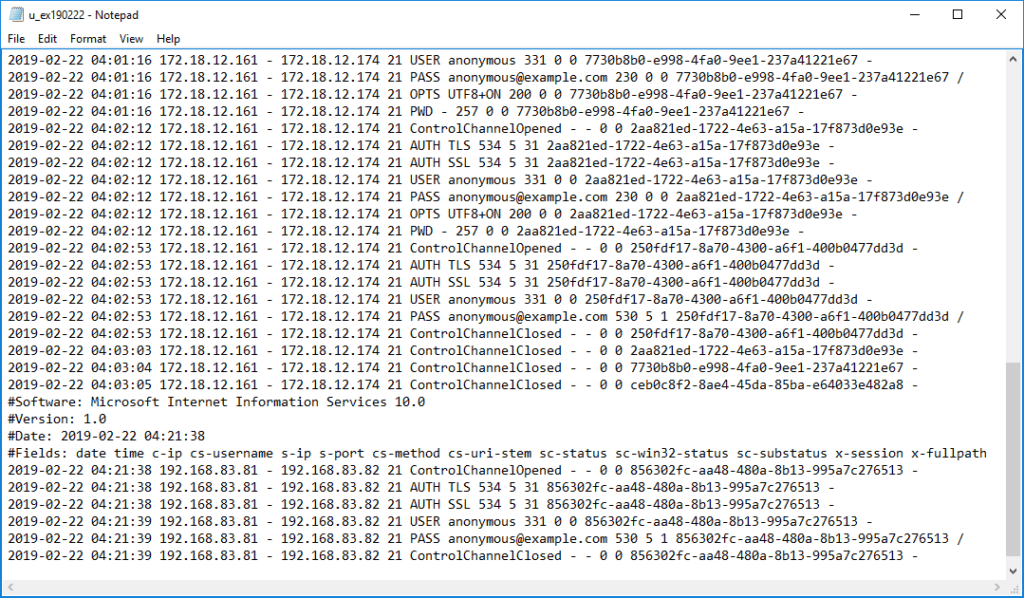
In FTP logs, you will see a status and sub-status code. Here is a list of the most common FTP status codes:
4xx- Transient Negative Completion Reply
The command was not successful, but the error is temporary. If the client retries the command, it may succeed.421 – Service not available, closing control connection. This may be a reply to any command if the service knows it must shut down.
425 – Cannot open data connection.
426 – Connection closed; transfer aborted.
431 – Need some unavailable resource to process security.
450 – Requested file action not taken. File unavailable (e.g., file busy).
451 – Requested action aborted. Local error in processing.
452 – Requested action not taken. Insufficient storage space in system.5xx- Permanent Negative Completion Reply
The command was not successful, and the error is permanent. If the client retries the command, it receives the same error.500 – Syntax error, command unrecognized. This may include errors such as command line too long.
501 – Syntax error in parameters or arguments.
502 – Command not implemented.
503 – Bad sequence of commands.
504 – Command not implemented for that parameter.
521 – Data connection cannot be opened with this PROT setting.
522 – Server does not support the requested network protocol.
530 – Not logged in.
532 – Need account for storing files.
533 – Command protection level denied for policy reasons.
534 – Request denied for policy reasons.
535 – Failed security check (hash, sequence, and so on).
536 – Requested PROT level not supported by mechanism.
537 – Command protection level not supported by security mechanism.
550 – Requested action not taken. File unavailable (for example, file not found, or no access).
551 – Requested action aborted: Page type unknown.
552 – Requested file action aborted. Exceeded storage allocation (for current directory or dataset).
553 – Requested action not taken. File name not allowed.Source
Note 1: In a case with “Connection closed by the server” error for FTP connection, we determined the root cause as the corruption of system files occurred during in-place server upgrade.
Note 2: If your FTP server is behind Azure Firewall, please check the known-issues page. For example, passive FTP may not work based on FTP configuration.
Are you trying to upload files to FTP server programmatically? Check this post out: How to upload a file via FTP in C#
- Remove From My Forums
-
Question
-
User-63786118 posted
This is the first time I have ever setup IIS, I have been extremely impressed on how easy it is to get going on the whole, however I have hit one problem I have gone to the furthest lengths to fix myself and I just cant work it out! The FTP service, despite
following good guides on this website, refuses to work for me! No matter what I do with permissions (even allowing Anonymous Login) I get this error: «Response: 530 User cannot log in, home directory inaccessible.» Process Monitor Output: http://img121.imageshack.us/img121/8315/ftpissue.jpg
I am just trying to get Basic Authentication working with Windows Users. I cannot make sense as to why there is no error. (Using IIS from within Windows 2008, not from iis.net) Any troubleshooting assistance is most appreciated! Thanks — Chris
Answers
-
User989702501 posted
In new ftp, you need to configure authorization before any access. and now it supports both Windows and IIS users, giving you more flexibility. For the folder direction, you must have add it to default web site (ftp publishing) I suggest you read the articles
here to know more about this new ftp component from MS.
http://learn.iis.net/page.aspx/356/ftp-7-for-iis-70/-
Marked as answer by
Tuesday, September 28, 2021 12:00 AM
-
Marked as answer by
 There are a ton of articles out there addressing IIS permissions issues that result in the error message “FTP 530 User cannot log in, home directory inaccessible.” I’m not going to repeat them here. What I am going to share is what to do when you’ve followed all of those articles and it still does not seem to work.
Let me review the problem.
Since the introduction of IIS 7.0 and now with 7.5, Microsoft has changed ftp authentication and authorization. This can be confusing because there are two critical steps that must be performed to ensure that a user will actually gain the access they need. First you must set the permissions on the folder they will be accessing then authorize the user in IIS under FTP authorization rules.
How to fix FTP 530
Here’s the kicker. If you do this in the wrong order, everything will appear correct but you will get an “Error FTP 530 User cannot log in, home directory inaccessible.”
Use this process in the right order to correct the problem:
- Remove FTP publishing from the site.
- Restart IIS
- Verify that the users have proper permissions to the folder you want them to use.
- Add FTP publishing back to the site.
- Add the user to the ftp authorization rules.
- Verify that the problem is gone.
Why does it break? No one seems to know.
This problem does not happen every time. I have yet to understand if there is any pattern to it other than the order that permissions and authorization are set. Even when they are set in the right order, I have seen this break when adding a new user.
If you read my article, “IIS 7 FTP problematic for PCI compliance” . You will see why I don’t recommend using IIS for FTP in the first place.